
In Memoriam
Douglas Mackenzie
1958 – 2025
Antique Golf Clubs from Scotland
CONTENTS
Acknowledgements
Introduction
Leaving Sandy Hill
The New Land
The Site’s Natural Bunkers
Golfers in the “O” Zone
New Sights and Sounds
Brigham Hall as Clubhouse
Inside the House
Around the House
The Ghost of Brigham Hall
1894: Chelsea Road Reconnaissance and Stakeout
Architect Alfred Ricketts
Penal Golf Course Architecture
13 holes
Bogey and Par
Course Length
Course Records
Flags Flying
Where Were the Holes?
Hole 1: Barn
What’s in a Name?
A One-Hit Wonder: Ottawa’s First Haskell
Hole 2: Chelsea
Hole 3: Elm Tree
Hazard of Despair
The Prodigious Poke of P.D. Ross
Hole 4: Mound
Hole 5: Horse Shoe
Hole 6: Swamp
Hole 7: Railway
Look Both Ways
Hole 8: Lake
A Second Railway
Hole 9: Baseball
Hole 10: A Nameless Wonder
Hole 11: Plateau
Hole 12: Another No Name Hole
Hole 18: Home
A Club of One’s Own: Ottawa’s Ladies
A Course of One’s Own
A Room of One’s Own
A Swing of One’s Own
A Competition of One’s Own: Approaching and Putting
Ottawa’s First National Champion
Conservator of the Links: Joseph Baizana
Greenkeeper John Fuller
Golf Pro William Divine
Royal Ottawa’s First Clubhouse Fire
Chelsea Links Caddies: Graduates Cum Laude, and a Dunce
The 1899 Championship
Reviews
Dandelion Whine
Watering the Fairy Ring
The Prodigy
Visiting Golfers
The Curious Case of Dr. Carruthers
Location?
Location!
1903 Construction Here and There
Can’t Wait
Acknowledgements
I thank Jennifer Mirsky, dedicated and enthusiastic Chair of the Royal Ottawa Golf Club’s Heritage Committee, for responding promptly and helpfully to questions that arose as I conducted research for this book. I appreciate the fact that she has always supported my work on Club history.
I also wish to acknowledge the usefulness to my research of longtime Club member Ernest Ross Heuchan’s copy of Robert Marjoribanks’ A History of the Royal Ottawa Golf Club, 1891-1991 (Ottawa: Royal Ottawa Golf Club, 1991), which was kindly provided to me by his son Ross Heuchan. Ross very much appreciates the history of the Club; I hope he appreciates this attempt to contribute to it.
Introduction

Figure 1 William F. Davis (1861-1902). The Golfer, vol 2 no 2 (December 1895), p. 51.

Figure 2 Tom Bendelow (1868-1936). Golf [New York], vol 17 no 1 (July 1905), p. 28
The Ottawa Golf Club did not own the land in Sandy Hill where its first golf course was laid out by Willie Davis in April of 1891. But it has always owned the land where its current golf course on Aylmer Road was laid out by Tom Bendelow in 1903. Between its original location in Sandy Hill and its present location on the Aylmer Road, however, the Club spent eight years on a golf course – laid out by its golf professional Alfred Ricketts in September of 1894 – on land located on what was known then as the Chelsea Road (today’s Boulevard St. Joseph).
The Ottawa Golf Club leased this property from 1896 to 1898 at $15 per year, but it became so enamored of the golf course that several members purchased it on behalf of the Club in 1899, and then the Club incorporated late in 1901 to assume ownership of the property in its own right.
Doing so proved to be the making of the Club, for when the International Portland Cement Company purchased the property in 1902, the windfall that accrued to the Ottawa Golf Club enabled it not only to purchase its present property on Aylmer Road but also to build the first of its magnificent clubhouses.
What became known as the Chelsea Links was used by the Ottawa Golf Club until November of 1903.
Deservedly less famous than the 18-hole Bendelow course that succeeded it on the Aylmer Road, the 13-hole Chelsea Links is also less famous than the short-lived 9-hole Davis course in Sandy Hill that preceded it.
And it is less understood and less appreciated than its precursor and successor: in A History of the Royal Ottawa Golf Club, 1891-1991, Robert Marjoribanks rather dismissively (and, as we shall see, quite inaccurately) described it as a “somewhat make-shift course” (Robert Marjoribanks, A History of the Royal Ottawa Golf Club, 1891-1991 [Ottawa: Royal Ottawa Golf Club, 1991], p 15).
In its day, however, the Chelsea Links was celebrated in a number of newspaper reports as one of the best – if not the very best – of the golf courses then existing in Canada. Indeed, in 1899, it was chosen by the Royal Canadian Golf Association as the course upon which the 1899 Canadian Amateur Championship would be contested.
Royal Ottawa’s second golf course deserves to be known better.
Leaving Sandy Hill
Why did the Ottawa Golf Club leave Sandy Hill?

Figure 3 Mary Scott on the grounds of the Sandy Hill course. Ottawa Citizen, 12 January 1952, p. 34. Scott was captain and vice-president of the Ottawa Ladies Golf Club during its final season on the Chelsea Road.
Two weeks after the inaugural Canadian Amateur Golf Championship held at the beginning of June 1895 on the Sandy Hill links, in an Ottawa Journal gossip column called “Entre Nous,” an anonymous writer suggested that the motive of the Club in its attempt to find a new location for a golf course was misogyny:
A couple of years ago, they [the men of the Ottawa Golf Club] were most anxious that ladies should join the club ….
They gave glowing accounts of the game ….
But now it is different and the men want to have the links all to themselves somewhere in the wild country the other side of Hull.
(Ottawa Journal, 22 June 1895, p. 5)
According to this account, the men of the Ottawa golf club schemed to find a place so far away from Ottawa, and so untamed, that the refined society women who played golf – all leaders in Ottawa’s elite social world – would not want to go there.
In an essay called “Golf in Eastern Canada,” published in Golf (New York) in the spring of 1898, Fredick Thomas Short (a member of the new St. John Golf Club, New Brunswick, in 1897, and the course record holder that year) offered a different reason for the Club’s leaving Sandy Hill:
Links were first laid out near the city, but they proved unsatisfactory owing to the strong growth of grass and the excessive number of sand bunkers. In the spring of 1896, the club moved over to the present grounds situated near Hull, which was found ideal golfing land, with sandy soil, short grass and just the requisite natural bunkers. (Golf [New York], vol 2 no 5 [May 1898], p. 24)
Short implies that the long rough and copious bunkers made the course unbearably difficult!
Decades later, in his 1927 Ottawa Citizen column called “Old Time Stuff,” George H. Wilson offered another reason for relocating: he claimed that “by the year 1895, the nine-hole course began to get too crowded and a movement was started for a larger course” (Ottawa Citizen, 29 October 1927, p. 36). And in a 1960 newspaper article called the “Origin of Golf in Ottawa,” local Ottawa Valley historian Harry J. Walker re-asserted the same idea: that by 1895, “the small rifle range course was becoming overcrowded with an increasing membership. So the club began to look around” (Ottawa Journal, 7 May 1960, p. 32).
None of these claims is accurate.
The sand bunkers, for instance, were regarded as the best part of the course. There were no sand bunkers on the first four holes (which were located on the low-lying meadow west of the rifle range); the sand bunkers were part of the next four holes laid out in the area of Charlotte Street north of the driving range – four holes that Club member E.C. Grant described in 1893 as “a succession of sand bunkers, some of them being eight and ten feet in depth, with steep banks” (Collier’s Once a Week, vol 11 no 45 [30 September 1893], p. 5).

Figure 4 "Sand Bunker to 7th Hole" of the Sandy Hill Links of the Ottawa Golf Club. Collier's Once a Week, vol 11 no 45 (30 September 1893), p. 4.
We know that golfers welcomed the challenge presented by bunkers like the one on the 7th hole shown above because when “a row of houses” was scheduled “to be erected” in this area in 1896, the Ottawa Journal informed readers that this “was the best part of the playing ground” (Ottawa Journal, 17 April 1896, p. 1).
And if the move to new grounds was intended to frighten away the Ladies’ Golf Club (formed in April of 1895) with nightmare visions of an untamed wilderness, the men failed in their aim, for, as indicated in a newspaper report about the reorganization of the Ladies’ Golf Club in the spring of 1897, women golfers found the landscape attractive and saw great potential in the farmhouse that had been secured as clubhouse: “The Golf Club quarters on the Chelsea Road are in a very picturesque locality …. One of the rooms of the clubhouse is being renovated for the use of the ladies and it is quite evident that the gentlemen have resigned their sway in that portion of the building” (Ottawa Journal, 13 May 1897, p. 5).
Furthermore, rather than being conceived as a way of escaping women, the new 13-hole golf course may have been designed with women golfers in mind: a nine-hole circuit of holes within the 13 holes seems to have been planned from the beginning to serve as what in those days was called a “ladies’ course.”
Finally, the Sandy Hill course was certainly not overcrowded with golfers in 1895. Note that the Club did not come close to having even forty people playing golf on the same day (at either its Sandy Hill or Chelsea Road courses) until Labour Day in 1896:
The attendance of players and enthusiasm shown during the past season [1896] … was unprecedented.
Labor Day, the 2nd of September, was a record in the history of the club when 40 players were out.
On several other days [in 1896], this attendance was nearly equalled.
(Ottawa Journal, 7 April 1897, p. 6).
The problem in Sandy Hill was not too many players for the nine holes; it was not misogyny; and it was not too much sand or grass that grew too fast. The problem was urban sprawl.
In 1909, one of the Club’s 1891 founders, Lieutenant-Colonel D.T. Irwin, recalled that the move away from Sandy Hill was “owing to the rapidly increasing building operations on the links” (Ottawa Journal, 13 December 1909, p. 17). He was well-placed to know the reasons for the move: serving as Club President in 1895, he was re-elected president in April of 1896 and so presided over this move from beginning to end.
Irwin’s recollection of the reason for leaving Sandy Hill is corroborated by the information about the club’s plans communicated to the local newspapers in April of 1896 – information presumably provided by the Secretary, Alexander Simpson:
The Golf Club are likely to have new links this season.
Building operations have interfered considerably the past season or two with the links near the rifle range, and this year a row of houses is to be erected on the best part of the playing ground.
So the club are looking for new links.
They have been offered grounds on the Chelsea Road about half a mile out of Hull. The grounds offered are ideal for the sport: level and clear.
(Ottawa Journal, 17 April 1896, p. 1)
Similarly, a year later, at the annual meeting in April of 1897, Simpson reminded the 40 members present that “it had been necessary … to make a change of quarters owing to the destruction of the course on the links formerly used” (Ottawa Journal, 7 April 1897, p. 6).
From the beginning, the Sandy Hill golf course had been bifurcated: the first three holes were in the meadow in the low-lying section of Sandy Hill to the west of the Dominion Rifle Range; the last five holes were played over and around a sand hill north of the elevated, long-range shooting bays of the rifle range; a fourth hole running from the meadow up through a vacant lot to Theodore Street (today’s Laurier Avenue East) connected these two sets of holes.
To get from the 4th green to the 5th tee required a walk of more than 100 yards along Theodore Street/Laurier Avenue East. And at the end of the round, there was a walk back to the clubhouse (at the southwest corner of Osgoode and Russell Streets) from the 9th green near the Protestant General Hospital (at the corner of Charlotte and Rideau Streets) – a stroll of just over 1,000 yards through the houses of Sandy Hill.
The photograph below shows the long-range shooting bays on the elevated ground of Sandy Hill at the end of Theodore Street/Laurier Avenue East, and in the background can be seen both, on the left, the meadow where the first four holes were laid out and, on the right, the house at the corner of Chapel and Theodore Streets on the near side of which the 4th green was laid out (the house and outbuildings of W.H. Davis seen in this photograph were built around 1894, a precursor of the development nearby of similar houses from 1896 on).

Figure 5 Undated photograph of the long-range shooting bays of the Dominion Rifle Range.

Figure 6 Ottawa Citizen, 12 January 1952, p. 34.
The photograph to the left shows people standing on the meadow where the Sandy Hill golf course adjoined the Dominion Rifle Range. Probably taken just before the rifle range closed in 1897, it shows how houses have already filled in the area behind the long-range shooting bays (seen in the photograph above) at the junction of Charlotte Street and Theodore Street/Laurier Avenue East where several of the best holes of the Sandy Hill course were laid out.
The remaining five holes were laid out behind the spectators visible on the right margin of the photograph of the long-range shooting bays above – the 9th green being in front of the Protestant General Hospital on Rideau Street.
This building, now known as Wallis House, appears, I think, in the background of the 1893 sketch of the 9th green seen below.

Figure 7 I colour red what appears to be the Protestant General Hospital in the sketch called "Putting at the 9th Hole" of the Sandy Hill links of the Ottawa Golf Club. Collier's Once a Week, vol 11 no 45 (30 September 1893), p. 4.
For a detailed discussion of the original Sandy Hill golf course, see my essay, “Ottawa’s First Golf Course,” on my website at donaldjchilds.ca.
The New Land
The new site for the golf course comprised meadowland rented annually for $15. Curiously, the size of this site varied from report to report.
When the land was purchased in 1899, the Ottawa Citizen reported: “the club has purchased about 100 acres of the property” (Ottawa Citizen, 26 September 1899, p. 6).
But in January of 1902, summarizing the Secretary’s report at that year’s annual general meeting, the Ottawa Journal reported: “The Club has eighty acres of ground” (Ottawa Journal, 17 January 1902, p. 10).
Later in 1902, when the Club sold this property, the figure for the acreage was again different: “The Chelsea Golf Links, about 106 acres, have been sold to the International Portland Cement Company” (Ottawa Journal, 4 November 1902, p. 9).
And a week later, noting that the Club had acquired a larger property on Aylmer Road, the same newspaper offered another figure for the size of the Chelsea Road property: “the Chelsea links contained only 96” acres (Ottawa Journal, 14 November 1902, p. 10).
A 1904 article looking back on the history of the Club reported yet another figure: “108 acres of ground was purchased on the Chelsea Road” (Ottawa Journal, 10 September 1904, p. 15).
Perhaps people calculated the acreage differently for different purposes. For instance, note that the number of acres over which the course was laid out was different from the number of acres leased from Emma Hall in 1896 and it was different from the number of acres sold by the Club in 1902. The golf course was played over the Chelsea Road and over the CPR tracks. The CPR owned the land under and alongside the train tracks crossing the property – a swath as much as 30 yards wide and over 450 yards long, amounting to about 3 acres. The Gatineau Road Company owned the Chelsea Road, amounting to about the same amount of land. And by July of 1900, the Gatineau Valley Railway Company had acquired a similar number of acres for a right of way (parallel to the CPR track) along the easternmost side of the golf course.
And so, the size of the property played over will have differed from the size of the property leased in the spring of 1896, and the size of the property leased in 1896 will have differed from the size of the property owned at the end of 1902.
What would become the golf course site had been cleared of forest almost 100 years before by Philemon Wright as he established his first farm in this region along the west side of the Gatineau River in the early 1800s. And so, in April of 1896, the Ottawa Journal reported: “The grounds offered are ideal for the sport, level and clear” (Ottawa Journal, 17 April 1896, p. 1).

Figure 8 Dr. A.J. Horsey (1843- 1928). Ottawa Journal, 6 February 1928, p. 1.
Similarly, Club member Dr. Alfred J. Horsey’s 1898 account of the property emphasizes that it had long been cleared of trees: golfers play “not through the forest, but over the hillside and meadow”; in fact, “the forests … have long since vanished. Now, there are green, undulating fields with only here and there a clump of cedars or a lordly elm standing in majestic loneliness” (Ottawa Journal, 15 October 1898, p. 12). And a glance at the fields, he says, will show that the wealth of the farm did not derive from “tillage of the soil, which is shallow, sandy loam with a bountiful crop of granite boulders, with here and there a sandy bunker which brings despair to the heart of the unlucky waif who plays foul of them” (Ottawa Journal, 15 October 1898, p. 12).
There is no account of any golfer ever striking a tree while playing golf here, and there is no account of any shot having to be played so as to avoid a tree.
Old links courses had no trees, so this aspect of the Chelsea Links will have appealed to golfers – and they were legion in the 1890s – who did not regard a tree as a proper golf course hazard.
These 100+ acres seems to have comprised two parts: about 30 acres west of the Chelsea Road where the 2nd and 3rd holes were laid out and about 75 acres east of the Chelsea Road where the other holes were laid out. This articulation of the property into two parts seems to be reflected in the Club’s offer in 1901 to rent its land to a sheep farmer:
SHEEP! SHEEP! – THE OTTAWA Golf Club owns between 75 and 100 acres of grazing land on the Chelsea Road in Hull and would allow a responsible person to pasture sheep there at a nominal rental, if satisfactory security were given that enough sheep would be put on the land to keep the grass cropped short at all times.
(Ottawa Journal, 16 January 1901, p. 8)
This implicit division of the available pasture land into 25 acre and 75 acre fields corresponds with the known division of the golf course made by the Chelsea Road. I mark this area on the 1887 map shown below.

Figure 9 Annotated 1887 map: “Map of the City of Ottawa, P. Ontario, and the city of Hull, P. Quebec, and their adjacent suburbs.” Complied by John A. Snow and Son, Provincial Land surveyors and C. Engs., from Personal Surveys and Official Records. Ottawa: Mortimer & Co Engravers and Lithographers, 1887. The area I have darkened west of Chelsea Road was marked as a future subdivision in 1887 but neither houses nor roads were built until the mid-1900s. This area was open field in 1896.
The area outlined on the map above represents approximately 108 acres.
The same area as it appears today can be seen on the Google Maps satellite image below

Figure 10 Annotated Google Maps image.
No semblance of the open meadowlands of the 1890s is left. Only the clubhouse remains.
Appearing below is the earliest aerial photograph of this land that I can find, dating from 1923.

Figure 11 Annotated 1923 aerial photograph, “View of City of Ottawa and Ville de Hull,” Library and Archives Canada, Collections and Fonds 5006653.
The only significant change to the open land across which the golf course was laid out is represented, first, by the cement plant and limestone quarry created along the eastern edge of the property (where the 8th, 9th, and 10th holes were located) and, second, by the growth of trees diagonally through the section of the golf course west of Chelsea Road (where the 2nd and 3rd holes were located).
Note that although it was said in the spring of 1896 that the land was not only clear, but also “level,” it actually rose steadily a total of about 125 feet from its lowest point along the eastern boundary of the course near Lac Leamy, which was about 150 feet above sea level, to its highest point along the western boundary of the course (near the fair View Estate), which was about 250 feet above sea level (Ottawa Journal, 17 April 1896, p. 1).
The item below describing the golf course land at the beginning of the Club’s last year of play on it makes clear that it sloped upward continuously from east to west:
From Brewery Creek [a.k.a. Brigham Creek], the surface on the mainland side [the island of Hull was on the other side of the creek] rises in an easy slope toward … the old golf grounds.
Near the creek, the limestone crops out freely. A few feet higher up, it disappears. Toward the centre of the ground, the soil is some six feet deep….
The bed of limestone runs a considerable distance … [and] rises from the water level [at the creek] at the same gentle slope as the soil on top…
(Ottawa Journal, 8 April 1903, p. 7)
The sandy nature of the soil on top of the limestone worked with the slope of the property to ensure good drainage.
For instance, there was heavy rain before and during the 1899 Canadian Amateur Golf Championship played on the Chelsea Links, yet the golf course remained quite playable. One reporter noted: “The links are on fine sandy soil and the recent rains have improved them rather than otherwise” (Ottawa Journal, 28 September 1899, p. 3). Rain during the 36-hole championship match was almost unrelenting, bothering golfers and spectators, but not the course:
The match was double the length of those in the preliminary rounds, half [18 holes] being played in the morning and half in the afternoon.
A downpour of rain prevailed during the whole day, making it very unpleasant for the golfers, although [with] the links being on sandy ground, their condition, as far as good golf is concerned, was not affected.
(Ottawa Journal, 30 September 1899, p. 7)
Horsey also notes the sand: “The soil … is sandy, shallow loam with a bountiful crop of granite boulders, with here and there a sandy bunker” (Ottawa Journal, 15 October 1898, p. 12).
In his 1898 article about Canadian golf, F.T. Short also notes that the sandy constitution of the soil was a great recommendation of the site: “In the spring of 1896, the club moved over to the present grounds situated near Hull, which was found ideal golfing land, with sandy soil, short grass and just the requisite natural bunkers” (Golf [New York], vol 2 no 5 [May 1898], p. 24).
The Site's Natural Bunkers
When Short said that the Ottawa Golf Club had moved to “ideal golfing land,” he pointed out the features he meant: “sandy soil, short grass and just the requisite natural bunkers” (Golf [New York], vol 2 no 5 [May 1898], p. 24).
Note that in the 1890s, the word “bunker’ was used in two ways: it sometimes referred to the sand-filled cavity that we designate by this word today, but at other times (as above), it referred to any kind of hazard on a golf course, including roads, fences, walls, creeks, ponds, swamps, and so on. In the latter use of the term, “bunker” was synonymous with “hazard.” When one reads that an 1890s golfer’s shot was “bunkered,” then, one must interpret carefully what this means: the ball have been in sand; it might have been up against a wall; it might have been in a ditch; it might have been in a pond; and so on.
Short’s focus on “natural” bunkers alerts us to the preference in the 1890s for sites with hazards already in place before a course was laid out, as opposed to sites with no such hazards – sites where it would be necessary to create artificial “bunkers.”
Since no artificial hazards were needed to lay out proper golf holes on the old Brigham farm, the Chelsea Road property was celebrated as a natural site for golf. That is what the word “naturally” signifies in the following sentence: “The Club’s links on the Chelsea Road form naturally one of the finest golfing courses in the country” (Ottawa Journal, 7 March 1901, p. 10, emphasis added). The word “natural” means the same thing in the following observation about the Chelsea Links: “The links, played on for three years, have great natural possibilities and even now are of a very sporting character. The chief hazards are palings, boulders and swamp” (Montreal Herald, 26 November 1898, p. 2, emphasis added).
Since the palings were on the site before the golf course was laid out, they were regarded as just as natural a hazard or bunker as the boulders or swampy ground. The existing stone walls, the Chelsea Road, and the CPR tracks were also regarded as “natural” hazards or bunkers.
In fact, roads and railway tracks were particularly welcomed in the 1890s as ready-made golf hazards. And golfers were expected to play their shot out of such hazards – even from railway tracks, whether the ball lay on a railway tie, against the steel rail, or nestled in the clinkers (as seen in the photograph below of play at Shinnecock Hills Golf Club during the 1900 US Ladies’ Amateur Golf Championship).

Figure 12 Attended by her caddie, losing finalist 17-year-old Margaret Curtis follows through on her shot from the railway hazard or bunker at Shinnecock Hills Golf Club as spectators follow her play during the US Ladies’ Amateur Golf Championship of 1900.
In the 1890s, golf holes were regularly routed perpendicularly across railway tracks, roads, walls and fences in order to test a golfer’s ability to carry the golf ball over them.
All hazards in those days were planned to impose the same requirement: that golfers lift the ball over them with a properly played shot.
And so, as in the case of roads, train tracks, walls, and fences, if a property was also blessed with such other natural hazards or bunkers as ponds, creeks, ditches, gullies, swamps, or preexisting areas of exposed sand, golf holes would also be routed across them perpendicularly.
In 1895, when reviewing the best golf courses in the New England area for Scribner’s Magazine, golf writer Henry Howland noted the types of “natural” hazards or bunkers that were found on the best courses. At Shinnecock Hills, he observed, “The hazards are mainly … some stretches of sand, a railroad embankment, and deep roads, that are tests of skill and temper”; the St. Andrews course “at Yonkers on the Hudson .... is an inland course of stone-wall hazards [and] rocky pastures”; the hazards at the Tuxedo Club include “hills, stone walls, railroad embankments lined with blast-furnace slag, … brook, boulders, and road”; “at the Essex County Club of Manchester-by-the-Sea,” “the hazards are nearly all natural, consisting of fences, barns, roadways …” (Scribner’s Magazine, vol XVII, no 5 [May 1895], pp. 531-33, emphasis added).
Note that “barn.”
In laying out the Sandy Hill course, Willie Davis had availed himself of similar “natural bunkers.” When, during the 1893 season, club member E.C. Grant wrote an article called “Golf in Ottawa “for Collier’s Once a Week magazine, he listed some of the natural features used as obstacles: “The ground is admirably situated for golf, there being plenty of space, and quite enough hazards in the shape of fences, ditches, hills, sand bunkers, etc.” (Collier’s Once a Week, vol 11 no 45 [30 September 1893], p. 5). Similarly, at the end of the 1893 season, Secretary Alexander Simpson informed David Scott Duncan, the editor of the British publication known as the Golfing Annual, that the “The green has at present only nine holes, and is intersected by sand bunkers, roads, fences, and patches of rough ground” (p. 351).
Today, most golfers baulk at the thought of such “natural” bunkers as roads, fences, stone walls, railways, and barns.
In the 1890s, as now, when a property lacked such “natural bunkers,” they had to be artificially constructed. So it was in 1893 at the original 7-hole course of the Morris County Golf Club at Morristown, New Jersey, where fairway-wide artificial bunkers for the last two holes were created – first a hazard called “Stone Wall Bunker” and then a hazard called “Hurdles” (as seen in the photograph below)

Figure 13 "Stone Wall Bunker, ‘Hurdles,’ and Club-House." Harper's Weekly Magazine, vol 39 no 2008 (15 June 1895), p. 571.
One played perpendicularly over the purpose-built “Stone Wall Bunker,” and on the next hole, one played perpendicularly over the purpose-built “Hurdles” fence.
Golfers in the "O" Zone
The atmosphere at the Chelsea Links was noteworthy – and I mean “atmosphere” not in the sense of the tone or mood of the place, but rather in the sense of the gases in the air.
In Canada and Its Capital (1898), James David Edgar observed: “it is a treat to play over [the] breezy links beyond the river” (p. 135). That breeze was thought to contain an ingredient able to preserve and restore health – ozone: “Whether it is the long drive, bicycle ride, or walk, or the ozone which hovers over the Chelsea Links, the tea and toast one gets at the clubhouse have a particularly delicious flavor” (Toronto Saturday Night, 11 May 1901, p. 6).
We now know that ozone (chemically, ozone is 03 as opposed to oxygen, which is 02) is fine in the upper atmosphere as a shield against the sun’s ultra-violet rays but is toxic for human beings.

Figure 14 Nikola Tesla's 1896 patent for his “Apparatus for Producing Ozone.”
In the late 1800s and early 1900s, however, ozone was thought to be a particularly active element in the air: its absence in the body was thought to leave one susceptible to disease, whereas its presence was thought to prevent disease. Nikola Tesla, for instance, one of the most brilliant of inventors, believed in the health benefits of ozone and invented an ozone generator in 1896, shortly thereafter founding the Tesla Ozone Company.
Everyone valued natural ozone.
In 1898, a Christian minister, in his defense of fellow ministers who were criticized for spending too much time on the game, referred to the healthful benefits of ozone: it cannot be “generally supposed that these golfers of the cloth preach any the worse from their indulgence in the national pastime – not to speak of the ozone which they inhale on the links” (Reverend Kirkwood Hewat, “Church and State versus Golf,” The Golfer’s Magazine, vol 9 no 7 [October 1898], p. 301).
At the turn of the century, the Muskoka Navigation Company invited city-dwellers to travel to Ontario’s Muskoka Lakes to avail themselves of healthful ozone: “this resort …. is surrounded with health-giving pinewood which makes the ozone in this locality one of great efficacy to sufferers of hay-fever and incipient pulmonary affections” (Highlands of Ontario: Muskoka Lakes [Muskoka Navigation Company Guidebook, 1902], p. 20).
Published in Golf magazine in 1899 was an essay called “Golf – From a Medical Standpoint,” by Dr. Burdett O’Connor, who claimed that “ozone … is a rapid oxidizer, causing fuller and deeper respiration and thus giving the lungs more thorough expansion and exercise,” and he observed further that since golf is “an outdoor sport requiring a large area of land,” it must be played in “a country or suburban situation away from the polluted atmosphere of a great city” – that is, precisely where ozone aplenty was supposed to be found (Golf [New York], vol 4 no 2 [February 1899], p. 102).
As Dr. O’Connor saw things, a golfer’s full, energetic driver swing was one of the healthiest things on earth because it caused deep inhalation of ozone: “few golfers have noticed that on all long shots, especially on the drive, a full inspiration is taken involuntarily, the breath escaping as the swing goes through…. Freer respiration is gained … by the extra physical exertion” (Golf [New York], vol 4 no 2 [February 1899], p. 102).
And what is more, according to the editor of Golf (New York), ozone contributed to a robust round of golf in another way: “June in America brings with it thoughts of warm summer days and hot, sultry nights. But for the golfer, the enterprising [resort] hotel proprietor has prepared breezy links where the ozone adds distance to the drive” (Golf [New York], vol 2 no 6 [June 1898], p. 33).
And so, ozone was recommended to golfers by doctors, preachers, and golf coaches: live longer, live better, and drive the ball farther!

Figure 15 In 1907, an unidentified woman breathes ozone as part of "Ozone Therapy." Photograph courtesy of the Science History Institute (USA).
Golf fanatics must have queued for “Ozone Therapy.”
Fortunately, when the Ottawa Golf Club moved to its present site on the Aylmer Road, it did not forego ozone-laden breezes that enhanced health and drives. Ozone on the new course helped to make the 1911 Canadian Open “one of the greatest tournaments that was ever held under the auspices of the Ottawa Golf Club”:
Perfect Golfing Weather
The weather was splendid for golf, the heat having dropped somewhat, while a slight breeze wafted the healthful ozone to the spectators in the galleries, together with keeping the golfers at a higher pitch throughout the game.
(Ottawa Journal, 8 July 1911, p. 11)
Ozone … what a gas!
New Sites and Sounds
The beauty of the new property and of the views in all directions from it were widely celebrated.
The Ottawa Citizen declared the course “the most picturesque links in Canada” (Ottawa Citizen, 19 October 1899, p. 6, emphasis added). Furthermore, from “the beautiful Ottawa links,” the Ottawa Journal added, there is a “picturesque outlook” (Ottawa Journal, 4 November 1901, p. 10, emphasis added).
This note had been sounded by Club members when they first saw the course at the beginning of May in 1896: “Although there is a great deal yet to be done before the course itself will be in first class condition, the members feel that it will repay the time and trouble. The situation is very picturesque and the view from many parts of the course is delightful” (Ottawa Journal, 15 May 1896, p. 6, emphasis added).
A few weeks later, members of the Kingston Golf Club played the course and carried a similar report back to a Kingston newspaper: “The day was very beautiful … The grounds were very interesting and picturesque” (Daily British Whig [Kingston, Ontario], 26 May 1896, p. 4, emphasis added). In 1897, the Ottawa correspondent for Toronto’s Daily Mail said something similar: “The golf links are situated on the Chelsea Road in a most picturesque bit of country” (Daily Mail and Empire [Toronto], 18 May 1897, p. 7, emphasis added). And in 1898, the Ottawa correspond for Toronto Saturday Night magazine told of “the opening of the Ladies’ Golf Tournament out at the picturesque links on the Chelsea Road” (Toronto Saturday Night, 8 October 1898, p. 3, emphasis added). After the Canadian amateur Championship held on the Chelsea Links in September of 1899, it was reported that “the visiting players … were more than pleased with the fine picturesque links which the club possesses on the Chelsea road” (Ottawa Citizen, 22 March 1900, p. 6, emphasis added).
There can be no doubt: the Chelsea Links were picturesque!
And members of the Ottawa Golf Club were wont to point this out to members of visiting clubs, but as Madge MacBeth recalled half a century later, whether such boasting about the beauties of the Chelsea Links was appreciated depended on the timing of an Ottawa golfer’s observation:
During a match played by the men, a member of the home team called the attention of his opponent to the rich beauty of the autumn scene.
Said the visitor, testily:
“I didn’t come here to admire the countryside, but to win my match. Kindly refrain from talking!”
(Ottawa Citizen, 12 January 1952, p. 34)
So just what does it mean that the links were said to be “picturesque” – apparently, for a certain kind of golfer, distractingly so?
Members of the Royal Montreal Golf Club who played the Chelsea Links told a reporter for the Montreal Herald of the views: “Either in view or close at hand are such beautiful and famous places as Leeming’s lake [sic; that is, Leamy’s Lake], Gatineau River, Chaudière Falls, Ottawa City and its grand Parliament Buildings” (Montreal Herald, 26 November 1898, p. 2).
In a newspaper column (called “Vanity Fair”) about the activities of members of Ottawa’s high society, a woman writing under the pseudonym “Frills” visited the Ottawa Golf Club in the spring of 1899 and described arriving at the clubhouse as a wonderful contrast to life in the city: “It certainly is a most pleasant and agreeable change from the city to find oneself in that exceedingly pretty bit of country known to Old Ottawans as the Brigham homestead” (Ottawa Citizen, 20 May 1899, p. 5).
Other people who travelled through the golf course area confirm the opinions cited above.
In 1899, an Ottawa cyclist described his ride up the Chelsea Road past the golf course. The Chelsea Road ran “high above the valley of the Gatineau [River],” he observed, and so one climbed a hill as one travelled north to the golf course and enjoyed views to the north and east along the way:
After the Hull railway station is passed, the road inclines upward until a high level is reached ….

Figure 16 The church steeple at Gatineau Point, 1902.
Soon the Golf Club’s links are passed on the right.
In the distance, the spire of the Gatineau Point church rises from a clump of trees and presents an attractive spectacle as it glistens in the sunlight.
Looking northward, the eye follows the sinuous course of the Gatineau, while away in the distance are seen the uplands ….
(Ottawa Citizen, 12 August 1899, p. 12)
Similarly, in 1891, men and women of the “Sunflower Club” (dedicated to “pleasant health-giving” country outings) went up the Chelsea Road, and one of them described the scenery. Approaching the golf course area, one met “a glimpse through the trees of the Gatineau, now deep, dark, and quiet, then fretted into restless foam, or glinting over shoals” (Ottawa Journal, 8 August 1891, p. 3). And one would see “away in the distance the ridge of the Laurentian range, with sides covered with a dark foliage so refreshing to the eye, and here and there an old time log house, with the mortar between the logs freshly whitewashed, shining in the sun” (Ottawa Journal, 8 August 1891, p. 3).

Figure 17 A view of the Laurentian Hills to the north and west of the Chelsea Links. Detail from a postcard of Gatineau Point, circa 1909.
Horsey made a similar observation: “To the westward, angling towards the north, following the course of the Ottawa [River] a few miles from its border, runs the Laurentian range of mountains whose alternately wooded and cultivated sides and purple-colored slopes form a fitting background to one of the loveliest pastural spots the country round” (Ottawa Journal, 15 October 1898, p. 12).
The approach to the golf course along the Chelsea Road also afforded beautiful views quite close at hand. Horsey notes that near the clubhouse, the road itself was attractive: “Passing through Hull, we soon find ourselves on the Chelsea Road where, half a mile beyond in a slight curve in the road, through an avenue of overhanging elms, we see flying from its staff the flag of the Ottawa Golf Club” (Ottawa Journal, 15 October 1898, p. 12).
Another traveller described the fields around the clubhouse:

Figure 18 The Suspension Bridge at the Chaudière Falls, circa 1884, the only bridge across the Ottawa River when the Club moved to its Chelsea Links.
Leaving Ottawa in a comfortable carriage by the Suspension Bridge, we passed through French-Canadian Hull ….
Crossing over a stone bridge which spans Brigham’s Creek, we reached the Chelsea Road, whose well graded, level and smooth appearance partly excused the extortionate tolls demanded.
A bend in the road and the turrets and spires of the city, with the flying buttresses of the Parliamentary Library, are seen.
Now the fertile slopes of the residence of the Hon. R.W. Scott come into view and the old Brigham homestead – a stone house and outbuilding, the fields enclosed with stone walls, a relic of the patience of fifty years ago.
On one side of the road is a heap of ruins – all that is left of a house in which a man tried to stir up some dynamite with a lighted pipe.
Fields of ripening grain ripening for the harvest on every hand, and away in the distance the ridge of the Laurentian range with sides covered with dark green foliage so refreshing to the eye ….
(Dominion Illustrated, 18 August 1888, p. 110)

Figure 19 Fair View House (now owned by the National Capital Commission) as it looks today.
As indicated above, looking west along Mountain Road from the entrance to the clubhouse (where Mountain Road started), one could see the Scott residence (Fair View House) at the top of a hill – the hill on the side of which the two westernmost holes of the golf course were laid out.
Fair View House was the grand residence of Richard William Scott, mayor of Bytown in 1852, then member of the Legislative Assembly of the Province of Canada, then a member of the Ontario Legislature (where he became a cabinet member), then a Cabinet Minister in the federal Liberal government of Alexander Mackenzie, and finally – during the Club’s residence at Brigham Hall – a member of the Canadian Senate.
Fair View House and Brigham Hall are the only buildings near the Chelsea Links to have survive to the present day, and, as noted above, they were the two buildings that one noticed as one approached the golf course:
We reached the Chelsea Road ….
A bend in the road, and the turrets and spires of the city [of Ottawa], with the flying buttresses of the parliamentary library, are seen.
Now, the fertile slopes of the residence of the Hon. R.W. Scott come into view, also the old Brigham homestead ….
(Ottawa Journal, 8 August 1891, p. 3).
In his book, Pioneers of the Upper Ottawa, Anson Gard describes a walk in the early 1900s along Mountain Road between Brigham Hall and Fair View House (which was a walk along the left side of the second hole of the golf course) and recalls how the Fairview Estate looked in its heyday:
To the right and left [of Mountain Road] is a part of the Brigham farm – a very little part ….
THE SCOTT LANDSCAPE GARDENS
Once might have been seen on the next farm to the right the finest bit of landscape gardening in this part of Canada.
It was the former home of the Hon. R.W. Scott, now Secretary of State.
Here were wont to gather the noted visitors of other countries.
It was, besides, one of the showplaces of the Capital ….
(Anson A. Gard, Pioneers of the Upper Ottawa and the Humors of the Valley: South Hull and Aylmer Edition [Ottawa: Emerson Press, circa 1906], p.19)
Now owned by the National Capital Commission, Fairview Estate was sold by Scott in 1892, but it still retained a good deal of its exotic grandeur when the Club moved into nearby Brigham Hall in the spring of 1896. As Gard noted, in the early 1900s, “it [was] far beyond any place around” (Gard, p. 20).
The Ottawa Golf Club clearly resided in a good neighbourhood: its 2nd putting green and its 3rd tee box at the western edge of the golf course marked the boundary between the old Brigham farm and the Fair View Estate.
Looking toward the northern boundary of the golf course, there was a special sight seasonally where Leamy’s Road departed from the Chelsea Road and made its way toward Lac Leamy, for settler Andrew Leamy had lined his road with plum trees, which made the road very attractive when they blossomed:
Wild Plum Trees Lined the Road
Entry to Leamy Homestead in Blossom Time was a Beautiful Sight
The road used to be a delightful one to drive over as it used to be lined on both sides for most of its length by wild plum trees.
In blossom time, the road was a treat to the eye.
(Ottawa Citizen, 31 August 1929, p. 36)
But perhaps the most spectacular view from the golf course was the one looking south over Hull and across the Ottawa River to the City of Ottawa.
The Ottawa Journal observed that from “the beautiful Ottawa links,” there is a “picturesque outlook over the city on the south” (Ottawa Journal, 4 November 1901, p. 10, emphasis added). The sketch below provides a silhouette image of the Ottawa skyline that was visible from the Chelsea Road near the golf course.
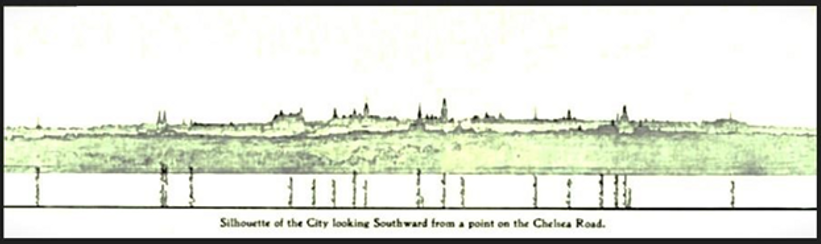
Figure 20 Edward Bennett, Report of the Federal Plan Commission: a General Plan for the Cities of Ottawa and Hull (Ottawa: Government of Canada, 1915), drawing no. 17.
The view above was accessible from most points on the golf course as well as from the clubhouse, which was “Situated on the face of a gradual, grassy slope inclining towards the River Ottawa, of which a good view [was] to be had, some half a mile away” (Ottawa Journal, 15 October 1898, p. 12).
Seen below is a sketch of this view dating from around 1903; it comes from a book published by the International Portland Cement Company to show off the new cement plant it had built on the land acquired from the Ottawa Golf Club in 1902.

Figure 21 A bird's-eye view of Hull and Ottawa circa 1903 imagined from a point of view above what was the northeast corner of the Chelsea Links. From Industrial and Picturesque Ottawa (Ottawa: City of Ottawa Publicity Department, undated).
Horsey explained what people visiting the golf course should look for in the panoramic view of the Ottawa River available from various points on the Chelsea Links:
look across its surface [and] see in full view a white and glistening curtain of water of another river, the Rideau Falls, where the river of that name, flowing from the south, gracefully glances over the edge of a perpendicular precipice some 60 feet high [in] a smooth, unbroken current of limpid water into the Ottawa below.
(Ottawa Journal, 15 October 1898, p. 12).
And do more than just look, Horsey suggested; also listen: “The roar of the [Rideau] falls, when conditions are favorable, may be heard where we stand [at the clubhouse], as well also the mighty roar of the great Chaudière [Falls]” (Ottawa Journal, 15 October 1898, p. 12).
The clubhouse, Brigham Hall, was set in the middle of a gentle slope. The land rose about 75 feet up to its back courtyard from Brigham Creek (also called Brewery Creek) and the land continued to rise from its front door about 75 feet up a hill at the top of which was Fair View House.
In April of 1903, when the Ottawa Harriers club conducted a chase that crossed the Chelsea Links, the four young men who played the role of the hares were given a bit of a break with a good downhill run all the way across the course. Coming south along the Chelsea Road to the toll gate at the northern end of the golf course, they were directed off the road: “The run was carried … to the Chelsea Road near the toll gate…. With a slight swing to the north of the main road, the line led over the golf course and down past the clubhouse then away across the CPR track into Hull ….” (Ottawa Citizen, 13 April 1903, p. 9). It was downhill all the way – from the highest part of the course at its western boundary (where the 2nd putting green and 3rd tee box were located) down to the clubhouse, which was at the centre point of the 750-yard descending run down to the CPR tracks.
Brigham Hall as Clubhouse

Figure 22 Brigham Hall, circa 1940.

Figure 23 376 Boulevard St. Joseph, Gatineau, Quebec.
The building often referred to as “the old Brigham house” was also known in the 1800s as “the Brigham homestead,” or “the Brigham farm,” or “Brigham Hall.”
It would serve as the clubhouse of the Ottawa Golf Club for eight years.
As seen in the photograph below, it still exists.
This building was the second house built for Thomas Brigham (1787-1842) and Abigail Wright (1796-1877), the eldest daughter of Hull founder Philemon Wright (1760-1839).
From the original house, which was several dozen yards to the north of the present one, Brigham managed Philemon Wright’s 800-acre Columbia Farm, which Wright began to clear in 1811 and named after the body of water he called Columbia Pond (and later Gatineau Pond) – now known as Lac Leamy.
When Wright died in 1839, Abigail inherited the farm.
Built not far from the present house, the original house built by Wright on the Columbia Farm had been serviceable – the “part to the westward next the [Chelsea] road being used for a brewery and the eastern end as a dwelling” – but “as time went on and resources became more plentiful,” according to Horsey, “the present spacious stone structure – the Golf Club House – … was built” (Ottawa Journal, 15 October 1898, p. 12). This was in 1834, Wright’s apparent intention being to tempt Thomas and Abigail out to the farm from their residence in town.
Horsey knew a great deal about Thomas Brigham and his extended property, probably having consulted the City of Hull’s records about Columbia Farm – records that were among those burned two years later in the great Hull fire of 1900.
After Thomas Brigham died in 1842, Abigail continued to reside in the house until her own death in 1877. Ownership of the Brigham homestead then passed to Abigail’s daughter Emma Robbins Brigham (1825-1909) and her husband John Smythe Hall (1821-1892), but this couple resided in Montreal and seem never to have lived in the house.
Indeed, Horsey indicates that the house had been neglected for many years before the Ottawa Golf Club moved in:
[the] house [has] recently been awakened to a new and vigorous life after long silent years of slumbering vacancy, during which time [and] decay, both within and without and all around, have wrought their crumbling, disintegrating influences wholly unhindered and unstaid by human intervention….
The smart swinging, whirring stroke of the golfer’s club … [now] resounds … over the hillside and meadow – giving a new life and spirit to the old place so long deserted and uncared for.
(Ottawa Journal, 15 October 1898, p. 12)
As we know, the Club had been contemplating this move to the farmland of Emma Hall since the late summer of 1894. One problem the club had in its negotiations was “the proprietor’s objection to selling or granting a long lease,” but it may also have been the dilapidated state of Brigham Hall that gave the Club pause (Gazette [Montreal], 26 November 1898, p. 2).
Perhaps it is no surprise that when the golf season on the Chelsea Links began during the first days of May in 1896, “the old Brigham house” was not yet ready to be used by Club members. In fact, when the first handicap competition of the year was announced, members did not event meet at the clubhouse:
GOLF
The weekly handicap golf match will take place this afternoon on the links on the Chelsea Road.
The meeting-place will be the tollgate.
(Ottawa Daily Citizen, 2 May 1896, p. 3)
There were two tollgates on the Chelsea Road close to the golf course.
One was at the northern limit of the course marked by Brigham Street, which was a street built by the City of Hull in 1877 – the tollgate having been built simultaneously by the Gatineau Road Company where the new street met the Chelsea Road. This tollgate at the junction of Brigham Street and the Chelsea Road was part of the tollhouse operated in the 1890s by old-timer William Rankin.

Figure 24 An example of the tollhouses along the Gatineau River: tollgate keepers on duty at the tollhouse north of Hull at Cascades, Quebec, circa 1910.
The other tollhouse, inhabited by David McCall (and his wife and five children), was on the Chelsea Road just south of the clubhouse.
It was at McCall’s tollgate that golfers met during the first week of May 1896.
Tollgate keeper McCall (who had been born in Glasgow) would become a familiar figure to members of the Ottawa Golf Club, for they were required to pass through his tollgate every time they came to the course and went home.
Tolls were levied per person and per type of vehicle. There were frequent complaints that toll charges on the Chelsea Road were outrageous – not necessarily because of the amount per se, but rather because the often poor condition of the road seemed not to justify a fee of any sort! Charges were pressed against anyone evading the Gatineau Road Company’s tollgates.
In 1902, the Club arranged for a horse-drawn bus to carry people to the course from the train station and back again: there were six round trips per day for which the Club paid a daily toll of 25 cents (Marjoribanks, p. 15).
From the beginning, Club directors recognized that Brigham Hall was positioned to take advantage of the scenery: “Club rooms are being fitted up in the old Brigham house, the house being well situated for the purpose, commanding a fine view of the whole course” (Ottawa Journal, 15 May 1896, p. 6).
An old but undated painting of the Chelsea Links clubhouse owned by the Royal Ottawa Golf Club (the artist was Col. D.T. Irwin) depicts an oversized Ottawa skyline and Parliament Buildings in the distant background, as seen in the greatly enlarged image below.

Figure 25 Greatly enlarged detail from Irwin's undated painting of the clubhouse.
Irwin depicts the Parliament Buildings greatly out of proportion to the way they really looked from the golf course – perhaps impressionistically to suggest how they captured the attention of golfers on the Chelsea Links.
Note also that the depiction of the clubhouse is surprisingly inaccurate: Irwin shows just two windows on the north (or left) side of the main floor, when there were actually four – two for the men’s room and two for the dining room. Irwin could not have made this mistake were he sitting on the golf course while painting this image, so I suspect that he painted this scene from memory – perhaps well after the Club had moved from the Chelsea Links.

Figure 26 Ottawa Citizen, 21 March 1970, p. 33.
Subsequent construction of all sorts of buildings has dramatically changed the view today from the former Brigham Hall, but as late as the 1970s, when the old clubhouse became La Ferme Columbia restaurant, windows at the southeast corner of the house still afforded “a view of the Parliament Buildings and Ottawa’s skyline” (Ottawa Journal, 29 November 1975, p. 22).
A newspaper report in mid-April of 1896 shows how much thought the Club had put into the question of whether Brigham Hall could be made to serve as a clubhouse:
NEW GOLF GROUNDS
THE OTTAWA CLUB MAY MOVE TO THE CHELSEA ROAD
Present Links Are Being Crowded by Building Operations – New Links Offered – Scheme for a Country Club to be Connected with It – The Details
The Golf Club are likely to have new links this season…. They have been offered grounds on the Chelsea Road, about half a mile out of Hull.
The grounds offered are ideal for the sport, level and clear….
Along with the proposal of the new grounds is a scheme to open a country club house near the links. A building capitally suited for the purpose can be had in the old Brigham house.
The idea of the officers of the club who are moving in the matter is that the building will be fitted up as club, with a resident steward and staff in charge, the same as at a city club – the club house to be the rendezvous for the golfers and their friends.
In the evenings, dances would be held.
(Ottawa Journal, 17 April 1896, p. 1)
The Club’s aspiration to have “the building … fitted up … with a resident steward and staff … the same as at a city club” shows that the Club was aware that standards were changing with regard to what constituted a proper golf clubhouse.
The Club decided to occupy Brigham Hall precisely when some of the biggest golf clubs in the United States had introduced an innovation: the purpose-built golf clubhouse. For instance, still existing today in all their glory, the clubhouse of the Shinnecock Hills Golf Club was built during the winter of 1891-92 and the clubhouse of the Newport Country Club was built during the winter of 1894-95. In the mid-1890s, such grand clubhouses were so new to golf culture that after former Open Champion Willie Park, Jr, visited the United States in 1895, he regaled Edinburgh reporters with tales of the clubhouses he had seen:

Figure 27 Willie Park, Jr. Munsey's Magazine (New York), vol 13 no 6 (September 1895), p. 604.
The clubhouses were spacious and well-appointed.
The style of clubhouse architecture, with which he had been favourably impressed, was unlike anything he had seen in Britain.
Shady piazzas surrounded the buildings ….
The establishments were hotels rather than clubhouses, so complete was their bedroom and other accommodation.
The cookery was beyond compare.
Thirty-five thousand dollars was the sum expended on erecting and appointing the Newport clubhouse.
(Edinburgh Evening Dispatch [Scotland], 31 July 1895, p. 2)
Obviously, “Brigham Hall” had not been designed to serve as a golf clubhouse, and some Club members were quite sensible of this fact – so much so that before the “annual meeting of the Ottawa Golf Club” in March of 1900, the following announcement was made in advance of the annual general meeting: “The question of improving the present clubhouse or of building a new one will be discussed” (Ottawa Journal, 1 March 1900, p. 2).
The ladies’ dressing room and the men’s locker room had been damaged by fire at the beginning of October in 1899, so the question of whether the old Brigham Hall would continue to serve the purposes of the increasingly ambitious Club had to be considered.
The Club decided on extensive renovations:
FOR THE GOLFERS’ COMFORT
Repairs are being made to the Ottawa Golf Clubhouse on the Chelsea Road and it is expected they will be completed in a couple of weeks.
The repairs are of a very extensive nature and will add greatly to the comfort and convenience of the members.
(Ottawa Journal, 14 April 1900, p. 5)
There was yet more work on the building during the 1901 season: “improvements at the clubhouse are underway and by the middle of the season, the club will have one of the best equipped links in Canada” (Ottawa Citizen, 10 May 1901, p. 6).
And in January of 1902, at the annual general meeting, when discussion turned to the question of what to do with the “good balance of money on hand,” most members favoured further work on the clubhouse:
The surplus will be used for an extension of the club building or to improve the grounds, as the club sees fit.
The members seemed in favor of the erection of a large roof garden or verandah from which a good view of the links could be had.
(Ottawa Journal, 17 January 1902, p. 10)
According to Madge MacBeth, all the while the Club leased and then owned Brigham Hall, it bore in mind its responsibilities as steward of a historically significant building:
Col. Meredith remembers that the committee in charge of arrangements went carefully over the old stone house and decided that it would be vandalism to tamper with its construction.
So only redecorating and refurnishing were undertaken, the Colonel being responsible for most of the renovations.
(Ottawa Citizen, 5 January 1952, p. 30)
Still, Club members were nonetheless aware of the increasingly grand clubhouses being built by precisely the Canadian and American golf clubs with which they wished to compare their own Club.
And so, when the Club acquired its present site on Aylmer Road at the end of 1902, it immediately began to plan for a new clubhouse by investigating best American practices in this regard.
When the executive committee discussed the matter in February of 1903, the local newspapers reported: “a special committee has been investigating the various American golf club houses and has prepared a report upon the features best adapted to meet local requirements” (Daily Witness [Montreal], 17 February 1903, p. 10). Members “agreed that the new clubhouse should be of most handsome proportions. It will be not only a clubhouse but also a country house and will be most modern in type” (Ottawa Citizen, 22 January 1903, p. 6).

Figure 28 Clubhouse of the Royal Montreal Golf Club. Canadian Magazine, vol 28 no 2 (December 1906), p. 156.
Mind you, members of the Royal Montreal Golf Club who had visited Ottawa, coming from a recently completed purpose-built, state-of-the-art clubhouse at their new Dixie site, told a reporter for the Montreal Herald that they quite liked the old-fashioned clubhouse at Ottawa: “Unlike the modern golf club house, the Ottawa one has a charm of homelike comfort all its own”
(Montreal Herald, 26 November 1898, p. 2).
Horsey implicitly agreed with this observation: although “the style of architecture … is not very pronounced or beautiful …, the house and its surrounding structures have a very utilitarian and, above all, homelike look about them” (Ottawa Journal, 15 October 1898, p. 12).
Nonetheless, one might wonder whether there been a note of condescension in the observation by members of the Royal Montreal Golf Club in 1898 that “homelike” Brigham Hall was “unlike the modern golf club house.”
Well, three years later, after another match on the Chelsea Links, many of the same Montrealers who had spoken of the “homelike” clubhouse in 1898 returned to their own home and told The Daily Witness that “the clubhouse was gay with life and beauty” (Daily Witness [Montreal], 4 November 1901, p. 5). It seems safe to assume that that they really enjoyed the way they were entertained in the Chelsea Links clubhouse.
In 1898, Brigham Hall certainly struck Horsey as by far the most interesting house in the area:
While the house itself cannot be included in any … orders of architecture called classic …. it might be designated as modified Norman-French – such as seen in the older parts of Montreal and Quebec – with its broad gables and central high peaked roof in front with dormer windows.
The curves and designs of its fan lights over the front and back doors, as well as the narrow sashes on each side, and the panels and patterns of the doors, show them to be of Norman design, as also do the windows generally – with casements, divided vertically from top to bottom, swinging on hinges and fastening both above and below by substantial brass-knobbed bolts.
There is little that is ornamental either within or without, though the workmanship is excellent. There are no carvings, nor escutcheons or armorial bearings, which one almost expects to see in an establishment of its age and extent.
For the time in which the various structures were built, they were lordly and baronial, and far exceed any of the modern structures in this part of the country, which, compared to them, appear ephemeral, artificial, and of yesterday.
(Ottawa Journal, 15 October 1898, p. 12).
And as we can tell from Horsey’s description of golfers entering the clubhouse after their round of golf, Brigham Hall certainly satisfied its primary function for golfers – providing a space and an environment for enjoyment and promotion of the Royal and Ancient Game:
The room on the left of the main entrance with its four large casement windows opening full length … overlooking the putting green at the beginning of the course …. is now the … sitting room of the golf club where temporary refreshments are dispensed and where all in common meet.
Here rush in twosomes and foursomes – florid, garrulous, excited, warm – whose noisy hilarity shows how entirely they have been absorbed in the game they have just finished as they explain in free and forcible language how the holes were lost or won – quite unconscious of self or their surrounding or the row they are making.
(Ottawa Journal, 15 October 1898, p. 12)
A clubhouse without a room like that is no clubhouse at all!
Inside the House
Horsey provides a comprehensive account of how the rooms of Brigham Hall were arranged for members’ use.
One entered the building from a “large stone flag before the front door” (a door admirable in “workmanship and design”) and then one stood in a vestibule “shut off from the main hall” (Ottawa Journal, 15 October 1898, p. 12). This hall ran “the whole depth of the building from front to rear, some 50 feet long and 8 feet in width” (Ottawa Journal, 15 October 1898, p. 12)

Figure 29 Ottawa Journal, 15 October 1898, p. 12
Clubhouse activities were mostly confined to the large rooms on the ground floor: “four rectangular rooms of about equally large dimensions … comprise the spacious apartments into which the ground floor is divided” (Ottawa Journal, 15 October 1898, p. 12).
Horsey’s only disappointment was “to find the ceilings so low” in the hallway and all four rooms (Ottawa Journal, 15 October 1898, p. 12). Observing that each of the four rooms possessed a “spacious” “health-giving fireplace,” he speculates that the low ceilings made it easier to heat these rooms (Ottawa Journal, 15 October 1898, p. 12).
“The room … used as the ladies’ dressing room,” he observes, was the one “on the right of the main entrance”:
[This] was the best room, where visitors were always welcomed and hospitably entertained and where the fire on the hearth, with replenished logs, crackled and burned with increased vigour and brightness to the newly arrived guests ….
It was in the room on the right (now the ladies’ dressing room) that the first christenings took place, and here also religious ceremonies were held….
Squire Brigham, being a duly appointed magistrate of the law, and having the distinction of writing J.P. [Justice of the Peace] in capital letters after his name, held his court here and was much in repute in settling little differences.
He generally discouraged litigation and had a peculiarly happy and celeritous manner in dealing with and settling disputes.
He constituted the whole court, the first and last tribunal of justice.
After giving a patient and impartial hearing to both sides, he would address them by their Christian names and generally, after a few words of admonition and advice, cause them to make it up, shake hands, and depart in peace with the promise to live in harmony with one another as neighbours should.
(Ottawa Journal, 15 October 1898, p. 12)

Figure 30 Ottawa Journal, 15 October 1898, p. 12
From the “Ladies’ Room,” women had their own access to the garden on the south side of the house: “Leading from this front room is a small hallway which opens in the centre of the southern gable upon a grassy parterre commanding a view of the [Chelsea] road towards Hull and from which, to the courtyard below, is a descent of stone steps” (Ottawa Journal, 15 October 1898, p. 12).
“The men’s sitting room of the golf club” was opposite the ladies’ dressing room:
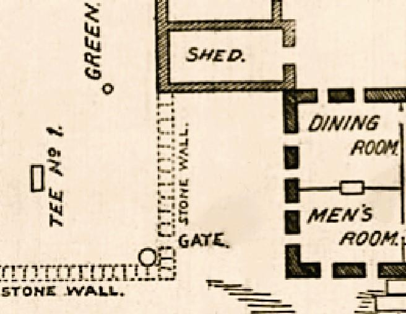
Figure 31 Ottawa Journal, 15 October 1898, p. 12
[This] room on the left of the main entrance, with its four large double casement windows, allows a good view of the west as well as to the north….
[It looks over] the putting green at the beginning of the course towards the high walls of the great stable [ruins] and the mountain ranges in the distance.
(Ottawa Journal, 15 October 1898, p. 12).
Whereas the women had the room associated with christenings, the welcoming of neighbours, and the dispensation of wise justice, it turns out that the men had the room associated with death:
This [men’s sitting] room, notwithstanding its pleasant aspect, was not a favorite of the [Brigham] family and [was] but little occupied – perhaps on account of its association with depressing recollections of last sad rites and parting looks on loved ones who had shared in life their every care and mingled in their joy.
(Ottawa Journal, 15 October 1898, p. 12)
Fortunately, as we know, this room soon came to be associated with life: it was the one in which “all in common” met – men and women – to enjoy refreshments and to tell with “noisy hilarity” of their adventures on the golf course.
In short, the room’s heritage of gloom was exorcised by Club life.
The women’s room was called the “ladies’ dressing room.” One presumes that women dressed for golf in this room, but it was provided with chairs, couches, and a writing desk, as well, so it also seems to have functioned as an exclusive sitting room for women. Yet the men’s “sitting room” – common to all – was clearly not a “dressing room” for the men. Instead, men dressed for golf in another room dedicated to their comfort:
The room in the rear on the right of the hall is equally spacious as those we have already looked into [the women’s dressing room and the men’s sitting room].
It is now set apart as the men’s dressing room, fitted with lockers around the walls and conveniences for bathing.
This room shows by its well worn floor and fireplace that of old it was much used – which is accounted for as being “mother’s room”: the centre around which circled the whole household.
It commands a view to the south over the garden and eastward over-looking the courtyard below.
(Ottawa Journal, 15 October 1898, p. 12)
By hook or by crook, the men ended up with the two rooms that seem to have had the best views. Their sitting room offered “a good view of the west as well as to the north, overlooking the putting green at the beginning of the course … and the mountain ranges in the distance,” and their dressing room offered attractive views south and east: “It commands a view to the south over the garden and eastward overlooking the courtyard below [by which] … the most old-world-like look is presented” (Ottawa Journal, 15 October 1898, p. 12).

Figure 32 Diners in La Ferme Columbia, 1972. La revue de Gatineau, 20 November 1974, p. 12. In 1970, the clubhouse rooms were “carefully restored” (Ottawa Citizen, 13 March 1971, p. 39). In its dining rooms, the restaurant preserved the look of the original rooms: “The décor has not disrupted the general feel of the house. Rooms have been left intact and there is a semi-rustic but elegant appearance” (Ottawa Citizen, 5 August 1972, p. 27). Note the old fireplace – presumably the fireplace enjoyed by Horsey and fellow Club members from 1896 to 1903. I suspect that the room we see was the men’s dressing room (there is a corner to the left of the fireplace – behind the standing man – the other side of which may be the hall that led out of the ladies’ dressing room).
There was one more room, the same size as the other three: “The remaining room on the ground floor,” says Horsey, was “used as a dining room” (Ottawa Journal, 15 October 1898, p. 12).
Beginning in 1970, as seen in the photograph to the left, rooms on the ground floor were again used for dining, for the old clubhouse became La Ferme Columbia restaurant.
Described above, the four rooms on the main floor of Brigham Hall were the locus of most of Club life for the members, but there were three other floors to the building.
There was an attic, with a full window at each gable, and immediately above the four rooms on the main floor was what Horsey called “the flat”: it had bedrooms that were able to accommodate the Brighams’ “six sons and two daughters” (Ottawa Journal, 15 October 1898, p. 12).
In the 1970s, La Ferme Columbia restaurant would use “seven separate rooms on two floors [to] offer charming and intimate dining to couples and groups” (Ottawa Journal, 29 November 1975, p. 22).

Figure 33 A photograph looking at the southeast corner of the old clubhouse. Circa 2000.
Seen in the photograph to the left is the rear of the house, where, says Horsey, there was an “extended lower flat on a level with the courtyard, divided into a spacious family kitchen and dining room” (Ottawa Journal, 15 October 1898, p. 12).
Perhaps this “spacious family kitchen” served as the clubhouse kitchen.
Refreshments were available daily in the clubhouse; tea could be arranged any day upon application to the caretaker; lunches and dinners were served to the members of visiting golf teams.
The family of the man who served as greenkeeper and golf professional from 1896 to 1898, Joseph Baizana, lived in the clubhouse. And from 1899 to 1903, both the family of the man who served as greenkeeper, John Fuller, and the family of the other man who served as golf professional, William Divine, lived in the clubhouse.
Around the House
Horsey explains the arrangement of the walls, gardens, and courtyard around the house.
Approaching Brigham Hall from the south as one came up the Chelsea Road from Hull, one first encountered a stone fence running to one’s right along the east side of Chelsea Road – and one saw on the east or right side of the wall a substantial garden to the south (Hull side) of the house. This stone wall ended at a gate at the southwest corner of the house, from which point another stone fence ran east along the south side of the house, forming the southern wall of the enclosed rectangular courtyard behind the house.
In Horsey’s words:
We approach a low dwarf wall of stone and mortar some five feet high and three feet thick, topped by rough flat slabs projecting some inches beyond the face of the wall on either side serving to protect it from the weather – which purpose it appears to have fulfilled as the wall is in a fair state of preservation.

Figure 34 An early, undated photograph of Brigham Hall. The photographer stands on the Chelsea Road at the southwest corner of the house. Marjoribanks, p. 15.
This wall runs southward from the gateway to the spacious courtyard and the southern gable, skirting the road and forming the west boundary of what was once a garden but [is] now a wilderness of weeds.
(Ottawa Journal, 15 October 1898, p. 12)
Seen in the photograph above is the “gateway” where the stone wall along the Chelsea Road met the stone wall running along the south side of the house to the courtyard behind it. Here was an informal way into the Ladies’ sitting room, accessed through the door in the southern gable (seen in the photograph above).
A stone wall also extended along Chelsea Road from the northwest corner of the house (paralleling the 1st fairway). From this wall, another stone wall ran up to a substantial two-storey addition or wing sticking out several yards from the northeast corner of the house – thereby “enclosing the [much smaller] garden” on the north side of the house. See the images below.

Figure 35 Left image: Ottawa Journal, 15 October 1898, p. 12, the word “garden” added. Right image from Marjoribanks, p. 15: undated painting by Irwin owned by the Royal Ottawa Golf Club. Note that the man stands on the Chelsea Road, which runs between the stone fence on the east (clubhouse) side of the road and a wooden fence on the west side of the road.
Also on the north side of the house, perhaps 100 yards beyond the garden wall and the shed/wing/addition, was another more substantial yard. It was bounded at its northern edge by another stone wall that ran east from the wall along the Chelsea Road to the substantial ruins of a roofless old barn or stables. As Horsey notes:
The stone walls about the old home are among the most striking features of the place, giving it a substantial enduring appearance seldom met with in this country….
[The Chelsea Road wall extends] on the northwest side [of the house] as far as the great stable walls, as well as enclosing the garden [on the north side of the house].
(Ottawa Journal, 15 October 1898, p. 12)
See below an annotated detail from another undated painting by Col. D.T. Irwin owned by the Royal Ottawa Golf Club.

Figure 36 Detail from an undated Irwin painting owned by the Royal Ottawa Golf Club.
Referring to “the ruinous but substantial stone walls of the great stable,” Horsey says that this building “was burnt … the same year” in which “the present house was built” – that is, 1834 (Ottawa Journal, 15 October 1898, p. 12). The ruins had stood desolate for 62 years before the Ottawa Golf Club found a use for them that would have been inconceivable in 1834.
Behind the house was a substantial courtyard that was enclosed by substantial stone fences to the south and east and by substantial outbuildings to the north:

Figure 37 Ottawa Journal, 15 October 1898, p. 12.
Extending from the northern gable is a wing [i.e. shed], also of stone, two storeys in height, which formerly had a gallery and external stairway overlooking and descending from the men’s dormitory over the kitchen [of the shed or wing] to the yard below ….
At right angle to this wing is another longer but lower extension forming the northern boundary of the yard. In this were separate apartments for the servants and the various household industries necessary to a large self-depending establishment … [and] required for its maintenance wholly within itself – such as kitchen, bakehouse, washhouse, smokehouse, woodhouse, and offices.
Across the courtyard, forming its southern enclosure, still stands (though in a very dilapidated condition) the proportionate and well-designed wooden structure which was the granary and stable for the riding and driving horses for family use.
(Ottawa Journal, 15 October 1898, p. 12)
The view of this courtyard from the clubhouse windows prompted Horsey to flights of fancy.
First, he was transported back to medieval times in the Old World. A “most old-world-like look is presented,” he observes, “by the courtyard”: “a once-upon-a-lifetime appearance – which requires only a little freedom of imagination to believe that here armored knights and fine ladies long ago sported themselves or assembled before sallying forth to meet some neighboring foe” (Ottawa Journal, 15 October 1898, p. 12).
Then he moved on to the history of the New World, conjuring up images of people two generations ago who worked on Columbia Farm for Wright and Brigham:
Here, sinewy axemen … struck [blows] in felling the forest, against which they waged daily war with ruthless hand. These came and went [to and from the courtyard] in their picturesque attire when free to follow comfort ….
Here might be seen men in homespun flannel shirts of gaudy hue, course trousers (tucked in beef-skin moccasins) supported by leathern belt or bright-colored sash about the waist, leaving the shoulders free and unconfined for their laborious toll.
Here, milkmaids, too, with milking pail and stool at morn and eve came tripping forth to strip from lowing herd their bounteous store.
(Ottawa Journal, 15 October 1898, p. 12)
Horsey’s writing was extremely arch and florid, but his imagination was fired by Brigham Hall. He loved the old building as much as he loved the old game that was so new to him, and he was determined to connect the two objects of his love:
as …. when the forest primeval was first awakened by the advent of the white man and re-echoed to the stroke of his ringing axe and the crash of the falling monarch at this very spot where the first tree was felled …. [so] now it is the vigorous warning shout of the golfer that is heard in the land as he cries “Fore!” to those in his way and, instead of the swinging, rhythmical stroke of the glittering axe, it is the smart swinging, whirring stroke of the golfer’s club that resounds not through the forest, but over the hillside and meadow – giving a new life and spirit to the old place ….
(Ottawa Journal, 15 October 1898, p. 12)
Horsey asks us to see swinging a golf club as like swing an axe so that we can recognize that the pioneering golfer was the true heir of the pioneering settler!
Below the courtyard, it turns out, there was another walled enclosure, which, according to Horsey, served as a paddock for young stock and as a pasturage convenient to the house:
The remains of its stone fence are still plainly visible as well as the fast-decaying stumps of the large Normandy poplars which were set at regular intervals around the parallelogram and must have represented a very pleasing ornamental appearance as well as affording shade and protection to the cattle.
Normandy poplars … were the first ornamental trees planted by the early settlers so that whenever they are found, they mark an early date of settlement.
(Ottawa Journal, 15 October 1898, p. 12)

Figure 38 Annotated detail from 1933 aerial photograph. National Air Photo Library (Canada). A4572. Photo no. 59.
This paddock marked near the edge of its northern stone wall by an elm tree, which Horsey presumed to be nourished by a spring flowing down to it from the courtyard of the house:
From beneath the foundation [of the wing or shed at the northwest corner of the courtyard], a never-failing spring of clear, cold, pleasant-tasting water continually overflows a natural basin in the rock and courses onwards through the courtyard to the green below – irrigating the expansive roots of the great elm whose giant size and luxurious foliage can reasonably be attributed to its being fed from this nutritional source.
(Ottawa Journal, 15 October 1898, p. 12)
By the word “green,” does Horsey mean “putting green”? Since he uses the phrase “putting green” earlier in his article, he probably uses the word “green” here to refer to the golf course in general. In the 1890s, what we call the fairway was called the “fair green,” what we call the “green” was called the “putting green,” and what we call the golf course was often called the “green” – hence the word “greenkeeper”: one who keeps the green (the whole course).
I believe that the elm tree and stone wall effectively marked the southern boundary of the golf course or “green” of the Chelsea Links. Marked as “Tree 2” below, it is probably this tree on the northern edge of the paddock that we see in Irwin’s undated painting of the clubhouse.

Figure 39 Annotated detail from an undated painting owned by the Royal Ottawa Golf Club
Looking from northwest to southeast in Irwin’s painting, we see “Tree 1” beside the offices, “Tree 2” (the elm) in the paddock, and then “Trees 3” – a stand of trees near the CPR tracks.
In the 1923 aerial photograph below, we look from southeast to northwest (twenty years after the last round was played on the Chelsea Links) and see the same trees in reverse order.

Figure 40 Annotated detail from a 1923 aerial photograph. Library and Archives Canada, Collections and Fonds 5006653.
The Ghost of Brigham Hall
By the beginning of the 1897 golf season, the Ottawa Golf Club had spent a full year on its new golf course, and it had finally renovated Brigham Hall to acceptable standards. At this point, after the Ottawa Ladies’ Golf Club held its first tea of the new golf season, a curious piece of information emerged regarding the new clubhouse:
On Saturday afternoon, [the President of the Ottawa Ladies’ Golf Club] Mrs. H.K. Egan, Ottawa, gave a most successful as well as enjoyable five o’clock tea at the golf grounds.
The golf links are situated on the Chelsea Road in a most picturesque bit of country and the members have a very suitable clubhouse, which rumour says is haunted ….
(Daily Mail and Empire [Toronto], 18 May 1897, p. 7)
If a lingering spirit presided over the clubhouse, the ghost of Brigham Hall might have been its last resident, Abigail Wright – alias Mrs. Thomas Brigham.

Figure 41 Philemon wright and Abigail Wright (née Wyman).
Abigail Brigham was born in Massachusetts in the mid-1790s, the first child of Abigail Wyman and Philemon Wright. In 1796, shortly after her birth, her father travelled north to the junction of the Gatineau and Ottawa Rivers to assess this area’s possibilities for development.
He returned again in 1798 and 1799 to consider more fully how he might go about settling the land. Then, in 1800, when Abigal was about five, he ventured north with his growing family, bringing with him four other Massachusetts families determined to clear farmland and build a community.
In The White Chief of the Ottawa (Toronto: William Briggs, 1903), although author Bertha Wright Carr-Harris says her book “is not fiction…. it is something stranger than fiction, a sketch of the life experiences of Philemon Wright and his family,” her account of Abigail Wright’s romantic life seems far-fetched, but she says her extraordinary story about “the love of Abbie … [is] based upon fact” (Preface p. iii).
I am sceptical.

Figure 42 Machecawa, p. 12a.
To summarize Carr-Harris’s story …. As a teenager, Abigail was the object of affection of four different men at the same time: shy settler Tom Brigham, Lieutenant Randall of Quebec City, Hull settler Harold Wrenford, and Algonquin Chief Machecawa. The latter had asked her to be his wife, but she refused, for “Abbie” was in love with Lieutenant Randall, who seemed to love her, but then disappeared, leading Abigail to write to her sister-in-law about her broken heart, only to have the letter intercepted by the man who handled the settlement’s mail, Harold Wrenford, who secretly loved Abbie himself. Devastated by this discovery about her true affections, he lost his mind: at an evening sugar-bush party, Wrenford snuck up on Abbie unobserved, grabbed her from behind, stuffed a handkerchief in her mouth, threw a hood over her head, and tied her to a tree. Tom Brigham found her and did his best to comfort the hysterical teenager. Machecawa later exposed Wrenford as the culprit and caused the scoundrel to leave the settlement forever. Then Abbie began to take an interest in Tom Brigham.
They married in 1816 and the rest is (real) history – including success on the farm and the birth of seven (or eight) children (Thomas, Charles, Christopher, Emma, Philemon, Abigail, Alwyn).
When her husband died in 1842, Abigail, then 47 years of age, assumed charge of the farm and the couple’s other enterprises. Living with her in Brigham Hall at the end of 1842 were 14 people, comprising employees and at least three of her children aged 10 to 17.
Said to have been “of a genial, kindly disposition,” Abigail Brigham became a respected figure in Hull, which grew from settlement to village and finally to incorporated city during her lifetime.
She was known widely for “her warm heart and good advice” (Ottawa Daily Citizen, 15 November 1877, p. 1). And she shared her wealth as well as her advice: “her name was associated with every charity. Many an unfortunate family have profited by her generosity” (Ottawa Daily Citizen, 15 November 1877, p. 1).
Abigail Brigham was the longest lived of Philemon Wright’s children, and she was the last Brigham to live in Brigham Hall. When she died there in 1877, she proved to be the last of the dead ever to be laid out in what became the men’s sitting room of the Ottawa Golf Club’s clubhouse – a room, as we know, that also served as a common room for all golfers to use.
Abigail’s room had been at the southeast corner of the house:
The room in the rear on the right of the hall is equally spacious as those [at the front of the house] ….
This room shows by its well worn floor and fireplace that of old it was much used – which is accounted for as being “mother’s room”: the centre around which circled the whole household.
It commands a view to the south over the garden and eastward over-looking the courtyard below.
(Ottawa Journal, 15 October 1898, p. 12)

Figure 43 Abigail Brigham, apparently in Brigham Hall sometime in the 1870s.
It was the view from these windows eastward over the courtyard that so enthralled Dr. Horsey in 1898, and it was the view from these windows that apparently preoccupied Abigail as she declined in November of 1877, yearning for something to come into view:
The deceased lady saw the Chaudière in all its grandeur before its magnificent water … was turned to account;
saw a city spring up on a spot she had gazed on as a dense forest for years;
and it was only a few days before her death that she expressed the wish to live to see the rails of the Montreal, Ottawa and Occidental laid through the property and the cars pass her door. [The Quebec, Montreal, Ottawa and Occidental Railway Company was soon to become part of the CPR.]
It was not to be, however, for she died while they were yet four miles from her home.
(Ottawa Daily Citizen, 15 November 1877, p. 1)
Abigail’s dying wish was not satisfied: was this disappointment enough to cause her spirit to linger in Brigham Hall, waiting to see trains crossing her land 400 yards below her window?
1894: Chelsea Road Reconnaissance and Stakeout

Figure 44 Golf (New York), vol 3 no 5 (November 1898), p. 314.
In the spring of 1898, Josiah Newman, the editor of Golf magazine (New York), wrote an essay called The Golf Clubs of Canada in which he includes an entry about the Ottawa Golf Club (Golf [New York], vol 2 no 4 (April 1898], pp. 10-19).
Newman gathered his information from the clubs themselves, probably sending them a questionnaire like the one seen to the left, published in Golf in the fall of 1898, inviting all clubs in North America to submit information for inclusion in his Official Golf Guide 1899 of the United States & Canada, which appeared in March of 1899.
For each golf club, he sought the following information: name, location, year the club was organized, number of holes, hole names and yardages, club champion, number of members, club prizes and current prize holders, office holders on the executive committee, and so on.

Figure 45 Golf (New York), vol 37 no 4 (October 1915), p. 196.
In his April 1898 essay, Newman’s detailed information about the Ottawa Golf Club was no doubt provided by 1897 Secretary-Treasurer Alexander Simpson (the second-place finisher in the 1895 Canadian Amateur Golf Championship, he would be elected president of the Club in April of 1898).
The information that Simpson provided concerned the state of the Club in 1897 – from the names of the 1897 prize holders to the names of the members of the 1897 executive committee, as well as the name of he course record holder: “The amateur record is held by E.C. Grant, who made the 18 holes in 81 strokes on May 24, 1897” (Golf [New York], vol 2 no 4 (April 1898], p. 13).

Figure 46 Alexander Simpson (1857-1932).
Simpson, manager of the Ottawa branch of the Bank of Ontario, had served as Secretary-Treasurer since 21 April 1891. He knew everything about the Club since its formation. Perhaps the most interesting information he provided to Newman concerns not just who laid out the course – but when: “This well-kept course was laid out by A. Ricketts in September, 1894” (Golf [New York], vol 2 no 4 (April 1898], p. 13).
September of 1894!
Can the Club really have had its golf professional stake out a course in September of 1894 on land it would not lease until April of 1896?
Could the statement have been a mistake – the result of a slip of the pen or typographical error? Was the intention to say that Ricketts laid out the course in September of 1895?
The Club gave no outward signs during the 1894 or 1895 seasons that it was in any way dissatisfied with the Sandy Hill course. It planned from early in 1895 to host in June the first Canadian Amateur Golf Championship, and members so much enjoyed the Sandy Hill course that they played on it until Christmas Day in 1895.
When Newman’s Official Golf Guide appeared in March of 1899, a year after information about the Club had been provided in Golf in April of 1898, Ricketts was again said to lave laid out the course in September of 1894.
There is no doubt that the Club knew that Newman had printed this information about Ricketts in Golf the year before:

Figure 47 Armory Alfred Zouch Palmer (1857-1929).
A.Z. Palmer (the Club’s president from April 1897 to April 1898) not only had a subscription to Golf but was also corresponding with Newman in January and February of 1898 about the magazine’s puzzle contests (Golf [New York], vol 1 no 2 [February 1898], p. 41).
Furthermore, between the publication of the entry about the Ottawa Golf Club in Golf in 1898 and the publication of the entry about the Club in the Official Golf Guide for 1899, someone at the Ottawa Golf Club had contacted Newman to give him new information about the Club for the information about the Ottawa Ladies’ Golf Club in the 1898 Golf essay was substantially modified and expanded for the Official Golf Guide.
Yet most of the other information about the Club that Simpson had sent to Newman about a year before was republished word-for-word. The only change made was to omit the names of the 1897 club prize holders.
Who provided the new information to Newman is not clear. Simpson was no longer secretary in 1898, for he had been elected president in April, when Irwin replaced him as secretary. Perhaps it was Irwin who sent new information, or it might have been the secretary of the Ottawa Ladies’ Golf Club, Mrs. Crombie (Elizabeth Jane Pendleton Gwynne).
The fact that no one at the Ottawa Golf Club saw fit to change the original statement about Ricketts’ work in September of 1894 leads one to believe that it was not erroneous.
Note that there is contemporary corroboration for the suggestion that by the beginning of the 1895 season, the Ottawa Golf Club had already identified the Brigham farm as its preferred new location and had already made some sort of arrangement to use it, for we find the following gossip recorded in the Ottawa Journal column Entre Nous in June of 1895 (just after the completion of the Canadian Amateur Golf Championship):
A couple of years ago, they [the men of the Ottawa Golf Club] were most anxious that ladies should join the club ….
They gave glowing accounts of the game ….
But now it is different and the men want to have the links all to themselves somewhere in the wild country the other side of Hull.
They have the links already, I believe.
(Ottawa Journal, 22 June 1895, p. 5)
Was there substance to this rumour?
In 1904, a newspaper story about the history of the Club recalled that well before the Sandy Hill location was abandoned, there had indeed been “much hunting around for a place near the city” (Ottawa Journal, 10 September 1904, p. 15).
And in another article about Club history published in 1910, names were put to these old stories about members hunting for a new golf course site while play was still underway in Sandy Hill:

Figure 48 Arthur Bentley Brodrick (1859-1926), 1902. Ottawa Citizen, 13 November 1937, p. 44.
The First Club Move
Owing to the rapidly increasing …. building operations on the links, it became necessary to look for other quarters.
Some members had been casting about for another course, and Messrs. A.B. Brodrick and R.C. Douglas had hit upon an admirable bit of territory on the Chelsea Road, a mile north of Hull.
In the spring of 1896, the club, under the presidency of Mr. A.Z. Palmer [the president was actually Irwin; Palmer became president in 1897], took a lease of this ground, known as the Bingham [sic; should be “Brigham”] property.
(Ottawa Journal, 3 December 1910, p. 2)
During this prolonged hunt for other quarters – as this or that member proposed this or that site as a possible location for a new golf course – the Club’s golf professional Alfred Ricketts must have been consulted about any possible site’s potential for development as a golf course.
Unlike many other fledgling North American golf clubs in the 1880s and 1890s, the Ottawa Golf Club never deigned to pretend that such golf knowledge as resided within the Club was sufficient to lay out a proper golf course.
For instance, debated on 21 April 1891, at the second of its organizational meetings, was not the question of whether anyone within the Club might lay out the first course but rather which golf professional the Club should hire:
In the matter of groundsman and trainer, there was a lengthy talk and it was discussed whether it was advisable to procure a capable man from Montreal or bring out Willie Dunn from the Old Country.
There is no better golfer anywhere than Dunn, the well known and extremely popular “linkist,” and his arrival here would be an acquisition not only to the Club but to the interests of the game in Canada.
(Ottawa Free Press, 21 April 1891)
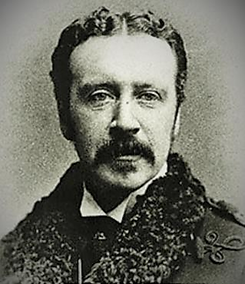
Figure 49 De la Cherois Thomas Irwin (1843-1928)
The Club decided to bring in the Royal Montreal Golf Club’s Willie Davis, who became the first golf professional to be hired as such in North America when he went to Montreal in April of 1881. The Ottawa golf Club’s decision was probably prompted by Col. Irwin, who first heard of Davis in May of 1881 when the latter was invited to Quebec to play against the Quebec Golf Club’s amateur champion, who was regarded as the best golfer in Canada before Davis’s arrival. Like many of the non-golfing socially prominent men in Quebec City, Irwin was a non-playing member of the Club – probably because Canada’s golf-mad governor General, Lord Lorne (Queen Victoria’s son-in-law), was a playing member who occasionally represented the Club in team matches against the Montreal Golf Club.
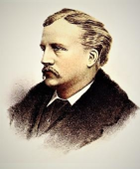
Figure 50 John Campbell (1845-1914), Marquess of Lorne, Governor-General of Canada, 1878-83.
Across the 12 holes on Cove Field, Lord Lorne headed a large number of spectators (which probably included Irwin) following the absorbing golf match involving the first play by a golf professional in North America.
When Davis came to Ottawa at the end of April 1891 (his remuneration making him the first professional golf course architect in North America), Irwin was one of the four Club members who accompanied him around the Sandy Hill site that day as the Davis explained where the holes should go. The five men even made a trial of the new layout.
We have reason to believe that Davis would not have been shy about explaining what parts of Sandy Hill would serve the purposes of golf and what parts would not, for when Royal Montreal loaned him three months later to the wealthy promoters of golf at Shinnecock Hills on Long Island, New York, he explained that he could not lay out a course on the land that he was first shown and made as if her were about to return to Montreal in frustration and disappointment before his host, William Parrish, showed him another site:
We asked the late Charles L. Atterbury, who was about to visit Montreal on a business trip, if he would interview the authorities of the Royal Montreal Golf Club (organized in 1873, the oldest golf club in Canada, and therefore in the western hemisphere) and arrange with them to have their professional come to Southampton and look over the ground.
As a result of this interview, the Scotch-Canadian professional, Willie [Davis], by name, arrived at Southampton with clubs and balls in the early part of July 1891, consigned to me.

Figure 51 New York Herald, 30 August 1891.
Immediately upon his arrival, we drove out to Shinnecock Hills but had proceeded only a few hundred yards … when [Davis] turned to me and remarked in a somewhat crestfallen manner that he was sorry that we had been put to so much trouble and expense, but that no golf course could be made on land of that character.
We had already turned our faces homeward toward Southampton when I said, … “Well, [Davis], what do you want?” ….
He then explained that ground capable of being turned into some sort of turf was necessary ….
I then drove him to a spot in the valley … composed of sandy soil comparatively free from brush and capable of some sort of treatment appropriate for golf at a reasonable outlay of time and money.
(Samuel L. Parrish, Some facts, reflections, and personal reminiscences connected with the introduction of the Game of Golf into the United States, more especially as associated with the formation of the Shinnecock Hills Golf Club [privately printed by Samuel Parrish, 1923], pp. 5-6)
Davis’s reaction to the new land he was shown was much different: “Willie Davis’s face lighted up, and with true golfing ardor, he exclaimed: ‘This is more like it’” (New York Times, 8 March 1896, p. 25).
In accompanying Davis around Sandy Hill, Irwin is likely to have acquired first-hand knowledge of the kind of things that a golf professional such as Davis considered in laying out a golf course. He would have been in no doubt of the need for professional advice in such matters. And serving as president of the Club in 1894 (as well as in 1895 and1896), Irwin was in a position to insist that well-respected golf professional Ricketts should be involved in evaluating any prospective golf course site proposed by this member or that.
It is likely, then, that Ricketts was instrumental in determining that the Brigham property should be the favored site for the new golf course. And so long as Emma Hall did not object to a couple of dozen wooden stakes being driven into her fields here and there to mark locations for teeing grounds and putting greens, it is quite plausible that Ricketts demonstrated to Irwin and other members of the Executive Committee the property’s potential for proper golf by staking out the future course in September of 1894.
And perhaps as had happened in Sandy Hill at the end of April 1891, the golf professional and any Club members accompanying him – say, Colonel Irwin, on the one hand, and the two men who had found the site, A.B. Brodrick and R.C. Douglas, on the other – made a trial of the course.
In this regard, it is interesting to note that at the end of November 1894, a friendly match was played at Sandy Hill by four of the five people who would have been involved in considering the viability of the Chelsea Road site:
The perfect weather Thursday brought out a large number of golfers and their friends.
In the morning, the principal match was a foursome between Lt. Col. Irwin [President] and A. Simpson [Secretary] against R.C. Douglas and A. Ricketts (prof).
The former won by two holes and one to play.
(Ottawa Daily Citizen, 24 November 1894, p. 5)
Brodrick was missing, but the others, during their match, may nonetheless have talked a good deal about the promising prospects of what would become known as the Chelsea Links.
Architect Alfred Ricketts
Chelsea Links designer Alfred Ricketts served as golf professional at the Club from March of 1893 to the end of the 1895 golf season.

Figure 52 The only known image of Alfred Ricketts, circa 1898. Democrat and Chronicle (Rochester), 28 October 1923, p. 38.
After Ricketts’ first year at the Club, President Irwin “spoke very kindly of the professional Ricketts,” affirming that he “was a good ground man” (Ottawa Journal, 4 April 1894, p. 7). That is, he was a good greenkeeper.
Confidence in Ricketts’ abilities as greenkeeper were made clear again in the spring of 1895: “various changes and improvements have been decided on, an assistant to the professional has been engaged, and every effort will be made to have the green the finest in America” (Ottawa Journal, 13 April 1895, p. 7). Ricketts was given the resources he needed to make the Sandy Hill course a proper test for the inaugural Canadian Amateur Golf Championship in June.
Twenty-two years later, Club members recalled for Ralph Reville, editor of Canadian Golfer magazine, that “the first professional in Ottawa, Alfred Ricketts, an Englishman of considerable note in golfing circles, gave much careful attention to the course and did much to lay the foundation of Ottawa golf” (Canadian Golfer, vol 3 no 2 [June 1917], p. 88).
Yet little is known of this golf pioneer who was, after Royal Montreal’s Willie Davis in 1881 and the Shinnecock Hills Golf Club’s John Cuthbert in 1892, just the third golf professional to come to North America to work as such.
Alfred Henry Ricketts was born in Wimbledon, England (about 10 miles south-west of London), in February of 1869. At this time, his mother Letitia was 34; his father George, a carter by trade, was 39. The family had a large enough home to take in lodgers – even a family of three at one point. Alfred had two older siblings, Francis (born 1864) and Martha (born 1867), and three younger siblings, Harry (born 1872), Walter (born 1874), and Edward (born 1875). By 1881, 17-year-old brother Francis was working with his father as a carter and 12-year-old Alfred was working as an errand boy. By 1891, his younger brothers were general labourers living at home, but Alfred had left the family home to make his own way in the world.
When Ricketts arrived in Ottawa on March 20th of 1893, a month after his 24th birthday, he was described by the Ottawa Free Press as “a professional from Wimbledon” (cited in the Montreal Star, 2 May 1893, p. 5). The newspaper refers to the site of his employment – the golf course laid out on the Wimbledon Common in the 1860s, one of the oldest golf courses in England.
Ricketts will have been associated not with the golf course per se, but rather with one or the other of the two distinct golf clubs to which this course on Wimbledon Common played host: the London Scottish Golf Club and the Royal Wimbledon Golf Club.

Figure 53 Clubhouse of the Royal Wimbledon Golf Club. British Golf Links, ed. Horace Hutchinson (London: J.S. Virtue & Co., 1897), p. 327.

Figure 54 Golfers and caddies pose in front of the" Irn House" of the London Scottish Golf Club, circa 1890. It is possible that Alfred Ricketts is in this photograph.
The two clubs, that is, played on the same golf course. By 1890, there were 500 members split fairly evenly between the two clubs (Wallington & Carshalton Herald [London, England] 1 February 1890, p. 6). Located at one end of the course in the more commodious red-brick clubhouse (seen above) was the Royal Wimbledon Golf Club; located at the other end of the course in the more spartan “Iron House” (seen below) was the London Scottish Golf Club.
Nine holes went each way from clubhouse to clubhouse, the members of these clubs commencing play at the tee closest to their own clubhouse.
As the municipal authority in charge of Wimbledon Common restricted the playing of golf to Tuesdays, Thursdays, and Saturdays (so as to make the golf grounds available to the public on other days for other forms of recreation), the golf course was often full – especially on Saturdays, when perhaps 250 hopeful golfers might line up in the morning in quest of a tee time.
Each golf club had its own golf professional. One of them, “[David Murdoch] Patrick, who used to look after matters at the Wimbledon end, was more of a club-maker than player” (Pall Mall Gazette [London], 4 November 1896, p. 10). He also laid out golf courses. Originally from Leven Links in Leven, Scotland, Patrick replaced his brother Alexander at Wimbledon in 1891 (at a reduced salary and with the title of greenkeeper only, not professional). It is possible that Ricketts apprenticed under each of the Patrick brothers.

Figure 55 Peter Fernie. Golf Illustrated (London), 3 January 1902, p. 8
At the other end of the common, at the London Scottish Golf Club, the golf professional from the 1880s to 1900 was Peter Fernie, from St, Andrews.
Like all golf professionals of the day, Fernie was a clubmaker (in fact, he became so famed for his club-making skills that he was one of the three club-making judges at the International Golf Exhibition in St. Andrews in 1910), but he was also a competitive golfer. He was a regular entrant in Open Championships from 1880 to the late 1890s and he participated in professional tournaments and match-play contests that began to be staged in the London area in the 1890s.
Fernie was also an excellent instructor, such that when he became the golf professional at Ipswich in 1900, club directors attributed to his teaching skills the fact that many of the members’ handicaps had to be lowered significantly within a few months of his arrival. Perhaps Ricketts apprenticed under Fernie.
Indeed, moving through the stages of apprenticeship from caddie to club-maker and golf instructor, Ricketts may have worked with all three of the Wimbledon common professionals.
The 18-hole golf course on the Wimbledon Common was described in the 1890s by Horace Hutchinson as “the healthiest, prettiest, and most natural course in the neighbourhood of London” (British Golf Links, ed. Horace Hutchinson [London: J.S. Virtue & Co., 1897], p. 327). This course where Ricketts would have learned his greenkeeping skills was like the nine-hole Ottawa golf course in having no artificial hazards: not because the greenkeeping golf professionals were lackadaisical, but rather because neither golf course needed such things.
At Wimbledon, during the last year or two that Ricketts was there, we read that
The part of the common over which play takes place is high and interspersed with patches of gorse and undulating ground.
The turf is gravelly and uneven, with patches of remarkably coarse, tough turf, but during the last year or two the course has improved considerably, and the putting greens are now about as good as it is possible to get them.
(The Annual Golf Guide, 1891-92, ed. David Scott Duncan [London: Horace Cox, 1892], p. 221)
An 1890s photograph of the fairway of the first hole at Wimbledon suggests that the land here was not much different from the fields parallel to the Dominion Rifle Range where several holes of the Sandy Hill golf course were laid out in April of 1891 and not much different from the fields where the Chelsea Links were laid out in September of 1894.

Figure 56 First hole of the golf course on Wimbledon Common. Enhanced and modified photograph from Hutchinson, British Golf Links, p. 329.
When the grand houses went up behind the fenced-off lots along Theodore Street (today’s Laurier avenue East) during the years Ricketts was at the Ottawa Golf Club, he may have been reminded of the grand houses behind the fences alongside the first fairway of his old golf course at Wimbledon.
Also located on the Wimbledon Common as of 1872 was the Wimbledon Ladies’ Golf Club, for which the Wimbledon golf professionals maintained a ladies’ course: “The course is one of nine holes … and is about 1200 yards in length” (The Annual Golf Guide, 1891-92, p. 222). Here, Ricketts became familiar with the capabilities of women golfers in the early 1890s and learned the art of instructing women players.

Figure 57 Tom Dunn, early 1880s.
The Wimbledon Common golf course had been overseen by Tom Dunn from 1872 to 1882. In fact, he “extended … Wimbledon from a seven to an eighteen-hole course” (Golfer’s Guide for the United Kingdom, ed. W. Dalrymple [Edinburgh: W.H. White & Co., 1895], p. 14). If Ricketts began caddying at Wimbledon by the age of 12 (as was common in those days) – and we know that by then he had already begun working as an errand boy – he may well have been given his first job by Dunn.
There was a great need for caddies at Royal Wimbledon’s spring and autumn “meetings” (that is, Club tournaments).
In 1883, for instance, 100 members entered the autumn handicap competition and 100 also entered the autumn scratch competition: “that part of the common on which the links are situated presented an unwonted scene of animation, so numerous were the couples of red-jacketed gentlemen who, accompanied by their ‘caddies,’ were to be seen traversing it ….” (Illustrated Sporting and Dramatic News [London, England], 10 November 1883, p. 218). Ricketts may well have been introduced to golf when he answered the calls that went out during these meetings for additional caddies.
Unlike caddies in Scotland, few of the Wimbledon caddies intended to make a future in the game, for golf courses were few in London in those days. At Wimbledon, Horace Hutchinson observed in 1891, “Your caddy … may not necessarily be an expert; he may be a casual person, not engaged on more permanent work. In that case you have to find the ball for him, and to instruct him on the difference between a lofting iron and a niblick” (British Golf Links, p. 328). But Hutchinson acknowledges that those (like Ricketts, presumably) who were “engaged on more permanent work” at the golf course were quite different: “many of the caddies are very quick at learning, and a few have developed a good deal of skill and interest in the game” (British Golf Links, p. 328).
Fortunately for Ricketts, there were enough Scottish members at Royal Wimbledon to prevent young caddies from mistaking English attitudes toward the game for proper attitudes:
There was no competition for the monthly handicap challenge medal in December [1887] as on the medal day, the snow was at least six inches deep.
One of the members, however (an Englishman), made a gallant attempt to get round with a caddie to play with and mark [an official score] for him, a caddie to carry [his clubs] for him, and two more armed with a shovel and broom to search out the holes.
His card, which he handed in, showed that he succeeded in doing the first hole in 12, the second in 16, the third in 35, and it is said that he played 78 for the fourth but, failing to find the hole, gave up in disgust.
Lest he should have a claim to the medal as the only starter, a pawkie Scotch member, between two rubbers of whist, went out to the teeing ground with a [playing] partner and struck off with his iron niblick a splendid drive of a couple of inches. This stroke was duly entered on his card [by his partner], authenticated, and given in – a fine example of Scotch caution.
(Field [London], 12 February 1887, p. 211)
If anyone among the founders of the Ottawa Golf Club had visited Wimbledon or had otherwise come to know of the nature of the membership divided there between the two Wimbledon clubs, he might have been inclined to think that a young assistant professional from Royal Wimbledon would be perfectly equipped to serve members of a golf club in the Canadian capital:
The Legislature is well represented.
Lord Wemyss, Lord Balfour of Burleigh, Lord Elgin, Lord Vernon, and others represent the House of Lords.
The Lower House contributes a large quota.
Beyond the redoubtable Mr. Balfour may be noticed Mr. Brodhurst …, Mr. R.B. Finlay, Q.C., Sir W. Houldsworth, Mr. H. Seton-Kerr, Mr. R.G. Webster, and last, if not least, Mr. Seymour Keay, the Socialist representative of Elgin and Nairn who, truth to tell, seems generally to play alone or with a professional.
In science, we have Professor Lankester and Professor Forbes, besides doctors innumerable.
Literature picks its dainty way in Mr. Andrew Lang accompanied as he was the other day, by his latest recruit, Mr. Rider Haggard.
(Wallington & Carshalton Herald [London, England] 1 February 1890, p. 6).
Whether or not Ricketts was one of the professionals asked to play along with some of these Wimbledon members, he would no doubt have learned how a golf professional was expected to interact with the kind of members that made up the Ottawa Golf Club in 1893.
Although Tom Dunn had left Wimbledon for Scotland in 1882, he returned to a golf club in the London area late in 1889 and would soon become the most important golf architect of the next decade as he became the pioneer in developing design strategies for building inland golf courses on non-links land. And so, Ricketts would not only have learned his golf on the Wimbledon course designed by Dunn, but he would also have been familiar with many of Dunn’s courses built near Wimbledon between 1889 and 1893. He would have learned from these courses the strategies by which Dunn became known as the father of penal golf course design (the subject of the next chapter). As we shall see, Ricketts would apply these strategies in his design of the Chelsea Links course.
As the golf professional of the Ottawa Golf Club, Ricketts would of course have had other responsibilities in addition to greenkeeping, such as making golf clubs, selling and repairing golf balls, and teaching. And finding a teacher was a priority of the Ottawa Golf Club as implied by its indication in the fall of 1892 that it intended to hire a golf professional: “The Ottawa Golf Club is engaging a professional for next year and it is more than likely they will be able to put some strong players in the field” (Ottawa Daily Citizen, 1 November 1892, p. 5). The Club anticipated both that its players would be made stronger by professional instruction and that many of its social members would become playing members after instruction: “A. Ricketts, the professional engaged by the Ottawa Golf Club, has arrived here for the season. Under his tuition it is expected that golf will boom” (Ottawa Daily Citizen, 21 March 1893, p. 4).

Figure 58 College Avenue at Laurier Avenue East (formerly Theodore Street), early twentieth century.
Immediately upon his arrival in Ottawa, Ricketts sought living quarters in Sandy Hill, not far from the golf course. He chose lodgings in the home of Frederick George Perrott, who lived with his wife and young children on College Avenue, just a few blocks from the clubhouse. (This street has since disappeared under the buildings of the University of Ottawa’s main campus.)
Perrott, an Englishman born in 1856, was a man with many interests and an abundance of energy.
He was at times a civil servant and a messenger at Alexander Simpson’s Ontario Bank. In his spare time, he also ran Perrott & Ashe, a catering company that also maintained a dining hall. The newspapers referred to him as “Fred Perrott, the well-known caterer” (Ottawa Journal, 2 Dec. 1893, p. 1). Perhaps through his Ontario Bank connection with Club Secretary Simpson, he had the contract to provide lunches and teas for special occasions at the Ottawa Golf Club, where he erected marquees for large events held at the clubhouse: “Mr. Fred Perrott provided a splendid lunch for the golf players yesterday in a handsome marquee erected for the purpose” (Ottawa Journal, 7 October 1893, p. 8).
In whatever other spare time he had, Perrott served as the treasurer of the Sandy Hill Cricket Club, which was formed in the spring of 1894. Ricketts was a founding member of this club, and he was also – perhaps because of his expert knowledge of turf in general and of the golf course turf in particular – one of three men appointed to a committee to “look after preparing a wicket” for “play near the golf grounds” (Ottawa Journal, 1 May 1894, p. 8; Ottawa Journal, 30 April 1891, p. 5).

Figure 59 Depiction of a cricketer batting in the match between Ricketts’ Sandy Hill Cricket Club and a team of Ottawa Bankers. Ottawa Journal, 13 August 1894, p. 5.
The Sandy Hill Cricket Club (renamed the “Rideaus” in 1895) finished the 1894 season with four wins and four losses. The next year, Ricketts was described as one of the team’s “best men” and served as “Captain” (Montreal Daily Herald, 13 May 1895, p. 2; 4 July 1895, p. 1). Perhaps his greatest personal achievement in the Club’s first season coincided with the Club’s greatest achievement: Ricketts bowled out the cricket professional of the Ottawa Cricket Club (along with two other batters before that), a feat late in the summer of 1894 that produced a surprise win by the Sandy Hill Cricket Club over the city’s strongest cricket club.
Ricketts also made good scores as batter in 1895 against both the “Ottawas” and the Invictas (of Montreal) when his teammates could do nothing against superior bowling (Gazette [Montreal], 19 August 1895, p. 6; Montreal Daily Herald, 4 July 1895, p. 1).
Perrott and Ricketts were regularly selected for the starting lineup of the Club (of which Ottawa Golf Club members Alexander Simpson and A.Z. Palmer were president and vice-president, respectively, in 1894), and together, they played with their cricket team as far afield as Montreal, Perth, Almonte, Carleton Place, and Napanee.
Perrot and Ricketts seem to have been a dynamic duo in the promotion of the Club and the game:
The committee of the Sandy Hill Crickett Club are canvassing the members and friends of the club for subscriptions. They require about $125 to re-turf and fix up the new grounds on which they hope to have a first-class wicket next year.
Messrs. Perrott and Ricketts are most energetic in their efforts for the club.
(Ottawa Journal, 20 September 1894, p. 1).
They were so successful so quickly with their subscription campaign that just two weeks later the Club was able to call for tenders for the work of constructing the new pitch. This achievement earned hearty applause at the Club’s year-end banquet.
Ricketts and Perrot were always paired together in other ways.
When the Sandy Hill Cricket Club staged a “Married vs Single” match, Perrott headed the list of the former, and Ricketts headed the list of the latter (Ottawa Daily Citizen, 7 September 1894, p. 5).
At “the first annual dinner of the Sandy Hill Cricket Club, … the genial disposition of the members of that organization was clearly evidenced by the happy and hospitable manner in which they entertained their guests …. The time for toast making having arrived …. Messrs. Ricketts and Perrott responded to the health of the Sandy Hill Cricket Club proposed in felicitous terms by Mr. Isbester” (Ottawa Daily Citizen, 3 November 1894, p. 7). It was most unusual for two people to have been charged with responding to another person’s toast: Ricketts and Perrott seem to have been a doubles act.
And the two of them seem to have been quite the party hounds, too. At “The most successful Cricket club dinner ever held in Ottawa … that of the Sandy Hill Club last night at the Bodega …. Mr. A. Ricketts sang the ‘Scotch Brigade’ and F. Perrott, ‘Jacob Smidt’ ….” (Ottawa Journal, 3 November 1894, p. 1).
It was no different in the Ancient Order of Foresters, of which Ricketts and Perrott were also members. In fact, at the end of 1894, Ricketts was elected Junior Woodward, one of the six officers of the Court Pioneer lodge of the A.O.F. in Ottawa (Ottawa Journal, 27 December 1894, p. 7). At the A.O.F.’s March dinner in 1895, of course, Ricketts and Perrott each sang a solo.
Alas, Perrott died young – he was just 49 years of age when he passed away in 1905.
Of course, Ricketts had not been brought to Ottawa to play cricket, but rather to do for the Ottawa Golf Club all the things that it fell to a golf professional to do in those days: to look after the golf course, to teach members how to play the game, to make and repair clubs, to make and repair golf balls.
Note that when he was hired at the Country Club of Rochester in the late 1890s, Ricketts negotiated a contract according to which the Club would buy up to $500 worth of golf balls from him – perhaps there was a similar stipulation in the contract he had secured from the Ottawa Golf Club in 1893 (Through Half a Century: Commemorating the Fiftieth Anniversary of the Founding of the Country Club of Rochester [Rochester: 1945], p. 12).
Another part of his job was to represent the Ottawa Golf Club in competition with either the professional golfer or the best amateur player of the clubs with which the Ottawa members engaged in competition (golfers such as A.W. Smith of Toronto and Thomas Harley of Kingston).
And the Club also hoped that he would represent it in major competitions in Canada and the United States, such as the professional tournament planned for Newport, Rhode Island, in the summer of 1894:
On the 24th and 25th of August a professional tournament takes place in Newport, R.I….
The sum of $250 is offered in prizes and W. Campbell, ex-champion of England, W. [F.] Davis, W. Dunn and other experts will take part.
A. Ricketts, the Ottawa professional, will also take in the matches. He is a good player and just now in fine shape. The club expect him to render a good account of himself.
(Ottawa Journal, 3 August 1894, p. 5)
Alas, Ricketts did not join the above-mentioned golf professionals in the tournament in question. Just Campbell, Davis, and Dunn took part.
We learn indirectly of another 1894 tournament that Ricketts planned to enter: “Ricketts, the professional of the club, has had a disappointment by reason of the falling through of the New York tournament for professionals” (Ottawa Journal, 6 September 1894, p. 5). It is not clear what New York competition this newspaper item refers to, but the report continues: “Later in the season, some professional matches may be played in Ottawa” (Ottawa Journal, 6 September 1894, p. 5).
One infers that the Ottawa Golf Club – perhaps ambitious to show off its golf professional – supported Ricketts’ ambition to play tournament golf. Note that as it planned the 1895 Canadian amateur Championship tournament for June of 1895, the Club expressed the hope of adding a professional competition to the event, but those hopes were also disappointed.
Club President Irwin played golf relatively often with Ricketts and spoke of him as “an excellent player” (Ottawa Journal, 4 April 1894, p. 7). Ricketts held the course record for an 18-hole sound on the Sandy Hill links (he and A.W. Smith each shot 83 when they played each other in the fall of 1893). And he would later hold the professional scoring record at a number of other courses: Lake Champlain (at the Hotel Champlain Golf Club), Albany, and the Country Club of Rochester (where he lowered the record from 70 to 69, and then from 69 to 68). The members of the Albany Country Club described Ricketts as a “a corking good player” (Golf [April 1898], vol 2 no 4, p. 45).
At Ottawa, Ricketts also supervised tournament play as part of his duties, from various club competitions to the interprovincial match between Quebec and Ontario held at the Club in October of 1893. By the end of his first season in Ottawa, he had made a good impression in this regard: “Mr. A. Ricketts is the club’s professional and a good player and a courteous official he is” (Ottawa Daily Citizen, 7 October 1893, p. 5).
As we know, Ricketts laid out the Ottawa Golf Club’s Chelsea Links north of Hull in September of 1894, but he would not be present for the move to the new course in April of 1896.
By the end of the 1895 golf season, Ricketts knew that he would not be returning as the golf professional of the Ottawa Golf Club. Instead, he intended to go to the United States as soon as possible, so in November he placed an advertisement in a Boston journal called The Golfer, which was “devoted to the game of golf and the golfers of the United States of America” (Golfer [November 1895], vol. 2 no 1, p. 7).

Figure 60 Golfer (November 1895), vol. 2 no 1, p. 27.
In the same month, the Montreal Star reported that “Alf Ricketts, professional of the Ottawa Golf Club, left this evening to accept a lucrative position in Buffalo. Ricketts is one of the best golf players in Canada, and he will be a loss to the Canadian golf circles” (8 November 1895, p. 3). But Ricketts did not go to Buffalo. Instead, in March of 1896, the New York Times reported that “The [Albany] Country Club has engaged M[r]. A. Ricketts, for the past three seasons the professional of the Ottawa Golf Club, for the season, from April 1 to Nov. 28” (New York Times, 15 March 1896, p. 21).
Ricketts flourished at the Albany Country Club, which allowed him to develop further his career as a competitive professional golfer and as a designer of golf courses. Indeed, his first year at Albany was a busy one. In July, he played in the U.S. Open at Shinnecock Hills and performed well in his first major competition, as the Ottawa Daily Citizen noted:
GOLF
Ricketts’ Good Showing …
James Foulis, of the Chicago Golf Club, won the championship at the open matches of the United States Golf Association at Shinnecock Hills. Foulis played phenomenal golf ….
A. Ricketts, formerly of this city, took part in the contest and made a most creditable showing …. his score … being beaten by the champion by only 11.
(Ottawa Daily Citizen, 22 July 1896, p. 3)

Figure 61 Lenox Cup.
The Albany Golf Club also encouraged him to play in the professional tournament at Niagara-on-the-Lake at the beginning of September in 1896 (although he would not, in fact, take part in it). Instead, at the end of that month, he entered the professional tournament at the Lenox Links in Massachusetts, at which U.S. President William McKinley would present the trophy to the amateur winner of the Lenox Cup.
Before the amateur portion of the Lenox tournament, “the professionals … had a driving contest, which was won by Ricketts of the Albany club. Each drove four balls and the aggregate distances were added together. Rickett’s score was 610 yards” (Boston Evening Transcript, 26 September 1896, p. 4). That the driving competition was won by four drives averaging 152.5 yards each shows how difficult it was to drive the gutta-percha golf ball of the day a long distance consistently and accurately.
And note that Ricketts’ professional opponents at Lenox Links were no slouches: they were the top players in America, including Willie Davis (now of Newport), Willie Dunn, Jr., John Shippen (the African American professional from Shinnecock Hills), Willie Campbell, Horace Rawlins (the 1895 U.S. Open champion), Willie Tucker (Dunn’s nephew), and so on.
To win this tournament would be prestigious: “the first prize being $200” meant that the prize money was the equivalent of that which was awarded to the U.S. Open winner in July (Boston Evening Transcript, 26 September 1896, p. 4). Ricketts did well: “W. Tucker of St. Andrew’s, Horace Rawlins of the Sadaquada Club of Utica, W. Campbell of Myopia, and W. Rickett [sic] of Albany were tied for third place and divided the money” (Sun [New York], 28 September 1896, p. 9).
After his first design work as a golf architect for the Ottawa Golf Club, Ricketts went on to a notable career as a course designer in Vermont and New York. He began at Albany: called by the New York Times “the greens keeper of the Albany Country Club,” he was also in charge of remodelling it, for we read in the Official Golf Guide 1899 that the golf course was “much improved by A. Ricketts,” with about 300 yards added to its length (New York Times, 18 July 1897, p. 4; Official Golf Guide 1899, p. 205). In May of 1897, he laid out a nine-hole course in Bennington Centre, Vermont, for the Mount Anthony Club. Two months later in July, he laid out a nine-hole golf course in Lake Placid for the Roussement Golf Club.
Then we read in January of 1898 that “A. Ricketts, of the Albany Golf Club, is making a business tour of Canada” (Golf [January 1898], vol 2 no 1, p. 51). Was he looking for more golf-course design work? Did he want to leave Albany? Was he looking for a new position as golf professional and greenkeeper?
Whatever the case may be, after two years at Albany, Ricketts did indeed move on – but not because Albany wanted to get rid of him:
Much to the regret of all the members of the club, A. Ricketts, the professional, leaves at the end of the month for Rochester, to take charge at the golf club there.
Albany’s loss is Rochester’s gain, for in him they got one of the most painstaking and obliging men in the business.
A clever instructor and a corking good player.
(Golf [New York], vol 2 no 4, [April 1898], p. 45)
His new job as of April of 1898 was at the Country Club of Rochester, where he immediately applied his skills as both greenkeeper and architect. He was asked to remodel the Club’s eighteen-hole layout that spring. A month after his arrival, we learn that “The new links are rapidly being toned” (Democrat and Chronicle [Rochester], 8 May 1898, p. 19). The re-design was for the amateur championship of the Central New York Golf League:
The course is, to some extent, rather new to everybody, it having been completed within a couple of weeks.
The club has had other courses in the past, beginning with a nine-hole course, and last season being equipped with an eighteen-hole course – the full number – but that course was somewhat different from the one which has been prepared for the tournament.
(Democrat and Chronical [Rochester], 30 June 1898, p. 12).
Before the amateur tournament began, Ricketts set the course record of 74. None of the approximately 40 players in the tournament shot better than 82. (Ricketts would lower the course record to 70 in 1899, to 69 in 1901, and then to 68 in 1902.)
Local northern New York newspapers regularly headlined Ricketts’ play in the U.S. Open tournaments held from 1896 to 1902, generally presenting him as a small-town golfer over-achieving on the national stage, where he finished as high as sixth. The following report of his play at the 1899 US Open held at the Baltimore Country Club is an example:
A. Ricketts, greens keeper of the Country Club, reached the city yesterday at noon from Baltimore and was the recipient of many congratulations at the Country Club for the game he put up at the Baltimore tournament.
Ricketts, who never gets a chance to get his best form by [comparison to] the practice which the professionals of the clubs around New York get with each other constantly in frequent matches, outclassed nearly all of them and really ranked tenth in the list of about 100 of the most noted golfers in the country.
The tournament was undoubtedly the finest of any in United States golf.
Ricketts’ only preparation for the tournament has been his play with members of the Rochester club …. This sort of play does not fit him to play in his best form and [so] his showing is all the more creditable.
He, himself, is dissatisfied with the number of strokes he took to make the first two holes on Friday, for by the handicap of that bit of poor play, it took him 44 strokes to go out the first time, while in the second round he covered the same course in 39.
(Democrat and Chronicle [Rochester], 17 September 1899, p. 20)
Ricketts also played occasional well-publicized exhibition matches against top golf professionals. In Albany in the summer of 1897, for instance, he defeated Horace Rawlins (U.S. Open champion of 1895). At Rochester in the summer of 1898, he was scheduled to play a home and away match against the Toronto Golf Club professional, Arthur Smith (who had designed the original 18-hole layout for the Country Club of Rochester), for a $50 prize, but one of the stone walls that Ricketts used as a hazard on his Rochester course literally got in his way:
The professional match between Arthur Smith, the expert of the Toronto Club, and Ricketts, of the Country Club, will commence at 4 o’clock, if held at all.
Mr. Ricketts met with an accident while going over the course yesterday afternoon, slipping while crossing a stone wall and injuring his knee severely. It will not be known until today whether he will be in condition to play.
If he is too lame, it is probable that a proposition will be made to the Toronto Club to send him over there several days ahead of the return match and give him time to familiarize himself with the Toronto course, the object being to play both matches as one with both purses hung up.
(Democrat and Chronicle [Rochester], 8 July 1898, p. 12)
Ricketts was indeed too severely injured to play the match.
In the summer of 1901, Ricketts played well, but ultimately lost, against one of America’s most famous golfers, Bernard Nicholls, who at that time held more course records in New England than any other person. He was celebrated as one of the longest drivers in the world – having notched a 315-yard drive on the Wollaston golf course in Massachusetts.

Figure 62 Bernard Nicholls, circa 1897.
Several years before, Ricketts and Nicholls had tied for sixth at the U.S. Open held in Chicago in 1897. When they played their match in 1901, Nicholls had become one of the most famous golfers in the United States as the only man to beat English superstar Harry Vardon twice during the latter’s virtually undefeated tour of the United States and Canada in 1900 (Democrat and Chronicle [Rochester], 26 June 1901, p. 14).
The match was a close one:
Ricketts shot 78 to Nicholls’ 75. Ricketts also continued his work as a golf course architect, and not just on the links of the Country Club of Rochester, but also on the city’s municipal golf course.
The City of Rochester owned a golf course located in “Genesee Valley Park” that was in need of renovations in the spring of 1901, and when the superintendent of the park system was asked about planned improvements, he deferred to Ricketts’ advice:
Superintendent Laney said that … improvement was under consideration and probably would be made before the playing season is in full swing. He wasn’t prepared to say where the bunkers would be placed, as he wants to get expert advice before he locates them.
Instructor Ricketts, of the Rochester Country Club, has promised to make a careful inspection of the course and give his opinion as to where it is advisable to raise bunkers.
Mr. Ricketts, by the way, has spoken of the Genesee Valley Park course in terms of high praise. Those who rail at it, he said, simply show their ignorance in doing so.
(Democrat and Chronicle, 5 April 1901, p. 13)
Ricketts took these responsibilities seriously and recommended such a large number of changes for the Genesee Valley Park golf course that the comprehensive plan for improvements he submitted was still being discussed at the beginning of the 1903 golf season when the officers of the Club called a meeting to report “on what has been done and what it is proposed to do” (Democrat and Chronicle, 24 April 1903, p. 15). We read as follows in connection with this meeting:
Mr. Ricketts, the professional of the Country Club, has been invited to be present ….
Material changes are to be made in the links, making them much more sporty.
Nearly every hole … will be changed somewhat, additional hazards put in and, while preserving the general layout of the links of last year, there will be practically a new links this season.
(Democrat and Chronicle, 24 April 1903, p. 15).
We can add the Genesee Valley Park’s new golf course to the list of layouts designed by Ricketts.
Ricketts’ architectural support of Rochester’s adventure in the development of a municipal golf course (still a rarity in the early 1900s) is notable. Furthermore, as the only golf professional in the city, Ricketts undertook single-handedly to teach the average people of Rochester how to play the game:
The [Genesee Valley] park players represent all grades of society.
That is, about all classes of persons whose occupations permit them to give to the game the time that it requires are to be found among the players at the park….
Not a few of those who played at the park last summer have been taking instruction in the game during the winter. Mr. Ricketts has conducted a school while the links have been under snow, and it is to be expected that the number of players who are able to put up a game a little better than the average will be larger this year than last.
(Democrat and Chronicle, 5 April 1901, p. 13).
Ricketts opened the same golf school the next winter, but exceedingly high demand for instruction forced him to open it earlier than ever (as he explained in a letter to the editor of the Democrat and Chronicle):
Dear Sir:
I take great pleasure in informing you that at the request of a number of my patrons of the past seasons, who were greatly benefited by the indoor instruction and the splendid winter exercise, that I will open my golf school on December 16, 1901, … one month earlier than formerly.
I will again be prepared to give instruction in golf in all its branches.
Thanking you for past favors, I am,
Yours respectfully,
A. Ricketts
(Democrat and Chronicle, 14 December 1901, p. 19).
It was as a golf instructor that Ricketts would establish his golf legacy. Women at the Ottawa Golf club particularly appreciated his instruction when they took up the game, but Ricketts’ greatest talent as teacher turned out not to be his ability to instruct beginners, but rather his knack for improving the game of the most talented of his pupils.
Golfers in Ottawa, as well as golfers at other clubs in Quebec and Ontario, had noticed how Ricketts had brought along young Rex Watters (the subject of a later chapter), but at Rochester, Ricketts came to be regarded as a genius for the way he brought along one of the most talented golfers the game has ever seen.

Figure 63 A young Walter Hagen.
Shortly after he arrived at the Country Club, Ricketts admitted to the grounds as a caddie a seven-year-old farm-boy named Walter Hagen who soon learned how to play the game.
In fact, “with assistance from head professional Alfred Ricketts, [he] gradually improved his golf skill to the stage where he was an expert player by his mid-teens, and was then hired by the club to give lessons to club members and to work in the pro shop” (https://en.wikipedia.org/wiki/Walter_Hagen).
The golf course became the boy’s second home, and the Club’s golf professionals became surrogate fathers for him: in effect, he was “‘brought up’ in the pro shops of Alfred Ricketts and his successors” (Through Half a Century: Commemorating the Fiftieth Anniversary of the Founding of the Country Club of Rochester [Rochester: 1945], p. 21).
Walter Hagen would win five PGA championships, four British Opens, and two U.S. Opens, ultimately trailing only Jack Nicklaus and Tiger Woods in the total number of professional major championships won.
And by means of his larger-than-life, swashbuckling persona as “Sir Walter,” he was the golfer who more than any other made earning a living as a touring golf professional possible.

Figure 64 In advance of the 1922 Open championship, Walter Hagen demonstrates his swing on the roof of the savoy Hotel, London, England.
Of course, Walter Hagen was installed in the World Golf Hall of Fame as one of the greatest golfers of all time, yet he never forgot his old mentor Alf Ricketts.
Ricketts’ life had progressed from success to success, from his arrival in Ottawa in 1893 to his first five years as the golf professional at the Country Club of Rochester. Shortly after arriving in Rochester, he married Nettie Belle Coventry in December of 1899, and the couple lived comfortably with her grandparents in the village of Brighton, not far from the Country Club.
Their son, Albert G. Ricketts, was born early in 1902. Things could hardly have been better for Alfred Ricketts at work or at home.
But then disasters struck – in both places.
In the fall of 1902, fire broke out at the Country Club of Rochester. The clubhouse and the locker building that contained Rickett’s pro shop were totally destroyed. Attempts to save the buildings were heroic. As firemen fought the blaze within and without the clubhouse, some were nearly killed by a falling chimney.

Figure 65 The original clubhouse of the Country Club of Rochester (circa 1896) which burned down in 1902. Post Express [Rochester], 12 December 1896, p. 4.
Ricketts was on the scene all night maintaining a vigil at the locker room:
In the locker room were the individual outfits of the members and it was estimated by Golf Instructor Ricketts that the property in there was worth between $5,000 and $6,000.
There was no insurance on that property.
His workshop, with a quantity of tools, also burned.
While one side was blazing, he broke a window on the south side and, reaching in, saved a few things.
(Democrat and Chronicle, 19 October 1902, p. 20)
With the ruins of the old clubhouse still smoldering, the members of the Country Club of Rochester met three days later and decided not just to carry on, but also to build a much grander clubhouse in the spring of 1903.

Figure 66 Country Club of Rochester clubhouse shortly after its completion in 1903. It lasted until 1970.
Another decision the Club took “was to re-engage Ricketts as professional and green-keeper” (Through Half a Century: Commemorating the Fiftieth Anniversary of the Founding of the Country Club of Rochester [Rochester: 1945], p. 17).
Ricketts, however, soon gave up his position as the Club’s golf professional – perhaps because of the tumultuous personal and professional upset caused by his wife’s death, for Nettie had died in March of 1903 (within a year of their son’s birth), as was announced in the Ottawa Journal:
DIED IN ROCHESTER
Word has been received in the city from Rochester, N.Y., of the death of Mrs. Ricketts, wife of Mr. Alf Ricketts, formerly golf professional of Ottawa.
The deceased lady had only been married three years and leaves one child.
Mr. Ricketts will have the sincere sympathy of many Ottawa friends and of the A.O.F., of which he is a member.
(Ottawa Journal, 16 March 1903, p. 10)
Alf Ricketts had no doubt told this sad news to his old friend, fellow cricketer, and fellow member of the fraternal Ancient Order of Foresters, Fred Perrott, who was probably the person who informed the Ottawa Journal of the sad news about Ricketts.
And so, at the beginning of 1903, Ricketts was left with a one-year-old child to raise on his own (he never re-married).
After his marriage and the birth of his son, he seems to have cut off all contact with family back in England. His older sister eventually tried to find him, placing advertisements randomly in North American newspapers, such as Winnipeg’s Free Press Prairie Farmer:
Ricketts (Alfred), club maker, was last heard of at Brighton, New York, nine years ago.
Sister Martha asks.
(Mother and brother Ernest dead.)
(Free Press Prairie Farmer [Winnipeg], 31 March 1909, p. 3).
Ricketts left the Country Club of Rochester “early in the summer” of 1903, being replaced in September of the same year by former U.S. Open champion Willie Smith, who was, in turn, gone by the spring of 1904 and replaced by James Mackie of Glasgow (he had apprenticed under Old Tom Morris at St Andrews) (Democrat and Chronicle, 19 March 1904, p. 15).
But before Ricketts left, he replaced his 18-hole course at the Country Club with a nine-hole course on the same site:
At a recent meeting of the Board of Stewards of the Country Club, it was unanimously decided to change the golf course at Brighton from an eighteen-hole course to one of nine holes.
The old course was only about 4,500 yards long, which is shorter than even the average course, and the holes were too crowded in together for comfort. For these reasons, … it was thought best to have but nine holes and yet take up about the same playing area as the old links did.
The Green Committee, together with Alfred Ricketts, the club professional, has been busy for the past few weeks locating a nine-hole course … and this course promises, when finished, to be first-class in every particular….
The course will be about 3,175 yards long, or a total of 6,350 yards for a round of eighteen holes, with a bogie score of eighty or possibly seventy-eight.
(Democrat and Chronicle, 15 March 1903, p. 19)
Only the 1st and 17th holes of Ricketts’ original eighteen-hole layout would endure in the new nine-hole layout. These “two very popular holes … were found to fit in very well with the new scheme” as the 7th and 8th holes (Democrat and Chronicle, 15 March 1903, p. 19).

Figure 67 "The New Golf Course." Democrat and Chronicle, 15 March 1903, p. 19. Cop bunkers are highlighted in yellow.
The map to the left shows that five holes had a fairway-wide cross bunker built on it – the standard penal golf course architectural strategy for inland golf course design at this time. Perpendicular to the line of play, trenches were dug across the fairway in straight or curved lines and then filled with sand, and the soil and sod from the trench were built up into a steep bank on the puttinggreen side of the trench to form a virtually impassable barrier to topped shots.
And so we can make sense of the word used by the Democrat and Chronicle to describe the building of these bunkers: “The bunkers are to be erected, the sand pits dug out” (Democrat and Chronicle, 15 March 1903, p. 19, emphasis added).
A similar word had been used to describe the bunkers Ricketts planned for the Genesee Valley Park course: “Ricketts, of the Rochester Country Club, has promised to make a careful inspection of the course and give his opinion as to where it is advisable to raise bunkers” (Democrat and Chronicle, 5 April 1901, p. 13, emphasis added).
Ricketts built standard penal fairway-wide cop bunkers: a trench was dug across the fairway and filed with sand, its soil and sod heaped into a vertical turf bank.
Ricketts never returned to his job as the head pro of the Country Club of Rochester, but he certainly maintained his association with the Genesee Valley Park golf course, continuing his strong support of municipal golf. In the spring of 1903, he seems to have supplied the city with a greenkeeper for the course:
The greens keeper has been engaged and will assume charge of his work the first of May. He is to devote all his time to care of the links.
He is an experienced man at his business, having been employed at the Country Club links for some years past under the supervision of Mr. Ricketts, who has had charge of the links in Brighton for so long.
(Democrat and Chronicle [Rochester], 8 April 1903, p. 19)
Ricketts’ scoring feats at the Genesee Valley Park course were documented in the local newspapers down to 1906, after which Ricketts’ name largely disappears from these newspapers.
Certainly there are no reports of golf being played by Ricketts after 1906, and he was no longer attached to a golf club by that time, but he remained in the golf industry. The census of 1920 reveals that he remained a golf instructor in Rochester: his profession was recorded as that of “Professor” of golf. He was living in rented rooms with his son, Albert G. Ricketts. Sadly, however, Albert died in 1921, at age 19, just after his graduation from high school.
Now in his early fifties, Ricketts retained his love of golf. In a 1923 newspaper article that presented a retrospective on 30 years of golf history in Rochester, we learn that a quarter century after his arrival in Rochester, Ricketts still hung around his old golf haunts:
Mr. Ricketts, who still resides in Brighton [now a suburb of Rochester], manufactured many of the first golf clubs used in Rochester.
He remains an ardent golf fan and is always present at the bigger matches played in Rochester each year.
(Democrat and Chronicle [Rochester], 28 October 1923, p. 38).
One wonders whether he might have met Donald Ross when the latter spent two days at the Country Club in May of 1913 planning to replace Ricketts’ nine-hole course with a new 18-hole golf course.
Ross played shots on a number of his projected holes and may well have consulted with local golf celebrities Ricketts and Hagen before laying out the new course: he would have been interested to learn from them about playing conditions on the Country club property – conditions regarding the climate during the golf season, the run of the ball during the summer months, the direction and strength of the prevailing wind, and so on.
The 1923 newspaper article includes the only known image of Alfred Ricketts, seen below (in what appears to have been a sketch based on a photograph).

Figure 68 "Alfred Ricketts Driving the Lane" (Democrat and Chronicle [Rochester], 28 October 1923, p. 38)
In the image above, Ricketts is shown driving over a sunken road called "Lovers' Lane." In another example of his penal design strategies, he laid out this hole at the Country Club of Rochester in the spring of 1898 so as to require the drive here to carry the fairway-wide cross bunker constituted by the road.
By the start of the Great Depression in the early 1930s, Ricketts had lost his professional connection to golf and was living alone in a boarding house.
To make ends meet, he had become a packer in a Rochester metal factory.
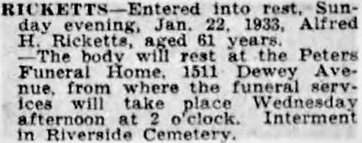
Figure 69 Democrat and Chronicle, 25 January 1933, p. 12.
Alfred Ricketts died a short time later in January of 1933.
Although the Democrat and Chronicle item announcing his funeral says that he was “aged 61 years,” he was actually 63 years old.
In fact, he was buried just a few days before his 64th birthday in Rochester’s Riverside Cemetery, where his remains were laid to rest alongside those of his son.
And so, the third golf professional hired to work in North America as such died without obituary notice, let alone an acknowledgement of his role as a true golf pioneer.
Penal Golf Course Architecture
When Ricketts left Wimbledon in March of 1893, inland golf course design was till a relatively new phenomenon, born of the spread of golf throughout the south of England beginning in the late 1880s.The sudden demand for inland golf courses gave rise to penal golf course architecture – the main tenets of which Ricketts applied in his design of most of the 13 holes he laid out on the Chelsea Links.
As we know, penal golf course architecture is associated with the design work of Scottish golf professional Tom Dunn, often called “the father of penal golf course design.” He was a leading figure in laying out inland golf courses far from the traditional home of golf on seaside links land. He was particularly instrumental in the building of new golf courses around London.
Dunn’s designs were distinguished by his tendency to dig across the entire width of a fairway a trench perpendicular to the line of play, heaping the earth from the trench into a wall on the putting-green side of the trench and filling the trench with sand. Any hazard spanning the width of a fairway was generally called a “cross bunker,” with Dunn’s version of the cross bunker often being called a turf dyke or cop bunker.
Tom Dunn said that he invented his famous cop bunker in 1890, when, “in laying out links … at Walton-on-Thames, he was compelled to invent a new kind of ‘hazard’” (Bournemouth Guardian, 1 December 1894, p. 3).
Dunn’s cop bunker turned out to be the simplest and most economical way for him to introduce hazards onto the generally featureless land where he was asked to build the majority of his inland courses:
Tom Dunn's courses were rudimentary given the lack of earth moving equipment available at that time.
His standard design feature was to lay out a ditch or bunker on the near side of the green, often right across the course, which had to be carried from the tee.
It was the same kind of carry for the second shot, and if the player had to hack out of the first bunker, the next hazard was in reach.
(Famous North Berwick Golfers http://www.northberwick.org.uk/dunn.html).

Figure 70 Willie Dunn, Jr, 1894.
One of Tom Dunn’s apprentices was his much younger brother Willie Dunn, Jr, with whom he built a golf course at Biarritz in 1889. Then, in the spring of 1893, the younger Dunn came to the United States to work as golf professional at Shinnecock Hills.
There, he immediately constructed in front of the green on what was Willie Davis’s 2nd hole in 1891 (but which became John Cuthbert’s 5th hole in 1892) a hazard that would become one of Dunn’s most famous cop bunkers.
Seen below, it became known as “The Bastion Bunker” (although some other contemporary reports refer to it as the “Zigzag Bunker”).

Figure 71 An example of a Willie Dunn cross bunker at Shinnecock Hills: "The Bastion" or "Zigzag Bunker." Illustrated American, 27 October 1894, p. 1029.
After Dunn added six holes in the spring of 1895 to make Shinnecock Hills an 18-hole layout, the Dunn family’s cop bunker became a staple feature of this course, as Garden Smith observed in 1898: “The embankment of the Long Island Railway (which is crossed four times) and artificial cop bunkers are the principal difficulties of the course” (Garden Smith, The World of Golf [London: A.D. Innes & Co, 1898], p. 259).
Willie Dunn immediately began designing golf courses for other golf clubs and for wealthy members of the American leisured classes. Everywhere he went across the United States and Canada in the 1890s and early 1900s, he laid out courses according to the principles of penal design theory and effectively introduced throughout North America the Dunn family’s cop bunker as the default cross bunker for land without natural hazards. Seen below are two of the cop bunkers on the private course that he laid out in the mid-1890s for William Bayard Cutting at Islip, Long Island, New York.

Figure 72 Two of Willie Dunn's cop-bunkers at the Westbrook Golf Club, Long Island, New York, circa 1895.
Cop bunkers were intended to prevent a player caught within one from advancing the ball very far – if at all. Exemplifying the main precept of penal golf course architecture, the cop bunker was designed to punish golfers who could not get the ball into the air to get over it.
Penal design theory emerged from the general conviction, at a time when championship golf was almost exclusively decided by matchplay, that it was unfair on a two-shot hole, for instance, to allow players first to top a drive then to top a fairway shot and yet still roll the ball onto the putting green with two bad shots, thereby having a chance to be “level” with the player who had reached the green with two proper shots.
In 1896, Willie Park, Jr, gave voice to the widespread disdain for such holes by referring to them as “what has not inaptly been termed ‘levellers’ – that is to say, the ball can be driven on the green in two strokes by anybody” (Willie Park, The Game of Golf [London: Longman, Green and Co., 1896], p. 200).
And so, penal golf course architects made sure to arrange for each hole at least one hazard stretching across the entire width of the fairway. A ditch, gully, creek or small pond might serve just as well as a cop bunker, and so might a wooden fence, stone wall, road or railroad. (Recall that since none of these obstacles was purpose-built for golf, they were all regarded as equally “natural” hazards.) When “nature” failed to provide a fairway-wide obstacle, the Dunns built a cop-bunker – one on a one-shot hole, two on a two-shot hole, and three on a three-shot hole – to punish the player for each shot that failed to get into the air.
So ubiquitous was the application of these design principles in the 1890s and early 1900s that a person playing a golf course for the first time could tell the par score of any hole by counting the number of cross bunkers on it: par equals the number of cross-bunkers plus two strokes for putts.
By the late 1890s, because of Dunn’s influence, building a golf course in North America according to any other philosophy than that of “penal” design theory was not easily conceivable. For instance, in his advice on how to build a golf course in his 1898 book Golf, Garden G. Smith writes as though “penal” design is the only design possible:
Supposing a hole be 250 yards in length (measured from the teeing-ground), there should be a hazard of some sort extending right across the line of the hole, about 100 or 130 yards from the tee.
Beyond this the ground should be good; but, guarding the hole again, and some 30 or 40 yards in front of it, there should be another hazard which the player would have to carry before reaching the putting green.
(Garden G. Smith, Golf [New York: Frederick A. Stokes Co, 1898], p. 10)
Similarly, in the 1897 second edition of Wright & Ditson’s Guide to Golf in America, there was a new section on how to build a golf course, and in it we see the same penal assumptions. First, golfers must always be required to carry the golf ball over hazards: “the hazard to be surpassed … should be sometimes near the teeing-ground and sometimes at nearly a full drive’s distance from it”; but “there should be always some hazard or bunker to trap a poorly played drive.” The Guide explains that “where nature, by some oversight, has forgotten to provide hazards or bunkers, they should be built by man.” The kind of obstacles recommended shocks a modern golfer: one option was “wooden hurdles with sloping sides” (a problem being that the obstacle does not always work, for “the ball often strikes them and bounds over on the other side”); another option was “building hedges of branches, such as are used in hurdles of steeplechasing” (the problem being that “the ball is apt to be lost in them or creep into such a nook as to be unplayable”). And so, the Dunn family’s cop bunkers were preferred:
The best [hazards] are made by building a pile of earth work, about waist high and with sloping sides….
The trench behind the mound should be filled with loose sand, if possible, as … it is less unpleasant to play a ball out of sand than out of the mud that is sure to collect in such a place in wet weather.
This bunker may be either in a straight line across the course, or in a zig-zag pattern like the lines of a fortification.
(Guide to Golf in America [Boston: Wright and Ditson, 2nd ed. 1897], pp. 29-35).
Similarly, in “Bunker Building on American Links,” an anonymously written newspaper article widely published in 1901, we see how standard the Dunns’ version of penal golf course architecture had become:
Take a 150-yard hole …. If there are no natural hazards, it is advisable to place two cop-bunkers 110 yards from the tee, side by side clear across the course. About onefourth of the bunker in front should overlap one-fourth of the other, leaving a path [for golfers] running sideways, and not straight for the hole, to prevent balls rolling through.

Figure 73 The 8th hole at the Flushing Country Club, Long Island, New York, designed in 1901 by John Duncan Dunn (a nephew of Tom and Willie Dunn) and Walter J. Travis. Note the pathways to allow golfers through the cop bunkers. Golf (New York), vol 9 no 1 (July 1902), p. 11.
Each of these bunkers should cover one-half of the width of the course.
The trap should be twenty feet wide and two and one-half feet deep, while the height of the cop should be three feet….
For a hole 340 yards long, the theoretical arrangement of artificial hazards would be:
Place two bunkers two feet deep, end for end eight[y] yards from the tee, with cops eighteen inches high to catch topped or foozled drives….
For variety, and in order to add to the picturesqueness of the course, mounds [turf dykes, instead of cop bunkers] are sometimes erected to guard the green. They should be placed 285 yards from the tee, and built about six or eight feet in height, twelve feet wide, and extending almost across the course. The end of one mound should overlap the other with a patch between, running sideways [for golfers to walk through] ….
The player who can consistently negotiate a 500-yard hole laid out as follows in anything like bogey figures should make a dangerous opponent:
Build a cop in two sections about three to five feet high, with a shallow bunker in front, extending across the course about fifty yards from the tee….
About 240 yards from the tee, it would be advisable to place a cop bunker twenty feet wide, three feet deep, and as long almost as the width of the course will permit. This bunker should be built in the shape of a half moon and have two paths running through it [for golfers] ….
Within fifty yards of the hole, an ordinary cop-bunker should be placed clear across the course to protect the green.
(Inter Ocean [Chicago], 19 May 1901, p. 49)
We recall that Ricketts used these kinds of cross bunkers at Rochester. At the Genesee Valley Park course in 1901, we read, “Ricketts, of the Rochester Country Club, has promised to make a careful inspection of the course and give his opinion as to where it is advisable to raise bunkers” (Democrat and Chronicle, 5 April 1901, p. 13). At the Country Club in 1903, we read, “bunkers are to be erected, the sand pits dug out” (Democrat and Chronicle, 15 March 1903, p. 19, emphasis added). Although we would speak today of digging or excavating bunkers, one spoke of raising and erecting bunkers in the late 1890s and early 1900s because the Dunn family had established the raised bank of earth (the “cop”) as the defining feature of bunkers.
As we shall see, Ricketts seems to have designed a cop bunker to face the second shot on the 9th hole of the Chelsea Links.
13 Holes
After the first round of matchplay in the Canadian Amateur Golf Championship held on the Chelsea Links at the end of September 1899, one of the rare Canadian reporters in the 1890s who actually knew the game well described the Ottawa golf course:
The Ottawa links are about average in terms of difficulty. The turf … is good, and they are taken all around as splendid links.
Properly speaking, they are a thirteen-hole links, the 18 holes called for in championship matches are made in playing over the first five holes a second time.
The 18-hole course comprises 5,002 yards …. (Ottawa Journal, 28 September 1899, p. 3)
Curiously, despite such an authoritative statement by a contemporary eyewitness, the Chelsea Links have regularly been described by later writers as comprising just 12 holes.
Today’s Wikipedia entry makes this claim: “The club moved to a new site in the Province of Quebec, just across the Ottawa River … along Chelsea Road …. This course consisted of 12 holes, of which six had to be played twice to comprise an 18-hole round” (Wikipedia site accessed 3 December 2025).
When Canadian Golfer editor Ralph Reville visited Royal Ottawa in the spring of 1917, he made the same claim: “The Chelsea Links were a great improvement on those of Sandy Hill; still, they only admitted of 12 holes …. Six of those holes were completed to make a full round of 18 holes” (Canadian Golfer, vol 3 no 2 [June 1917], p. 89). It turns out that he had recycled this information word-for-word from a 1910 article in the Ottawa Journal (“Re-Emergence of the Ottawa Golf Club,” Ottawa Journal, 3 December 1910, p. 2).
And it turns out that this 1910 article took its information from a 1909 Ottawa Journal article said to have been authored by founding member “Lt.-Col. D.T. Irwin”: “The Chelsea Links were a great improvement on those in Sandy Hill but were only large enough for 12 holes” (Ottawa Journal, 13 December 1909, p. 17). But it turns out that these words were not really Irwin’s words after all; they were lifted word-for-word from a brief item published in the Ottawa Journal two months before: “Although the Chelsea Links were a great improvement on those at sandy Hill, they were only large enough for 12 holes” (“Golf Club History: Story of Inception and Progress of Club Which Owned Burned Buildings,” Ottawa Journal, 21 October 1909, p. 6).
Although the source of the claim is unknown, it seems to be one person’s statement that is repeated over and over again in these 1909 and 1910 articles.
A 1904 article in the Ottawa Journal,” called “Some History of Progress of Golf in City of Ottawa,” made the same claim: “There was a course of 12 holes laid out” (Ottawa Journal, 10 September 1904, p. 15).
The earliest reference to the Chelsea Links as a 12-hole course comes in an 1898 article called “Canadian Golf” published in the American magazine Outing in which John P. Roche reviewed the history of Canada’s main golf clubs:
Shortly after the commencement of the season of 1896, it was found necessary to abandon the [Sandy Hill] clubhouse and links hitherto used and links were obtained on the Chelsea Road and the old Bingham [sic] homestead was occupied as a clubhouse.
A course of twelve holes was laid out, crossing the Chelsea Road and the railway twice in the round, and the course remains practically the same as used at present.
(Outing, vol 32 no 3 [June 1898], p. 263).
Since the Ottawa Journal reporter cited at the beginning of this chapter says that the Chelsea Links had 13 holes in September of 1899, whereas Roche writes in the spring of 1898 that the course had 12 holes, could a 13th hole have been added between 1898 and 1899?
No.
We know that the course had 13 holes in 1897, for at some point during the fall and winter of 1897-98, Club Secretary Alexander Simpson wrote to the editor of Golf (New York) and explained that the Chelsea Links had 13 holes. As we know, editor Newman’s comprehensive and detailed account of when each Canadian club was founded, who laid out the course, the number, names, and length of the holes, names of committee members, course records, and so on, suggests that he researched this article throughout the fall and winter of 1897-98, and so the information he received from Simpson apparently referred to the Chelsea Links as they existed in 1897.
Regarding the 1897 Ottawa layout, Newman informs readers that “This well-kept course … numbers 13 holes, the first five being played a second time to complete the full round of 18 holes” (Golf [New York], vol 2 no 4 (April 1898], pp. 12-13). Newman then names the 13 holes and indicates the length of each of them. The 13th hole was called “Home” – the traditional name of the last hole on a golf course – and it was one of the two shortest holes on the course: each 153 yards long.
There is no doubt that from at least 1897 to 1899, the Chelsea Links comprised 13 holes.
In September of 1899, a writer for the Ottawa Citizen reported on each of the 13 holes in a description of the course published just before the Canadian Amateur Golf Championship tournament began at the end of that month. He fully describes the first 12 holes, and then he describes a thirteenth hole different from any other hole: it is the only par-3 hole among the 13 holes and he calls it 18: “The eighteenth hole, 165 yards, rough ground and ditch before drive. Par play 3” (Ottawa Citizen, 26 September 1899, p. 6). It is the shortest hole on the course.
The Ottawa Citizen writer seems not to have been a golfer and may not have recognized that some of the things he said about the golf course were incoherent.
For instance, although describing 13 distinct holes in detail, he blithely – but perversely – also writes: “The course consists of only 12 holes at present. The 18 holes are completed by playing the first five over again and then playing from the fifth to the twelfth” (Ottawa Citizen, 26 September 1899, p. 6).
One wonders how on earth the reporter did not recognize that he had described 13 holes – not 12. Could his statement that “the course consists of only 12 holes at present” have been a misprint of 12 for 13?
Yet if the reporter somehow really meant to say that the course had 12 holes, he seems not to have recognized that his statement that “the 18 holes are completed by playing the first five over again” makes no sense: one cannot get to a total of 18 holes played by playing 12 holes and playing “the first five” again.
And his statement that golfers proceeded “by playing the first five over again and then playing from the fifth to the twelfth” is just plain wrong. We know from accounts of play in 1899 that golfers did not play 1 to 5 and then immediately play 1 to 5 again, and only then play on to the 12th . They played 1 to 12, then played 1 to 5 over again as 13 to 17, and concluded the round by playing a new hole as the 18th .
The Ottawa Citizen reporter in question sucked at math and he did not understand what he had been told about the order in which the holes were played to make up an 18-hole round. He did not know golf. I wonder if he was among those he describes as not liking golf:
Golf is not popular with a number – largely for two reasons.
There is, first, no opportunity for brute strength. There is a certain amount of strain, but a steady hand, sure eye, and calm, cool nerves are the main requisites of a good golfer.
The second objection to the game is that it is not a sociable one.
There are team matches, but the members are pitted alone against their opponents. They have no clubmates near them to extend sympathy, encouragement, or congratulation, and they do not know until all the pairs are in whether their side has won or not.
(Ottawa Citizen, 26 September 1899, p. 6)
Still, we must be grateful for this reporter’s detailed account of each of the 13 holes that Club members described for him.
Fortunately, a Globe reporter sent to watch the championship matches on the Chelsea Links reported on every stroke made by Vere C. Brown and Stuart Gillespie on 29 September 1899 and his report makes absolutely clear that the Chelsea Links comprised 13 distinct holes, that golfers first played from 1 to 12 and only then played 1 to 5 over again, and that golfers completed their round – if their matchplay contest required an 18th hole – by playing another hole (a distinct 13th hole) as the final hole of the round (Globe [Toronto], 30 September 1899, p. 25).
Note, however, that since this hole never followed the 12th hole as the 13th hole in a round of golf, Club members always referred to it as the 18th hole. It was therefore given the most common name for the last hole on a golf course: “Home” (Golf [New York], vol 2 no 4 (April 1898], pp. 12-13).
Jennifer Mirsky, Chair of the Royal Ottawa Golf Club Heritage Committee, recently drew my attention to the fact that Club minutes in 1901 record that when the Executive Committee “resolved that … the following official … [hole by hole] score has been agreed to by the members of the committee,” it indicated that “Hole No. … 18 = 3” (Minutes, Executive Committee, Ottawa Golf Club,1901, provide by Jennifer Mirsky, email to the author, 14 February 2026).
As was the case when the Canadian Amateur Golf Championship was played on the Chelsea Links in September of 1899, so during the 1901 season, the 18th hole was the only 3-stroke hole on the course (there were three 5-stroke holes, nine 4-stroke holes, and one 3-stroke hole). I presume that this 1901 3-stroke 18th hole is the same 3-stroke 13th hole described by Newman in 1897 and the same 3-stroke 18th hole described by the Ottawa Citizen reporter in 1899.
According to the 1901 Executive Committee minutes, the Chelsea Links seems to have been played that year just as it had been in 1899: holes 1 to 12 were followed by a replaying of holes 1 to 5 as 13 to 17, and then the round was completed by playing the unique 3-stroke 18th .
That the Chelsea Links comprised 13 holes for its entire duration – and that the 13th hole that was known as the 18th hole was the 13th hole all this while – is perhaps suggested by a curious “backwards” tournament played at the Club in September of 1902.
Playing a course backwards involves starting from somewhere in the 18th fairway and playing to the 17th green, then teeing somewhere in the 17th fairway and playing for the 16th green, then teeing somewhere in the 16th fairway and playing for the 15th green, and so on, until one completes the round by playing from somewhere in the 1st fairway to the 18th green.
The account of the Club’s 1902 “backwards” tournament is brief:
ON THE LINKS
Ottawa Club’s Handicap
The autumn season of the Ottawa Golf Club opened yesterday amid circumstances of the most perfect nature. The links were never in better condition ….
Play commenced at the 18th hole and the course was played backwards.
Although confusing for a while, the members soon caught on to this arrangement of things and the play thereafter was first class.
(Ottawa Journal, 2 September 1902, p. 10)
Of course, the Chelsea Links did not have 18 holes. But as we know, it had a 13th hole that was never played as hole 13 because it was used only as the final hole in an 18-hole round and therefore had always been called the 18th (or “Home”) hole.
Is the reference to “the 18th hole” in the 1902 newspaper item cited above a reference to the 165-yard three-stroke 18th hole?
It is a great mystery why, after the club moved to its Aylmer Road site, the Chelsea Links was never remembered as having had 13 holes. And considering the above information about the course having had 13 holes from at least 1897 to 1901 (and probably for its entire life from Ricketts’ 1894 layout to 1903), it is perhaps just as great a mystery why the Chelsea Links was ever thought to have had just 12 holes.
Note that since matchplay was the favoured form of competition in the 1890s and early 1900s, Club members played the 18th hole much less often than they played the main 12 holes. That is, most matchplay contests ended without the need to play the 18th hole.
Did the “Home” hole thereby acquire a lesser standing in members’ minds? Was it perhaps implicitly regarded by members as an auxiliary hole? If so, could this be the reason that it lapsed from collective memory?
Bogey and Par
In September of 1899, the Ottawa Citizen reported that the 1st hole of the Chelsea Links was 290 yards long and observed the following: “Par play for this hole is 4 strokes” (Ottawa Citizen, 26 September 1899, p. 6, emphasis added).
And yet in 1903, it was also said that a score of 4 on the first hole was “the bogey score”:
GOLF
Mr. B.T.A. Bell, playing with Sheriff Sweetland yesterday afternoon, holed out the first green in two, which is a record for the Chelsea Links.
The bogey score for the first hole is four. (Ottawa Citizen, 1 April 1903, p. 6, emphasis added)
How could the score of 4 on the 1st hole have been both par and bogey?
Note that the hole had not been shortened between 1899 (when par play was 4) and 1903 (when the bogey score was 4). Bell’s feat of making 2 on this hole was said to have been the first time this had been done on the Chelsea Links. Since the score of 2 had been made on the one-shot 18th hole many times, we know that Bell’s unique achievement was holing out a second shot on a two-shot hole.
If anything, rather than having been shortened since 1899, the 1 st hole may have been lengthened a bit, for in 1901, when a member introduced that year’s new revolutionary rubbercored golf ball on this hole, P.D. Ross said the length of the 1st hole was “300 yards” (Ottawa Journal, 4 September 1943, p. 19).
Although according to our contemporary understanding of golf concepts and golf terms, the par score and the bogey score for a hole are not the same (the bogey score is one stroke higher than the par score), it turns out that in the late 1890s and early 1900s, par and bogey were regarded by most golfers as synonyms.
The Ottawa Golf Club was the first North American golf club to encounter the concept of bogey. In the spring of 1893, as the Club prepared to begin its third season, we learn from the newspapers of a peculiar competition scheduled for later in the year: “The season’s matches include weekly handicaps with prizes, semi-monthly competitions to decide the [Club] championship (and the holding of the Gilmour Cup), a valuable cup donated by Col. Allan Gilmour, and a ‘Bogey’ competition” (Ottawa Free Press, cited in the Montreal Star, 2 May 1893, p. 5, emphasis added)
The information contained in this item in the Ottawa Free Press – including both the quotation marks around the word “Bogey” to mark it as a neologism and the capital letter that marks the word “Bogey” as a name – was no doubt supplied to the newspaper by the Secretary of the Ottawa Golf Club, Alexander Simpson.
The word “Bogey” had been introduced to golf in England less than two years before it was used for the first time in North America by the Ottawa Golf Club. And, as we shall soon see, the idea of a “Bogey” score became associated with one of the most important concepts ever developed in golf – the idea of a proper score for a golf hole (and thereby a proper score for a complete round of eighteen holes), the idea we now call par.
But in the early 1890s, two decades after its invention in 1870, the concept of “par” had still not caught on with golfers. And when the concept of Bogey was invented in 1891 (in support of a new form of competition that it enabled), it immediately became more famous and more popular than the concept of par had ever been.

Figure 74 Late 1890s Royal Montreal Golf Club scorecard.
For the first 500 years of golf history, there was no such thing as a par score for a golf hole or for a golf course. The goal of the golfer was simply to take as few strokes as possible to complete a golf hole.
For neither a golf hole nor a golf course was there recognized a theoretically proper number of strokes that a first-class golfer should take in completing them.
Note the 1890s Royal Montreal Golf Club scorecard seen to the left, which, like most scorecards of the day, indicates no par score for any hole. Since what mattered was simply the number of strokes a golfer took on each hole, there was no use for a number on the card to indicate a theoretically correct number of strokes that should have been taken.
After the concept of a “Bogey” score was invented in 1891, however, it encouraged golfers to think about the score that should be made on their golf course by a person playing proper shots. The idea of a Bogey score became so popular that by the turn of the century, the Bogey score for each hole began to be marked on scorecards. Par figures on scorecards had not yet appeared and their appearance would be delayed by a preference for the term “Bogey” over par that endured well into the twentieth century. Note, for instance, that at the Country Club of Brookline in 1913, the scorecard on which golf writer Bernard Darwin recorded young American amateur Francis Ouimet’s scores during his US Open playoff victory over English professionals Harry Vardon and Ted Ray indicates for each hole not a par score, but a Bogey score.

Figure 75 Francis Ouimet’s scorecard for the playoff with Harry Vardon and Ted Ray, 20 September 1913.
The word “par” was first used in reference to a golf score in a discussion amongst some of the top competitors at the 1870 Open Championship in Prestwick, Scotland.
Before and during the competition, two top amateur players of the day, brothers Alexander Hamilton Doleman and William Doleman, shared a cottage at Prestwick with three of Scotland’s leading professional golfers: Jaimie Anderson, Davie Strath, and Young Tom Morris. It was generally assumed that one of these three accomplished young professionals would win the championship, Young Tom having won the previous two (and he would win his third in a row that year, thereby earning permanent possession of the Championship Belt).
One night, talk amongst the housemates turned to the question of what the professionals thought the winning score would be. American golf writer Charles Quincy Turner summarizes the conversation that ensued:

Figure 76 David Strath (1849-79).

Figure 77 James Anderson (1842- 1905).

Figure 78 William Doleman, 1880.

Figure 79 Young Tom Morris (1851-1874).

Figure 80 A.H. Doleman, circa early 1890s.
Davie Strath, Jamie Anderson, Tom Morris, Jr., and the brothers Doleman were staying in the same cottage, when naturally they fell to discussing what score ought to win on the morrow. Some said one thing, some another. At length William Doleman, so says his brother A.H., asked Davie Strath and Jamie Anderson what a certain hole should be done in, if played correctly.
Davie Strath gave the required number at once.
“Ah!” says Jamie Anderson, “that’s a’ very guid, but what about a bad lyin’ la’?”
“Tut! Tut!” says Davie, “that has naethen’ tae dae wi’ it, Jamie; that’s the number you should do it in.”
And Davie laid great stress on the “should.”
By degrees M[r]. W. Doleman led the professionals on to give the “should” for all the other holes.
And this ideal, or perfect, round was found to be 49 for the twelve holes.
And then says Davie, “That is the number we should do it in, if we play perfect golf, but I know we won’t do it.”
While Davie was still talking, in walked Tom Morris, Jr.
And hearing what Strath was saying, he shook his head, smiled, and then said, “We’ll hae to try ony how.”
And Young Tom did try, and made a noble effort, coming within two strokes of perfect golf by holing the thirty-six holes in 149 strokes, very nearly an average of fours.
Mr. A.H. Doleman, thinking it would be a good thing to have some word to indicate the required number of strokes for a hole, and so for the whole round, on an infallible principle, chose the word “par.”
(Golf [New York], vol 14 no 2 [February 1904], p. 100)
A.H. Doleman had chosen the word “par” for the number of strokes that a hole should normally take because this number struck him as analogous to the price used to indicate the “par” value for a stock certificate.
A corporate charter indicates the original or nominal value of shares issued for purchase. In the stock market, however, shares may sell for a price higher or lower than the “par value.”
Similarly, golfers can make a score on a golf hole higher or lower than its “par value.”
Between 1870 and 1890, the term “par” is rarely encountered in writing about golf. The most important factor in keeping the concept of par from gaining popularity was that it had no practical implications for the playing of the game.
Golf culture in Scotland had from the beginning understood matchplay to represent the essence of the game. Contests among members of golf clubs were conducted by matchplay. Team contests between golf clubs were conducted by matchplay. The nineteenth century’s many famous, high-stakes matches between the top professionals were conducted by matchplay (before hundreds – and sometimes thousands – of spectators).
Matchplay required no concept of par, and it gained nothing from it.
In those days, medal play (stroke play) was regarded as a necessary evil – a departure from matchplay made necessary by a large field of competitors: medal play was merely a practical and convenient way of determining a champion from a large number of players in a much shorter time than matchplay among them would require. Obviously, since the winner was the one who completed the course in fewer strokes than any other competitor, medal play also required no concept of par and gained nothing from it.
Note that the idea of using a universal standard of par as the basis for handicapping golfers did not occur to anyone until the mid-1890s and an acceptable system for doing so was not worked out until the early 1900s.
And so, for the first twenty-five years of its existence, the concept of “par” seemed to be literally useless.
The invention of the concept of “Bogey” in 1891 changed everything.
As Robert Browning points out, in 1891, the concept of a proper score for the golf ground of the Coventry Golf Club was calculated by the Club’s Secretary, Hugh Rotherham, to enable a new form of competition he invented (Robert Browning, A History of Golf: The Royal and Ancient Game [1955; reprinted Pampamoa Press, 2018]).

Figure 81 Hugh Rotherham. Golf Illustrated, vol 2 (22 December 1899), p. 283
Rotherham had set himself the task of considering whether a way might be devised for a large number of people to engage in matchplay competition such that a winner might be determined after a single eighteen-hole round played by all contestants on the same day.
As things stood up to 1890, if (say) sixty-four club members were to engage in a match-play tournament, it would take at least three days of matches, comprising two eighteen-hole rounds per day, to determine a winner.
Rotherham recognized that, in theory, were each contestant to compete simultaneously in a match against a common opponent, their relative performances against this person could be measured in terms of how many holes each of them won or lost against him. The person who won the most holes from (or lost the fewest holes to) this common opponent would win the day’s competition.
Rotherham’s ingenious insight was that the common competitor requisite for such a contest need not be real: for each hole on the golf course, a score could be recorded ahead of time as the score achieved by an imaginary opponent with whom each club member would then compete in matchplay.
What scores should be recorded ahead of time for this imaginary opponent?
Rotherham decided to attribute to his fictitious golfer the scores that the Club’s best amateur golfers tended to make at each hole, provided they made no serious mistakes. By February of 1891, he had determined such scores for each hole of the Coventry golf ground, thereby determining what he regarded as a proper score for a complete round of golf as played by his imaginary golfer. He called this score the Coventry “ground score.” Conceived as a proper score against which players could measure their performance in competition, it was the first meaningful application of a concept resembling par.
The first tournament that the Club conducted based on each golfer’s match against the hole-byhole scores recorded for this imaginary competitor occurred in the second week of May in 1891:
An interesting competition was played on the Coventry links on May 13th, for a handsome prize given by Mr. Hugh Rotherham.
The scratch score of the holes had been fixed, and each player played a match against the ground score under handicap.
The arrangement was found to be an excellent one, enabling a match-play competition to be finished in the day.
(Golf [London], vol 2 no 36 [22 May 1891], p. 173)
Less than a week after this innovative form of golf competition was introduced, Coventry Golf Club member Harold Smith (who had finished third in the inaugural tournament) passed along news of the innovation to the Great Yarmouth Golf Club: “I introduced Mr. Rotherham’s system of playing against an imaginary fixed score for each hole to several members of the Great Yarmouth Golf Club at their Whitsuntide [i.e., mid-May] meeting in 1891” (Golf [London], vol 3 no 78 [11 March 1892], p. 410).
As was required to enable this system of single-day matchplay competition, the Club Secretary, Dr. Thomas Browne (a surgeon in the Royal Navy), worked out the requisite “ground score” for the Great Yarmouth golf course and golfers immediately began informally to compare their score at each hole to the scores making up the theoretically proper ground score.

Figure 82 Dr. Thomas Browne, Golf Illustrated, 11 July 1902, p. 28.
The reaction of golfers to the difficulty of achieving these scores soon resulted in the name “Bogey” being given to the imaginary opponent against whom golfers competed.
This name was first invoked by one of Browne’s regular playing partners, a good golfer who became determined to match the Great Yarmouth ground score. Enjoying the challenge but frustrated one day to the point of exasperation at being unable to match the scores stipulated for Browne’s imaginary player, he erupted: “This player of yours is a regular Bogey man!”
He was alluding to a song popular in the early 1890s, “Hush! Hush! Hush! Here comes the Bogeyman!” The lyrics describe a mischievous, timorous, hard-to-catch goblin:
Children, have you ever met the Bogeyman before? No, of course you haven't for You're much too good, I'm sure; Don't you be afraid of him if he should visit you, He's a great big coward, so I'll tell you what to do:
Hush, hush, hush, here comes the Bogeyman, Don't let him come too close to you, He'll catch you if he can. Just pretend that you're a crocodile And you will find that Bogeyman will run away a mile.
Browne immediately proposed that the imaginary, mistake-free golfer against whom they were competing be named “Mr. Bogey.” The name became popular, and within months the “ground score” at Great Yarmouth and elsewhere became known instead as the “Bogey” score.
Then, in the fall of 1891, Mr. Bogey joined the armed forces.
An anonymous member of the United Service Golf Club of Gosport, which was organized for the exclusive use of members of the military, wrote to the editor of Golf (London) to explain Mr. Bogey’s commission:
Bogey was introduced to the members of the United Service Golf Club some months ago by the well-known secretary of the Great Yarmouth Golf Club, Dr. T. Browne, R.N.
The versatile sportsmen of the United Service Golf Club were not long in trying a taste of his [i.e. Mr. Bogey’s] quality, much to their discomfiture at first, as they did not realise sufficiently that “Bogey” is a player who cannot lose his temper, or be in any way demoralized….
“Bogey” assumed the designation of Colonel on admission to the United Service Golf Club, as naval or military rank is an indispensable qualification for its membership….
Joking apart, the advent of “Colonel Bogey” seems likely to introduce a new and permanent feature into the game of Golf. By using him as an intermediary, one can compete with the whole field simultaneously by match, instead of medal, play….
It appears to me, then, that the so-called “Colonel Bogey” is destined to take and to hold a permanent place in the game of Golf, and to add some fresh and interesting features to the noble art.
(Golf [London], vol 3 no 76 [26 February 1892], pp. 384-85)
By 1892, the name “Colonel Bogey” was coming to be used in preference to “Mr. Bogey” by golfers at the several golf clubs in the south of England where Bogey competition had gained a foothold.
Was there a difference between Colonel Bogey’s score and a par score?
On the one hand, committees determining a Bogey score for their golf course tended not to regard Colonel Bogey as having the ability of the first-class players who competed annually at the Open Championship. He was modelled, instead, on each club’s scratch player, for the latter’s score was the one by which members’ handicaps were calculated. A club’s scratch player, however, was simply the club member who shot the lowest scores on the club’s course: regardless of whether this player’s average low score was 75, 85, or 95, he or she was denominated a “scratch” player. Consequently, the “scratch” standard varied from club to club, and so, Colonel Bogey’s ability was defined differently by each club.
On the other hand, the way of calculating par was seen as insufficiently elastic for calculating a Bogey score. The Doleman brothers’ par score was determined by an abstract mathematical calculation: say a first-class player can hit a drive up to 200 yards; say a first-class player can hit a fairway shot up to 180 yards; divide the yardage of a hole by these distances, add two putts per hole, and you have par scores. The identical formula was applied to all golf courses. But since golfers competing against Colonel Bogey played the game on soft or hard golf courses, in strong prevailing winds or in no wind, in rain or shine, going up hill or down, and so on, the influential editor of Golf (London), A.J. Robertson, recommended that committees not adhere to a “Bogey principle” based on the mathematical abstractions of par calculations but rather reckon Bogey scores according to local playing conditions:
[By some committees,] A “Bogey” score is compiled by taking every hole at its par value, that is to say, in the number of strokes that a scratch player at the top of his game will hole them in.
Such a scratch score is the ideal round of the green, and takes no account of variations in the weather, such as wind and rain, or the heaviness of the course.
In this lies the defect of the “Bogey” principle, because the score is invariable, while the actual competitors are handicapped seriously in playing down to a score which is fixed under the most favourable auspices in which the game can be played.
It is, therefore, better to allow a few more strokes on the gross total of the “Bogey” score to meet these variations.
(Golf [London], vol 8 no 193 [25 May 1894], p. 197)

Figure 83 A.J. Robertson. Golf Illustrated, vol 1 no 3 (30 June 1899), p. 77.
Robertson found conflation of the concept of a Bogey score with the concept of a par score so common that he felt compelled to return to the subject later the same year:
[For many,] “Bogey” is the par round of the green, or, in other words, the ideal scratch score.
It is always better, however, to allow an extra stroke or two; so that, if the ideal round, without a mistake, is 78, “Bogey” ought to be fixed at 80 or 81, which would correspond to the very best score of a scratch player.
(Golf [London], vol 9 n0 229 [30 November 1894], p. 215).
The question for each golf club committee to decide was where Colonel Bogey would take more strokes than par to complete a hole.
Inevitably, committees debated long and hard about how many strokes it should take Colonel Bogey to play this hole or that.
In Golf Illustrated in 1899, golf writer W.L. Watson gave vent to frustrations arising from his long experience of these sorts of committee arguments at the West Middlesex Golf Club where he was a member:
The bogey score is not a score at all; it is the product of some imaginary player and the predilections of the club committee.
It is usually arrived at by count of hands.
If a majority decided that any particular hole is too difficult for four, they make it five.
Approaching the matter from the other point of view, they may resolve that it would be too easy in five and so make it four.
That is bogey; he is really not a bogey at all, but merely a mild-mannered abstraction of votes and opinions, ready to change his play at any committee’s bidding, and hole out in any number of strokes they may suggest….
A most complacent fellow he is, but certainly no bogey, rather a timorous, middle-aged fool.
(Reprinted in Golf [New York], vol 5 no 6 [December 1899], p. 398)

Figure 84 Colonel Bogey in the Game of Sporting Snap deck of playing cards, Major Drapkin & Co., 1928.
Whereas Watson’s West Middlesex committee was used to these sorts of meetings, the Ottawa Golf Club, going through the process for the first time in 1893, must have found the whole business complicated, disorienting, and frustrating.
It was Alfred Ricketts who guided the committee through this process. In March of 1893, he had brought knowledge of Bogey to Ottawa a year before news of the Colonel reached any other North American golf club.
Within six weeks of his arrival, Ricketts had persuaded the Ottawa Golf Club’s executive committee to include a “‘Bogey’ competition” in its fixtures list for 1893.
Perhaps Ricketts promoted this innovative form of matchplay in response to the expectation that he would help to “boom” the game in Ottawa, for he certainly knew how popular Bogey competitions had become in England.
By the end of April of 1892, Bogey was known only in England, and only to members at Coventry, Great Yarmouth, “the United Services Golf Club, as well as some other southern clubs” (Field, vol no 2052 [23 April 1892], p. 594). Ricketts’ Royal Wimbledon was one of the “southern clubs” that had among its members a number who were strong advocates of Bogey competition. In fact, one of the members of Royal Wimbledon was promoting Bogey competition at the club by late 1891 and even wrote to the editor of Golf in January of 1892, calculating a Bogey score for the Wimbledon course, and recommending Bogey scores be established everywhere as a way for single golfers to play a round of golf quicker than they otherwise might:
I am very pleased to see that the “Bogey” play is coming more into fashion, and to see in your interesting paper some competitions played under that system.
It savours more of the legitimate match play and makes a little change from the long and tedious medal rounds.
I also strongly recommend it to those players who are so fond of toiling around by themselves, keeping their correct scores, thereby blocking up the greens and proving themselves a nuisance to many.
I do not mean that I advocate single play, but that I think that anyone who prefers that way of practice can get along much faster on the “Bogey” plan and so help less to block up a green.
(Golf [London], vol 3 no 71 [22 January 1892], p. 302, emphasis added)
Since when playing against Colonel Bogey, golfers would not be playing for the sake of a proper medal score, golfers could pick up their ball after the hole had been lost to the Colonel instead of holing out on each green for the sake of a proper score and infuriating people in the group behind who were waiting to play as a golfer sank a long putt for a 9.
As we know, Royal Wimbledon also had a thriving women’s club that had its own course, and it was on this course that the Wimbledon Ladies’ Golf Club played a well-organized Bogey Competition in mid-November of 1892. It drew over forty entrants (twice the number of playing members at the Ottawa Golf Club at this time).
We can see, then, that during his last two years at Wimbledon, Ricketts would have learned a good deal about this new method of golf competition. Still, it would take him a whole season at Ottawa to set up the first Bogey competition to be held in North America: announced in May, the tournament was held in November.
And it is clear that this tournament was Ricketts’ baby: “On Saturday next the ‘Bogey’ competition for the handsome prize given by A. Ricketts will take place”; “The ‘Bogey’ competition for the Ricketts prize will take place this afternoon at 2:30 sharp” (Ottawa Daily Citizen, 1 November 1893, p. 5; Ottawa Daily Citizen, 4 November 1893, p. 5). Ricketts played in many competitions over his three years at the Club from 1893 to 1895, yet this was the only competition for which he purchased the prize himself. Just as at Coventry Hugh Rotherham was the only one to step up and offer a prize for the new form of competition he had invented, so at Ottawa, Ricketts was the only one to step up and offer a prize for the new form of competition he had introduced.
In 1894, mind you, the Ottawa Golf Club held a second Bogey competition on the Sandy Hill course. This time, the prize was offered by A.Z. Palmer. He seems to have become enamored of this new form of competition, for we find him later offering a prize for a Bogey competition on the Chelsea Links. In 1897, as Club President, Palmer had introduced a Captain’s Prize, which involved a regular matchplay tournament in its first year of competition, but the format was changed for the same prize 1898:
GOLF …
The competition for the Captain’s Prize …. is to be by match play against “Bogey” and under handicap.
It is open to the whole club.
The matches must be played Saturday next.
(Ottawa Citizen, 31 October 1898, p. 8)
No results of the competition were published in the local newspapers, but it was anticipated that the competition against Colonel Bogey would be popular: “Tomorrow will be the last day for entering and playing for the Captain’s Prize. The conditions have been posted in the clubhouse. A large number of entries is expected” (Ottawa Journal, 4 November 1898, p. 6)
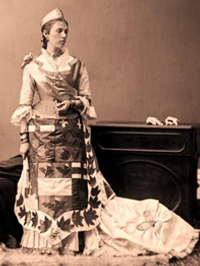
Figure 85 Margaret Louise Mackey (1853-1948), alias Mrs. St. Denis Le Moine, dressed as the "Dominion of Canada" for a fancy-dress ball in 1876.
The Ottawa Ladies’ Club also organized competitions against Colonel Bogey at the Chelsea Links, such as in 1902: “Mrs. St. Denis Lemoine has given a prize for the winner of the match against ‘bogey’ which will be played tomorrow by the ladies of the golf club” (Ottawa Citizen, 22 May 1902, p. 8).
Mrs. St. Denis Le Moine (Margaret Louise Mackey) was married to Juchereau de St. Denis Le Moine, Senate Sergeant-at-Arms and clerk of French journals, and the prize she offered was a valuable “silver loving cup” (Ottawa Citizen, 29 May 1902, p. 8).
Her daughter Marguerite was one of the best golfers in the Ottawa Ladies’ Golf Club. In fact, Marguerite would win the Club championship in 1903.
The winner of the 1902 Bogey competition was another of the Club’s better players: “On Tuesday, the Ladies’ golf club played a match against bogey for a prize given by Mrs. St. Denis Lemoine. Mrs. Sidney Smith was the winner, 8 down to bogey” (Toronto Saturday Night, 31 May 1902, p. 6).

Figure 86 Winner of the 1902 Bogey competition of the Ottawa Ladies’ Golf Club, Emily Ashford Wise (1861-1939), alias Mrs. Sydney Smith. Official Lawn Tennis Bulletin (Cambridge, Massachusetts), vol 2 no 10 (25 July 1895), p. 152.
Mrs. Sidney Smith (just as often spelled Sydney Smith) was born Emily Ashford Wise (1861-1939). A natural athlete, she was described by the Illustrated Sporting and Dramatic News of London, England, as having become by the early 1890s “undoubtedly the most brilliant and strongest [tennis] player in Canada” (Illustrated Sporting and Dramatic News [London, England], 21 October 1893, p. 213). She was a finalist in the Canadian championship of 1892 and 1893, was unable to play in 1894 (because of a family bereavement), won the championship in 1895 and was a finalist again in 1896. Joining the Ottawa Ladies Golf Club soon after this, she won the Club championship in 1898, 1899 and 1900 (defeating Marguerite Lemoine in the 1900 final), and she would win it again in 1903. She would also win a handicap competition as the scratch player in 1907 at age 46.
In 1893, the Ottawa Golf Club had been the first in North America to become acquainted with Colonel Bogey, but by 1900, knowledge of Colonel Bogey had become quite general, Bogey competitions had become quite popular, and they would become increasingly popular over the next two decades.
Since virtually every golf club in North America and England worked out Bogey scores for their golf courses by the late 1890s and early 1900s, Colonel Bogey came to represent in the minds of most golfers the standard of proper golf. And so, when the concept of par began to circulate through golf clubs in the late 1890s as the USGA considered it as a possible basis for calculating handicaps on a universal standard, par was treated by most golfers as a synonym for Bogey.
In 1899, for instance, Blackwood’s Edinburgh Magazine characterized the prevailing disdain for Bogey among Scotland’s golfers as arising from their perception of the sameness of the concepts of Bogey and par:
We do not recognize the golf Bogey. He is a bastard English invention.
We really have the same idea ourselves and call it the par score, but we never play with it.
Why should we play against abstractions when there are so many fellow mortals for whom defeat is a salutary experience?
(Blackwood’s, vol 48 [September 1899], p. 389).
Similarly, the year before this, The Sportswoman’s Library also defined the terms as synonyms: “Besides match and medal play, another species of competition has of late years been started, namely, ‘Bogey.’ This is simply a score fixed for each of the eighteen holes, the same as the par of the green” (The Sportswoman’s Library, vol 1 [London: Archibald and Co., 1898], p. 294).
And when two Toronto Golf Club members (Stewart Gordon and W.H. Blake) wrote a hole-by-hole description of their new eighteen-hole golf course for Golf (New York) in the spring of 1898, they not only used the terms interchangeably, but they also mistakenly made Colonel Bogey’s limited abilities the determiner of what they thought “par” to be:
In the 7th hole (410 yards), there is an awkward bunker consisting of two roads and fences to clear from the tee…. After the tee, with straight play, there are no hazards, but Colonel Bogey has to be allowed 6 for this hole.
The eighth hole, the “Casci,” is 260 yards, has a very pretty hazard in the second shot, and the green cannot be reached in the second shot unless the drive is of reasonable length and well placed. It is a little beyond Colonel Bogey’s powers to drive the requisite distance and the “par” is placed at 5.
(Golf [New York], vol 2 no 6 [June 1898], p. 10)
Toronto Golf Club members Gordon and Blake have heard of the new term “par,” and they acknowledge its newness by putting the word in quotation marks (in the same way Simpson had put the word “Bogey” in quotation marks in Ottawa in 1893), but they do not understand the differences between a par score and a Bogey score.
They allow Colonel Bogey 6 strokes to complete a 410-yard hole and 5 strokes to complete a 260-yard hole and they declare the “par” scores for these two holes to be 6 and 5, respectively. Yet the USGA had indicated in January of 1897 its understanding of the mathematical calculations for determining par scores:
Clubs belonging to this association shall handicap their members on the following basis of scratch:
Distances from tee to hole under 165 yards, three strokes;
165 and under 300 yards, four strokes;
300 and under 450 yards, five strokes;
450 yards and over, six strokes.
(Democrat and Chronicle [Rochester], 30 January 1897, p. 15)
In this light, the 1898 par value of Toronto’s 410-yard hole was 5; the par value of its 260-yard hole was 4. Gordon and Blake pretended that they had determined the par scores for these holes, but they had actually accorded these holes Bogey scores, merely replacing the word “Bogey” with the au courant word “par.”
In 1898, the concept of a Bogey score was all they knew.
This was the situation at the Ottawa Golf Club when the Ottawa Citizen introduced the course to readers in September of 1899. For each hole, a “par value” was published: 1 290 yards par 4; 2 440 yards par 6; 3 410 yards par 5 or 6; 4 175 yards par 4; 5 260 yards par 4; 6 210 yards par 4; 7 260 yards par 4; 8 250 yards par 4; 9 275 yards par 5; 10 260 yards par 4; 11 175 yards par 4; 12 350 yards par 5; 18 165 yards par 3 (Ottawa Citizen, 26 September 1899, p. 6).
But we can see several instances where what was presented was not the par score but the Bogey score. The par value of the 440-yard 2nd hole was 5, not 6. The par value of the 275-yard 9 th hole was 4, not 5. The par value of the 165-yarf 18th hole was technically 4, not 3. Like Gordon and Blake in Toronto, the Ottawa Citizen reporter did not understand the concept of par and simply introduced the au courant word “par” for scores that were Bogey scores.
A question I cannot resolve is whether the word “par” was introduced on the Ottawa reporter’s initiative, or whether a Club member introduced the word “par” to the reporter when explaining the nature of the course to him.
But perhaps there is a hint of the Club’s 1899 method in determining what the reporter calls “par values.” His report that the par score for the 410-yard 3 rd hole was “5 or 6” was probably a legacy of Club debate about the proper Bogey score for this hole. Note that there was no question in par theory about what the par value of a 410-yard hole might be: it was 5. It could not be “5 or 6.” Like Gordon and Blake in Toronto, however, the Ottawa Golf Club seems to have voted occasionally to allow Colonel Bogey (at least under certain conditions) to take 6 strokes on a 410-yard hole.
The Globe reporter who described play during the 1899 Canadian Amateur Golf Championship tournament says of play on the 3rd hole that Brown and Gillespie “Halved in 6. Bogey” (Globe [Toronto], 30 September 1899, p. 25). I suspect that this reporter reflected in his reference to the “Bogey” score on the 3rd hole the language of Bogey scores that he had heard being used by most Club members.
In Ottawa Golf Club minutes, in fact, we have a record of the Executive Committee’s vote to establish the Bogey Scores for the 1901 season (see below).

Figure 87 Minutes, Executive Committee, Ottawa Golf Club, 1901. Photograph supplied by Jennifer Mirsky, Chair, Heritage Committee, Royal Ottawa Golf Club. Email to the author, 14 February 2026.
The Ottawa Colf Club maintained its affection for Bogey scores well after it moved to its Aylmer Road course. In 1905, for instance the course was accorded a Bogey score of 84 and one finds no reference to a par score. Indeed, the competition committee calculated over 250 handicaps in relation to the Bogey score, beginning with “Col. Bogey, official score, 84; handicap, zero” (Ottawa Journal, 11 May 1905, p. 2). The member accorded the lowest handicap was A.Z. Palmer: 2.
Obviously, since each golf club established its own Bogey score according to its own lights, golf courses of similar length could have widely divergent Bogey scores. And so, the handicaps of players calculated at a course with a generous bogey score would be lower than the handicaps of players with the same ability whose handicaps were calculated at a course with a more stringent bogey score. This fact was not a problem when each golf club kept to itself, or when matches between golf clubs pitted players against each other at scratch, but when handicap matches involved players from different clubs handicapped according to the idiosyncratic Bogey score of each golf club’s course, problems soon presented themselves.
When golfers with handicaps based on their club’s generously high Bogey score competed against golfers with handicaps based on their club’s more stringently low Bogey score, there was significant inequity – as well as embarrassment and hard feelings. Golfers of the same ability faced each other with significant disparity in their handicaps; golfers of significantly different abilities faced each other with the same handicap. As W.L. Watson observed:
Let a man have a handicap, however small, and he can finesse it a little, explaining, if it be 2, for example, that after all it is “2 at Mudbury.”
Everybody knows Mudbury and can appreciate that 2 at that “drive-and-iron” place does not betoken deadly accuracy over a course where a long second shot is for the most part demanded.
But the moment the word “scratch” is attached to a man’s name the qualification “at Mudbury” loses half its force, for “scratch” is a very serious term indeed and carries with it a claim that admits of no abatement.
As a consequence, the Mudbury champion gets sadly knocked about at times …. [A] day arrives when he leaves his beloved Mudbury and journeys to the Longcarry links, where the hazards cannot be dodged, but must be fairly driven; where the grass is unfamiliar, the tee-sand of strange quality, the caddies contemptuous, and the putting greens billowy.
Behold, he is scratch no longer; nay, he is not within nine strokes of it.
All that he can pretend to is “local scratch,” and although Mudbury may be proud of him and he of it, he stands as a monumental warning of a wrongly-framed bogey score, a defective standard of handicapping, and probably a short and badly laid out course.
(Golf [New York], vol 5 no 6 [December 1899], pp. 397-98)
Many agreed with Watson that what was needed was a system of handicapping that would make handicaps calculated at Mudbury equitable with handicaps calculated at Longcarry. Rather than tolerating inaccuracies and inequities produced by allowing each club to establish its own Bogey score according to the ability of its best player (who might not be very good), and perhaps according to the egos of its most influential players (who would not countenance a hole being accorded a Bogey score that they could not match), should golf clubs not agree to apply universal criteria in determining the scores to be used for determining handicaps?
The answer would be “yes,” but debate raged for years whether the par score or some sort of universalized Bogey score should be used for calculating handicaps.
And so, until the mid-twentieth century, many scorecards indicated Bogey scores side-by-side with par scores. Often, of course, the Bogey score for a hole and its par score were the same, but the Bogey score for a course was often 10 strokes higher than its par score. Also complicating matters was the fact that seeking greater accuracy and fairness in calculating handicaps, some golf clubs calculated par scores in increments of half strokes – as at Royal Ottawa in 1912 (see below).

Figure 88 Royal Ottawa Golf Club scorecard 1912. Image courtesy of Ross Heuchan.
Eventually, as we know, Colonel Bogey, who once set the standard of proper golf, had to accept the ignominy that his score for any hole came to be regarded as one over par for that hole.
Oh how the mighty had fallen!
For a more detailed and comprehensive discussion of the relationship between bogey and par, see my essay Ottawa Golf and the Bogey Man: How the Ottawa Golf Club Became the First to Bring Colonel Bogey to North America (on my website at donaldjchilds.ca).
Course Length
The 18-hole playing length of the course in 1897 was 4,507 yards.
This was a proper distance for 18-hole championship play at that time. Note that in 1896, the U.S. Open was played on the 4,400-yard 18-hole course of the Shinnecock Hills Golf Club.
Lengthened in advance of the Canadian Amateur championship held on the Chelsea Links in the last week of September of 1899, the course officially measured 5,002 yards at that time (its Bogey score being 79 or 81, depending on whether the 3rd/16th hole was accorded a Bogey score of 5 or 6).
In 1899, 5,002 yards constituted a proper length for a test of championship golf. For the 1899 US Open at the Baltimore Country Club, for instance, the USGA had Willie Davis modify the course so that by moving tee boxes back, the length could be stretched out to a maximum of 5,400 yards. Its actual playing length during the competition was probably slightly shorter than this.
Note also that for the 1899 championship tournament, the Chelsea Links may have played slightly longer than 5,002 yards. In listing the distance of each hole during tournament week, reporters for the Ottawa Citizen, Toronto Star, and Toronto Globe provided slightly different yardages for the length of certain holes: taking the longest yardage reported for each hole, one finds that the course may have played at about 5,100 yards in length.
There was an apocryphal account of the Chelsea Links, emerging after the club had moved to its present site, that claimed the course was longer than 5,002 yards – “the holes varying in length from 160 to 470 yards, [f]or a total length of nearly 5,200 yards for a complete round of eighteen holes” (Ottawa Journal, 10 September 1904, p. 15).
I find no reference before this to a 470-yard hole, mind you, nor, indeed, reference to any hole longer than 440 yards. And it is surprising to see above a claim that the shortest hole on the Chelsea Links had been 160 yards, for the Toronto Evening Star had reported at the 1899 Canadian Amateur Golf Championship that there were three 154-yard holes and Newman had earlier reported that the 1897 course had two holes that were 153 yards in length. So there is reason to doubt the accuracy of the claim above about a 5,200-yard course with holes from 160 to 470 yards in length.
Course Records
By definition, the first course record was established by the lowest official score on the first day of play on the new course: Saturday, 2 May 1896. The tournament that day was a handicap competition amongst thirteen men. 16-year-old Rex Watters shot the lowest gross score: 100 (Ottawa Daily Citizen, 4 May 1896, p. 3). The relatively high scores on that first day of play were attributed to bad conditions on the very young course: “The greens were somewhat rough and interfered with the scores of the players” (Ottawa Daily Citizen, 4 May 1896, p. 3). Twelve Days later, A.Z. Palmer and Alexander Simpson each recorded scores of 97 (Ottawa Journal, 15 May 1896, p. 6).
One year later, in May of 1897, E.C. Grant, who had scored so badly on the first day of play the year before that he did not hand in his scorecard, established a course record of 81.
I note that when Grant’s record score was published in Golf (New York) by editor Newman, it was described as “the amateur record” – phrasing that may imply that there was a different professional record, probably lower than 81. If so, this record would presumably have been established by Joseph Baizana, the only golf professional known to have played the Chelsea Links between 1896 and 1898.
The course record for the lengthened Chelsea Links that hosted the Canadian Amateur Golf Championship in September of 1899 was established by 1898 champion George Lyon during a practice round with Ottawa’s own A.Z. Palmer and eventual winner Vere Brown:

Figure 89 George S. Lyon beside the trophy for his 1904 Olympics victory.
The links are in grand order ….
Lyon is doing extremely well and stands a good chance of holding on to the cup for another year.
The course covers 5,002 yards, the record for which is 82. In a threesome with Palmer and Brown the day before the tournament, Lyon played a star game and broke the record by two strokes, going round in 80.
The tees were longer, too, than when the 82 score was made, which goes still further to Lyon’s credit.
(Toronto Evening Star, 28 September 1899, p. 1)
The claim in the newspaper item above that the record was 82 before Lyon’s round suggests that Grant’s score of 81 in May of 1897 had somehow been forgotten.
And just what score Lyon made is not clear. Was the score 80, as indicated above, or 79?
An Ottawa Journal reporter observed: “as G.S. Lyon, of the Rosedale Club, Toronto, covered the course in 79 strokes – an excellent performance – it will be seen by this that the present champion is playing in fine form and that he will make a strong bid for the championship this year” (Ottawa Journal, 28 September 1899, p. 3). A report in the Ottawa Citizen also said the number was 79: “Mr. Lyon played a round with Mr. A.Z. Palmer on Monday, doing the 18 holes in 79, thus making a new record for the course. The previous record, 82, was held by Percy Taylor of Montreal” (Ottawa Citizen, 27 September 1899, p. 6).
Grant’s 81 in 1897 may have been discounted because the course then was 500 yards shorter than the 1899 course.
Just before the Chelsea Links were abandoned at the end of the 1903 season, A.Z. Palmer played an exceptional round on a course that now consisted of nine holes. Palmer had played remarkably poor golf at the end of October to lose the Club championship with a closing round of 98, prompting an expression of surprise in a local newspaper because “Mr. Palmer had made a round the day before in 79” (Ottawa Journal, 29 October 1903, p. 5).
I can find no information about medal scores made by member of the Ottawa Ladies’ Golf Club. Most of the Club’s competitions described in the newspapers were conducted by matchplay and so total scores were not reported, and scores for handicap competitions that were mentioned in the newspapers were never reported.
Flags Flying
We recall that as one approached the clubhouse along the Chelsea Road, the first glimpse of the building revealed a flag flying above the main entrance: “Passing through Hull, we soon find ourselves on the Chelsea Road where, half a mile beyond in a slight curve in the road, through an avenue of overhanging elms, we see flying from its staff the flag of the Ottawa Golf Club” (Ottawa Journal, 15 October 1898, p. 12).
This flag was presumably the one donated to the Club by women members in 1894 when the clubhouse at the corner or Russell and Osgoode was relocated (to move it several yards to the east so it would not interfere with the opening of a new street). During this move, the clubhouse was expanded and a flagpole was added:
Improving the Golf House
The improvements to the new golf clubhouse are now about to be completed.
A new wing has been added and the entire structure moved off the street line on to a lot given the club by Mr. C. Magee. The club now have ample accommodation and have put in a fine bath and wash room.
A handsome flagpole has been erected and the ladies intend presenting the club with a handsome flag.
(Ottawa Journal, 30 April 1894, p. 5)
There is no indication as to who might have been the Ottawa Golf Club’s Betsy Ross.

Figure 90 At Sandy Hill, a caddie holds the metal hole marker while a player putts. Enlarged detail from "Putting at the 9th Hole," Collier's Weekly Magazine, vol 11 no 45 (September 1893), p. 4.

Figure 91 At the Perth Golf Club, an unidentified woman putts on the 9th green in the early 1900s.
At the Chelsea Links, there were other flags of more practical consequence.
At the Sandy Hill course, the putting holes were not marked by flagpoles. As was usual at that time, the holes were marked by steel poles with rectangular or circular numbered metal plates welded to the top of them, as seen to the left in a sketch of play on the Sandy Hill 9th green in in the summer of 1893. Standing to the left of the golfer who is about to putt, the caddie holds the hole marker upside down in his right hand, waiting to replace it in the hole. “In each hole,” according to E.C. Grant, “is placed a white disk, about six inches square, on a pointed stick about eighteen inches long, and which the caddy boy removes and replaces again after each hole” (Grant, Collier’s Weekly Magazine, p. 4)
As can be seen in the photograph to the left, the Perth Golf Club, with which the Ottawa Golf Club competed in the early 1900s, used a similar version of these metal hole markers.
But by at least 1899, the Ottawa Golf Club had switched to flagpoles.
We know of this change only because a flagpole figured in the dramatic conclusion to an early round match in the 1899 Canadian Amateur Golf Championship held on the Chelsea Links:
The best contested match of the day was that between Gillespie of Quebec and Baxter of Rosedale.
They were even at the end of the round, when the latter should have won the match, but he missed a short putt and only halved it.
They played an extra hole and Gillespie won by his ball hitting the flag pole on his third and lying dead when he won by 1 up on the nineteenth hole.
(Globe [Toronto], 28 September 1899, p. 9)
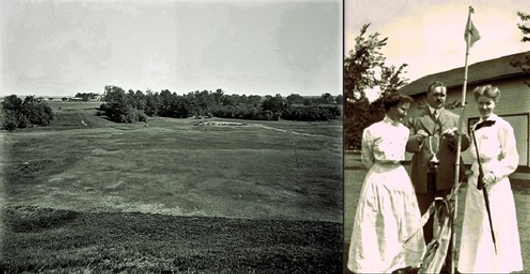
Figure 92 Left: undated photograph, circa 1904, of one of the new greens of the tom Bendelow course on the Aymer road. Right: undated photograph of an early 1900s award ceremony on the 9th green of the Caledonia springs golf course.
We see to the left a flagpole in the corner of one of the flat square greens built on the Aylmer Road course in 1903 by Chelsea Links greenkeeper John Fuller. It may well be a flagpole brought over in 1904 from the Chelsea Links. It resembles the bamboo flagpole (seen above right) used at the Caledonia Springs golf course, where Ottawa Golf Club professional William Divine (and son-in-law of John Fuller) was hired in the spring of 1904 after he was replaced by John Oke.
One wonders whether hole numbers were printed on the flags at the Chelsea Links and whether a Club logo might have been printed on them.
Where Were the Holes
In chapters that follow, I will discuss in detail what we know about each of the 13 holes that made up the Chelsea Links. At this point, however, since we have no map showing the location of these golf holes, I briefly outline how what we know about the holes allows us to construct a provisional (at times speculative) map of the layout.
We know that the first hole departed from a tee north of the clubhouse and ran further north alongside the Chelsea Road for about 300 yards.
Between the 1st fairway and the Chelsea Road (which was left or west of the 1st fairway), there must have been at least a 50-yard wide space to accommodate the 2nd tee and the 3rd green, for we know that golfers drove west over the Chelsea Road and then played uphill for about 400 yards to the Fair View estate. Then golfers turned around and drove east, playing downhill for about 400 yards – playing an approach shot back over the Chelsea Road.
Irwin’s painting of this area (seen below) shows golfers on the 3rd hole playing this approach shot back over the Chelsea Road. They stand near the junction of Chelsea Road and Mountain road. Their backs are to the 2nd hole, which ran parallel to the 3rd hole in the opposite direction.

Figure 93 Annotated version of Royal Ottawa's undated D.T. Irwin paining of the Brigham Hall clubhouse.
The 2nd and 3rd holes were the only ones played across the Chelsea Road.
The eleven other holes were in the fields east of the Chelsea Road, and three of these holes (in whole or part) were east of the CPR tracks which ran on a north-south axis across the golf course about 400 yards below the clubhouse.
The 8th and 10th holes were the only holes played across the CPR tracks. The 8th crossed the tracks from west to east to the edge of Lac Leamy at the northeast corner of the property, the drive being the shot that crossed the tracks. The 10th crossed the tracks from east to west at the southeast corner of the property, the second shot being the one that crossed the tracks.
The 7th hole paralleled the CPR tracks, running from south to north. The 9th hole ran the same distance in the opposite direction on the east side of the CPR tracks.
In the diagram of the clubhouse accompanying Horsey’s 1898 article about the Chelsea Links, the green shown north of the clubhouse shed and offices was presumably the 18th green.
The information summarized above about holes 1, 2, 3, 7, 8, 9, 10, and 18 is virtually certain.
Below, I show how this information translates onto the 1887 map of this area produced by Snow.

Figure 94 Annotated detail from Snow's 1887 map.
Attention to the information plotted on the map above allows reasonable inferences to be drawn as to where other tees and greens were located.
Since to play an 18-hole championship round required replaying holes 1 to 5 after completing the 12th hole, it is likely that Ricketts placed the 12th green relatively close to the 1st tee. We know also that in 1899, a player sliced his approach shot to the 12th green through the door of the roofless barn – probably the open door depicted in Irwin’s undated painting of the barn.
And to facilitate the playing of the 18th hole after the replaying of holes 1 to 5 as 13 to 17, Ricketts is likely to have place the 5th/17th green relatively close to the 18th tee.
Since we know from the diagram accompany Horsey’s 1898 article that the 18th green was located between the clubhouse outbuildings and the roofless barn, we can infer that the approximately 160-yard shot to reach this green was likely to have been played from east to west. And so, the 18th tee was probably located about 160 yards east of the clubhouse and north of the stone fence and elm tree marking the north end of the paddock (which are never described as being involved in play on the golf course).
Irwin’s undated painting of the roofless barn may indicate the location of the 1st and 12th greens, as well as the 6th tee.

Figure 95 Annotated version of Irwin’s paining of the roofless barn. I mark the hypothetical positions of greens 1 (where two players putt after two shots to the green (the shots marked in red), 12 (approached from the north), and 5 (also approached from the north). I presume that the two golfers on the left margin of the painting are playing from the 6th tee. In the background, marked by a purple line, I mark the flight of the ball on the 18th hole. Along the right margin of the painting I mark the likely positions of the 2nd tee and 3rd green along the east side of the Chelsea Road.
I mark on the painting above what may be the position of the 6th tee near where the 5th green is likely to have located (so as to be close to the 18th tee).
And we know that the 6th green was probably close to the 7th tee (the position of which was along the CPR track about 300 yards south of Brigham Street). If the position of the 6th tee above is correct, then we know the 6th hole proceeded from west to east (downhill from the tree seen in the painting above to the CPR tracks).
We know that holes 5 and 6 played across swampy ground. The 6th hole was even named “Swamp.”
Perhaps revealed by the 1933 aerial photograph shown below is the swampy area in question. I draw on this photograph the likely location of the 6th hole and the 7th tee.

Figure 96 Annotated detail from 1933 aerial photograph National Air Photo Library (Canada). A4572. Photo no. 59. I outline in blue what may be a swampy area. Because the 5th hole was named “Horseshoe,” I draw the blue line in the shape of a horseshoe to draw attention to the possibility that from a certain perspective, this land may have struck golfers as resembling a horseshoe.
The 11th tee would have been close to the 10th green. And so the 6th green, 7th tee, 10th green, and 11th tee were probably all in the same general area, with the 11th fairway running in the general direction of the 12th tee.
Similarly, the 4th hole would have run in the general direction of the 5th tee.
See below a complete diagram of the layout as suggested by the information and analysis presented above.

Figure 97 Annotated version of the 1887 Snow map.
According to my reconstruction of the Chelsea Links layout, there would have been a walk of about 200 yards from the 3rd green to the 4th tee. Since in Sandy Hill there was a walk of about 500 yards from the 4th green to the 5th tee and then a walk of about 1,000 yards from the 9th green back to the clubhouse, the Club may not have baulked at all when Ricketts proposed a 200-yard walk from the 3rd green to the 4th tee.
Hole 1: Barn
Name: BARN
Original length: 268 yards
1899 length: 290 yards (Ottawa Citizen), 287 yards (Toronto Evening Star and Globe)
1899 Bogey Score: 4
1899 Average Score (played 10 times by 3 top players): 4.6

Figure 98 Ottawa Journal, 15 October 1898, p. 12).
As shown to the left in a detail from an 1898 diagram of the clubhouse, “Tee No. 1” was located on the north side of the clubhouse. It was visible from the north-facing windows of the “Men’s Room” on the ground floor of the clubhouse (this room actually served as a common room).
A “Stone Wall” defining a small yard or garden on the north side of the clubhouse separated the teeing ground from the clubhouse. What is marked on the diagram above as an “Old Stone Wall” along the left side of the tee box served as the boundary between the golf course and the Chelsea Road.
The tee shot was required to clear the walls of what the diagram calls the “Stone Stables (Ruin)”: Club members referred to the ruins not as a stables but as a barn and so named the hole “Barn.”
Note that the diagram above showing the “Stone Stables (Ruin),” “Tee No. 1,” and “Green” is inaccurate regarding scale: the roofless barn was much further from the north side of the Brigham homestead than is depicted.
Given that Brigham Hall was about 20 yards wide, if the land to the north of the clubhouse were drawn to scale in relation to the clubhouse, the diagram would indicate that the near side of the barn was about 10 yards from the stone wall and outbuildings on the north side of the clubhouse, which is impossible, for between barn and the clubhouse outbuildings was a putting green that was certainly not ten yards wide.

Figure 99 Undated early photograph of a square putting green on the tom Bendelow 18-hole course along the Aylmer road. Topley. LOC
Putting greens in the 1890s were laid out flat and square – ranging from the smallest with sides 20 yards long to the largest with sides 70 yards long. We have already seen above an example of this sort of green built at the Club’s Aylmer Road site in the spring of 1903 by Chelsea Links greenkeeper John Fuller. This green is shown again to the left.
And so, the 1898 diagram does not give accurate information about how far the barn was located from the 1st tee, but it is correct in indicating that a putting green and a tee box were laid out between the clubhouse and the barn.
As Horsey looks out the two windows of the “Men’s Room” on the north side of the clubhouse, he observes this putting green:
The room on the left [north] of the main entrance, with its four large double casement windows opening full length, allows a good view of the west as well as to the north, [with the view to the north] overlooking the putting green at the beginning of the course towards the high walls of the great stable and the mountain ranges in the distance.
(Ottawa Journal, 15 October 1898, p. 12)
This putting green presumably belonged to the approximately 160-yard 18th hole, which I have marked on maps and photographs above as running up to this green from the east. It was the only one-shot hole on the golf course. One infers that there was a good deal of space left and right of the putting green, for descriptions of this hole never mention either the barn or the outbuildings as factoring in play on this hole.
The 1898 diagram is inaccurate regarding the distance between the clubhouse and barn, but it is probably at least relatively accurate in showing the relative positions of the 1st tee and the 18th green.
If so, the diagram suggests that there was room to move the 1st tee back by at least the width of the putting green that was also in this space. Is this how the hole was lengthened from 268 yards in 1897 to 290 yards in 1899?
Probably.
For when George S. Lyon set a course record 79 (or was it 80?) on the Chelsea Links during practice for the 1899 Canadian Amateur Golf Championship, it was observed that “the tees were longer … than when the [previous record] 82 score was made” (Toronto Evening Star, 28 September 1899, p. 1). The position of “Tee No. 1” marked on the 1898 diagram had probably been moved back 22 yards.
My guess is that the nearest wall of the roofless barn was 80 to 100 yards from the clubhouse outbuildings.
The roofless barn certainly fulfilled the expectation in penal golf course architecture that golfers who failed to carry it with their drive should be punished. Horsey describes the ordeal suffered by those who could not carry “the high walls of the great stable”:
The stables, as the walls indicate, were very commodious, capable of sheltering thirty teams of horses, which were used in lumbering….
The walls as they now stand … at the beginning of the course form at the outset a very formidable hazard to the golf tyro, who is continually adding to their nine [sic; does Horsey mean “nine-hole score”?] in vain endeavors to drive his ball over, or seemingly through, them as he tries again and again to surmount their height from tee number one.
(Ottawa Journal, 15 October 1898, p. 12)
How high were the fearsome walls that had to be surmounted?
Note that the perspective in the painting of the roofless barn prevents determining the height of the walls by reference to the height of the man and woman depicted on the putting green, for they are in the foreground and the barn is in the middle ground. Similarly, knowing the height of the still-existing clubhouse in the background is no help: in the painting, the perspective required the image of the barn to be bigger than the image of clubhouse (although the clubhouse was probably taller than the barn).
Perhaps the best indication of the height of the old barn is provided by the depiction of the door in its north wall. How high would it have been?
Recall that the Brigham family’s stables for its riding and carriage horses was in the courtyard below Brigham Hall. For the safety of people entering stables while mounted on a horse, exterior doors on such stables were typically 12 to 16 feet high. According to Horsey, however, the roofless barn had been used for “sheltering thirty teams of horses, which were used in lumbering” (Ottawa Journal, 15 October 1898, p. 12). One did not ride such horses but rather led them or drove them (usually in teams). The exterior barn door for such horses might have been just eight feet high.
If so, the north wall depicted in Irwin’s painting would have been about 12 feet high and the peak of the end walls would have been about 24 feet high.

Figure 100 Detail from Irin’s undated painting of the roofless barn.
Horsey calls the roofless barn a stables and says it was built on the model of the Duke of Bedford’s early 1800s stables in the English city of Peterborough.
I find Horsey’s identification of a model for the Brigham stables curiously specific.
Was this early 1800s building on the Columbia Farm really designed according to a well-known and easily recognized model?
Showing a contemporary view of the Duke of Bedford’s stables (now serving as a residence but retaining its original dimensions), the photograph below bears out the resemblance asserted by Horsey.

Figure 101 Contemporary image of Duke of Bedford's early 1800s stables.
Like the Duke of Bedford’s tables, the Columbia Farm stables has gables at each end, a big door at the left end, and dormer windows in the roof.
The proportions of the two buildings seem similar, too. The peak of the gable visible on the Duke’s stables is about 24 feet high.
Horsey seems to have known the Duke of Bedford’s stables well, for he details a particular comparison between the Columbia Farm stables and those of the Duke of Bedford:
The stables, as the walls indicate, were very commodious, capable of sheltering thirty teams of horses which were used in lumbering.
They were fitted up after the pattern of the stables of the Duke of Bedford, the mangers and fittings being of oak bound with iron bands.
(Ottawa Journal, 15 October 1898, p. 12)
Horsey had spent many years in England and had perhaps seen the stables in person.
Born in Kingston, Ontario, in 1843 and graduating from Queen’s University in 1865, Horsey spent the next years studying medicine in London and Edinburgh. First coming to Ottawa in 1871, he practised for several years and then returned to England to become an ear, eye, nose and throat specialist – returning to Ottawa to become the first such specialist in the city.
Although Horsey says that the walls form “a very formidable hazard to the golf tyro, who is continually adding to their nine [sic] in vain endeavors to drive his ball over, or seemingly through, them as he tries again and again to surmount their height from tee number one,” there were no reports of any competitors at the 1899 Canadian Amateur Championship incurring disastrous scores because of the barn (Ottawa Journal, 15 October 1898, p. 12).

Figure 102 Vere C. Brown, 1898. Newman, Official Golf Guide 1899, p. 36.
In fact, the only time the barn is mentioned in newspaper coverage of the tournament is in connection with the championship match, when ultimate winner Vere Brown, playing the hole as the 13th, hit one of the walls: “Browne’s drive was not quite high enough and caught the barn but went over” (Globe [Toronto], 30 September 1899, p. 25).
In 1896, the Kingston golfers who played the course in May thought it was unusual to have to play over the barn, apparently mistaking it for an old house: “The grounds were very interesting and picturesque, and several novelties were presented to the Kingston team in the shape of walls and old houses over which they had to play” (Daily British Whig, 26 May 1896, p. 4).
This barn hazard was also described as “an old ruin with pits behind” (Ottawa Citizen, 26 September 1899, p. 6). Unfortunately, whether these pits were on the tee side of the barn or the green side of the barn is not clear. When writing of the sand pit on the tee side of a cop bunker, for instance, golf writers who habitually thought of holes from the green backwards described such a pit as “behind” the cop, whereas golfers who habitually thought of holes from the tee forward described the same pit as “before” the cop.
And it is not clear whether these pits were a natural hazard in place when Ricketts staked out the course or whether they were artificially created to serve as a golf hazard.
Horsey, for instance, describes a similar landmark along the east side of the Chelsea Road between the house and the barn:
There are about the old place [the Brigham homestead] other almost obliterated marks which might readily be passed by unobserved, but which have served their little day and purposes, such as the grass-grown hollow, behind the [stone] wall midway between the house and stable walls, which marks the place of the outdoor root-house.
(Ottawa Journal, 15 October 1898, p. 12)

Figure 103 Annotated detail of 1933 aerial photograph. National Air Photo Library (Canada). A4572. Photo no. 59.
The 1933 aerial photograph seen to the left seems to show the hollow representing the remains of the root-house described by Horsey.
This hollow was at least 50 yards north of Brigham Hall.
Since, according to Horsey, the remains of the old root house were “midway between the house and stable walls,” if the photograph does indeed show the remains of the root house, we know that the near side of the roofless barn was about 100 yards north of Brigham Hall.
What's in a Name?

Figure 104 B.T.A. Bell, 1902. Ottawa Citizen, 13 November 1937, p. 44.
The year 1903 saw the earliest ever start to the golf season in Ottawa: play began on all 13 holes of the Chelsea Links in mid-March. By the end of the month, B.T.A. Bell was already rounding into form – so much so, in fact, that on March 31st, he recorded a score of 2 on the first hole:
SPORTING GOSSIP
At Ottawa yesterday, Mr. B.T.A. Bell, playing with Sheriff Sweetland, holed out the first hole in two, which is a record for the Chelsea Links.
The bogey score for the first hole is four.
(Gazette [Montreal], 2 April 1903, p. 2)
In 1903, Bell’s feat had no name: the golf term “eagle” had not yet been invented.
Sometime between 1899 and 1903, for a score of one under a hole’s par/bogey score, the word “birdie” was starting to be used at the Atlantic City Country Club in New Jersey (accounts vary as to the precise date), but it had not entered common parlance in the United States, and the term certainly remained unknown in Canada for several more years.
And the words “albatross” and “double eagle” were still far away over the horizon, so neither was there a name for what A.Z. Palmer had earlier accomplished on the Sandy Hill links when he recorded a hole-in-one in 1894 on a hole with a Bogey score of 4: “in playing on the Ottawa Links against the Kingston Club on the 2nd of June [1894], Mr. A.Z. Palmer, of the Ottawa Club, made the third hole, 193 yards, in one” (Golf [London], vol 8 no 202 [26 June 1894], p. 350).
But what’s in a name?
Surely a “one” by any other name would taste as sweet!
A One-Hit Wonder: Ottawa's First Haskell
The invention of the Haskell Flyer golf ball revolutionized golf.
A member of the Ottawa Golf Club somehow managed to acquire a single Haskell ball after the hottest property in golf was finally released in New York City in March of 1901 and brought it to Ottawa lickety-split for a trial of its already mythical properties.
At the Chelsea Links, on hole one, this one ball survived one shot.

Figure 105 Coburn Haskell (1868-1922).
In the spring of 1898, golfer and dental surgeon Coburn Haskell called at the B.F. Goodrich plant in Akron, Ohio, to pick up his friend Bertram Work, the plant superintendent, for a round of golf.
While waiting for his friend, Haskell picked up discarded rubber threads from the floor of the factory and wound them around a piece of hard rubber into a ball. When he bounced this ball on the floor, it rebounded to the roof.
He showed this remarkable phenomenon to Work, who suggested that Haskell cover the ball with gutta percha and make a golf ball out of it.
Haskell applied for a patent for his golf ball on 9 August 1898, and the patent was granted 11 April 1899. The rest is history.
By early 1899, even before the patent was granted, the new ball was being tested at various locations in the mid-West and rumours were spreading about an extraordinary new golf technology:
A new golf ball with which experiments are being made will work a revolution in the game should some defects be overcome which now keep it from the market.
It differs from the present gutta percha as the lively ball does from the dead ball in baseball.
With it, the ordinary player will, it is said, make long drives with ease.
(Scranton Republican [Scranton, Pennsylvania], 17 March 1899, p. 4).
Some of the reports stretched credulity:
A new golf ball invented by a Western man is attracting the interest of golfers. With it, the average golfer is said to be able to drive 300 yards with ease.
“I assisted at a test of this ball at a Cincinnati links,” said an Eastern golfer, describing it, “and after all those present had made their drives with the standard ball, the inventor of the new ball outdrove us all with a one-handed shot with a putter.”
“Then I tried a driving iron, and after sending a regulation skyscraper with the new ball, it went nearly as high on the first rebound and kept on with mighty leaps for fully 250 yards.”
“The ball has a centre of pure rubber, which is tightly wound round with some sort of gut and then with twine. It is then coated with gutta-percha, and after moulding the ball looks like the ordinary type.”
“Aside from its excessive liveliness, another fault is brittleness, for not one of them has yet withstood more than four hits with a driver. The men behind the ball are now striving to correct these faults.”
(Philadelphia Times, 14 March 1899, p. 8)
After an ironic summary of the above article, the editor of The Golfer expressed a reasonable scepticism:
Despite this description, we shall wait a while yet in the hope of seeing this marvellous production.
We are not at all sceptical as to the possibility of improving the gutta now in use. The large makers are bent on it all the time.
But while we believe all things are open to improvement, this 300 yards with a putter is too great and sudden an increase for us to swallow easily.
(The Golfer, vol 8 no 6 [April 1899], p. 303)
If rumours about how far golfers could hit the ball proved true, there would be a number of problems:
A new golf ball has been invented which will revolutionize the game, so say the parties who are to put it on the market next season.
Instead of being made of solid gutta-percha, it is made, like the old-fashioned “lively” baseball, of a rubber core on which is tightly wound a rubber band or cord which gives a wonderfully resilient power to the new ball.
With it, beginners can make drives of such length as to place them nearly on an equal footing with professionals and the length of the present links will have to be increased.
(Sun-Journal [Lewiston, Maine], 11 September 1900, p. 10)

Figure 106 A pictorial depiction of the five stages in the construction of the Haskell Golf Ball: core, wound rubber centre, seamless gutta percha cover added, trimmed ready for paint, complete. Country Life in America (April 1905), p. 641.
By September of 1900, fully six months before the Haskell ball was even scheduled to be on the market, a movement was underway in the United States to encourage the USGA to adopt an official golf ball:
Out there a movement has been started to secure the adoption of an official golf ball.
Those back of the movement contend that formal action should be taken by the United States Golf Association at once; that unless such action is taken, the coming open championship will be a farce.
It is said that golf demands an official ball as truly as baseball, tennis, billiards and other sports, and that without it the game is certain to receive a setback….
What has caused this feeling is doubtless the new golf ball invented recently by a Cleveland player, and which, it is said, can be driven a hundred yards further than the ordinary variety, possessing, also, the same superiority in roll.
This ball has made it evident that a revolution in links is imminent, should all that is claimed for it prove true.
The ordinary distances from tee to green will prove wholly inadequate for such a “bounder,” and players will demand added lengths and fewer holes.
With this new ball to help him, a man will have a tremendous advantage over an opponent not so supplied, and consequently it is urged that the association should step in and say what is to be the official make.
(Democrat and Chronicle [Rochester, New York], 25 September 1900, p. 13)
Various Chicago newspapers had undertaken a discussion of the problem, and the Chicago Times-Herald even published an editorial on the controversy:
Yankee ingenuity has brought the game face to face with the same trouble that required such stringent legislation against the too lively baseball.
In the early days the baseball manufacturers bent their energies to perfecting a ball that could be knocked “out of sight” without being at the same time knocked out of shape. It is unnecessary to say that they speedily manufactured a ball so lively that accessible ball grounds became too small to hold it, and Texas seemed the only state of the Union extensive enough to offer a home for the home-run batter.
And now golf, the Scotch game to which Americans have taken with characteristic rush, is threatened by a lively ball to which the Scotch original is dead.
It is estimated that if Harry Vardon were to hit one of these new India rubber stuffed inventions it would fly three hundred yards and roll one hundred yards further.
An official standard must be established for golf balls or the game is doomed.
(cited in Democrat and Chronicle [Rochester, New York], 25 September 1900, p. 13)
And so, when American newspapers and golf journals widely advertised late in March of 1901 that the Haskell ball was finally available for sale, there was a rush to buy it. The Haskell Flyer was priced at $6.00 per dozen, as opposed to a price of from $1.98 to $4.00 for a dozen top-of-the-line gutta-percha balls.
Ottawa Golf Club member Nicholas Charles Sparks (1869-1945) made a point of purchasing the ball on a visit to New York City early in April. But such was the overwhelming demand for the wonder ball that, try as he might, he could only acquire a single ball.

Figure 107 N Nicholas Charles Sparks (1869-1945). Photographed circa 1903 when he was an executive officer of the Ottawa Hockey Club (nicknamed “The Silver Seven”), Stanley Cup champions for three years in a row from1903-05.
More than four decades later, Ottawa Journal proprietor Philip Dansken Ross, who had taken up the game at the same time as 29-year-old Sparks in 1898 (and who would become president of the Club ten years afterwards), recalled “the first appearance of the Haskell ball in Ottawa”:
One of our members of the Ottawa Golf club (not then the Royal Ottawa) was Mr. Charlie Sparks.
Charlie had been on a visit to new York and had managed there to get hold of a Haskell ball.
Just one.
They were already in great demand.
(Ottawa Journal, 4 September 1943, p. 19)
According to Ross, “there was great curiosity in Ottawa” about the ball (Ottawa Journal, 4 September 1943, p. 19).
And no wonder: for whether or not Ottawa golfers kept abreast of golf news via a subscription to Golf (or other American golf journals), they had been informed by local newspapers from the spring of 1899 onward that the new ball promised a revolution.
The Ottawa Citizen carried a story at the end of August in 1900 that must have made more than a few Club members wonder whether the 5,000-yard Chelsea Links would remain a viable golf course in the face of this new golf ball technology:
The newest golf ball is a wonder. Nothing like it has ever been known in the game.
In appearance, size, and weight, the new ball looks the same as the standard guttapercha ball, but the resemblance, as the adage tells of beauty, is only skin deep.
The skin is a shell of pure gutta-percha, a fraction less than an eighth of an inch thick, which is compressed in the mold to fit like a glove over the inside part of the ball.
The heart of the ball is a small cube of gutta-percha.
While this is [still] soft, the end of the thread of the best Para rubber is stuck in it.
As the gutta hardens, it is tightly wrapped with the rubber thread, much as baseball is wound with a cord, until the desired dimension is obtained.
The next process is to mould on the shell, when, after the usual coats of white paint, the ball is ready for play [as opposed to the gutta-percha ball which required to be cured for several months].
It is the invention of Coburn Haskell, one of the governors of the Cleveland Golf Club, who has been experimenting with the ball for two years. It is now practically perfected, but none will be put on the market until next spring.
The cost will be about twice as much as the regular ball.
The rubber filling adds greatly to the resiliency of the ball and the inventor claims that an ordinary player may easily drive from 250 to 300 yards every time. Iron shots carry in the same way and the ordinary cop bunker or trap is not a pitfall, for the ball usually bounds over all obstacles….
“The inevitable result,” said one of the firms to handle the ball next spring, “of the use of our ball will be that all the golf links must be lengthened.”
All amateurs who have tried the ball concede that nothing like it has ever been seen for carry and roll….
One thing is certain: the ball will carry further than any ball ever used on our links.
Should it come into general use, the present game would be revolutionized if one half that is claimed for the new ball be true.
(Ottawa Citizen, 31 August 1900, p. 6)
When Sparks returned to Ottawa in mid-April, he could hardly get to the Chelsea Links fast enough to show his golf buddies the new ball. As Ross tells the story:
The Ottawa course at that time was on the Chelsea Road. The first hole was alongside the road for 300 yards or so.
On a Saturday afternoon, about twenty of us gathered at the first tee to see Charlie play the first drive with the Haskell ball.
Charlie teed up and took a mighty swipe. He was a long driver, too.
He didn’t get it just right. It was what is technically known as a pulled shot.
It sailed out nobly high and far, swerved in mid-flight over to the left, over the Chelsea Road, and disappeared in a thick wood on the other side.
A dozen of us, more or less, hunted for it for a long time, but we never found it.
(Ottawa Journal, 4 September 1943, p. 19)
Alas, “The best-laid schemes o’ mice an’ men / Gang aft agley ….”
A one-hit wonder, Ottawa’s first Haskell ball lies now under the parking lot of the Walmart store on Boulevard St. Joseph.
Hole 2: Chelsea
Name: Chelsea
Original Length: 325 yards
1899 Length: 440 yards (Ottawa Citizen), 417 yards (Toronto Evening Star and Globe)
1899 Bogey Score: 6 (voted 5 in 1901)
1899 Average Score (played 10 times by 3 top players): 5.8
The 2nd hole, “Chelsea,” was named after its first hazard.
Players teed off on the east side of the road, from which “The Chelsea Road, a stone heap and a ditch face[d] the drive” (Ottawa Citizen, 26 September 1899, p. 6). We learn here of three fairway-wide cross bunkers, which are presumably listed according to the order in which they were encountered: road first, stone heap second, ditch third.
This hole was the first of two that required play across the Chelsea Road.
In the 1890s, roads were regarded as proper cross “bunkers” on a golf course. Indeed, golf professionals laying out courses in those days sought to route holes perpendicularly across roads. Their intention was to place the tee box at a distance sufficiently far back from the road to force golfers to carry the road with a proper drive. (Holes were also routed across roads so as to require a carry over them with an approach shot to the putting green.)

Figure 108 Rules and Regulations of the Ottawa Golf Club (Ottawa: Ottawa Golf Club, 1899).
In its 1899 booklet, Rules and Regulations of the Ottawa Golf Club, the Club specifically defined the roads on the course as a conventional hazard: “When a ball lies on a road …, the ground shall not be touched by the club before striking the ball, and in no way must the lie of the ball be improved” (p. 14).
Just as in a sand trap, there was no grounding the club!
When golfers found themselves on the Chelsea Road, what might the surface of this “natural” hazard have been like?
The Chelsea Road had originally been constructed according to a method used by Philemon Wright on his first roads built in this area in the early 1800s: “Mr. Wright first marked [a road] out … then ploughed it on each side and threw the earth to the centre to form the top” (Joseph Bourchette, A Topographical Dictionary of the Province of Lower Canada [London: 1832]).
Although the Gatineau Road Company periodically macadamized parts of the Chelsea Road, especially the sections closest to Hull, it tended to allow conditions to deteriorate such that the road began to revert to its original non-macadamized state – prompting regular complaints, especially in the spring of 1895:
WHERE’S THE MACADAM?
The road from Hull to Chelsea, which is the property of the Gatineau Road Company used to be a good macadam road….
But the method of repair which is being adopted this spring …. is this: A road plough is run along the sides of the road making two ditches …. The sods and earth which come out of these ditches are being plastered on to the road.
If this is all that is to be done, the result will be simply to make the roadway a platform of dust in dry weather and mud in wet weather.
(Ottawa Journal, 11 June 1895, p. 7)
When the Club moved to its Chelsea Links the next year, the road had indeed deteriorated and was in even worse condition the year after that, as we can see from a letter to the editor of the Ottawa Journal in the spring of 1897:
THAT CHELSEA ROAD
Editor Journal: Permit me to occupy a small space [in the Journal] in order to call attention to the wretched condition of the Chelsea Road upon which the full toll is exacted and no value given therefor.
That portion of the road from Hull to the first gate is simply disgraceful and positively unsafe to go at a faster rate than a walk.
The remainder of the road to Chelsea is so bad as to encourage profanity to a degree highly discreditable to the [Gatineau Road] Company’s directors.
(Ottawa Journal, 15 May 1897, p. 12)
And so, rain or shine, the Chelsea Road was a fearsome cross bunker. Golfers strove to avoid having to play a ball from it.
The Rules and Regulations booklet cited above may have been produced by the Club in preparation for hosting the Canadian Amateur Golf Championship in September of 1899. The Royal Canadian Golf Association alluded to it in its advice to prospective entrants for the tournament: “Rules of play will be those of the Royal and Ancient Golf Club of St. Andrews, 1891, except as modified by the local rules of the Ottawa Golf Club” (Ottawa Journal, 18 September 1899, p. 3). Those local rules are explained in the 1899 booklet.
The booklet explains what to do when up against one of the stone walls or wooden fences on the Chelsea Links, such as those bordering the Chelsea Road (as seen in Irwin’s painting of the clubhouse):
In all cases where a ball is to be dropped [because of an unplayable lie], the party doing so shall front the hole to which he is playing, standing erect behind the hazard, and dropping the ball behind him from his head.
When the ball lies close to a fence or wall, the player may lift the ball and drop it over his head three yards from the fence or wall opposite the spot where the ball was lifted and lose a stroke.
(Rules and Regulations of the Ottawa Golf Club [Ottawa: Ottawa Golf Club, 1899], p. 22)
Gillespie seems to have found himself close to the fence along the Chelsea Road in September of 1899: “Gillespie pulled his drive and got dangerously close to the fence” (Globe [Toronto], 30 September 1899, p. 25). But Gillespie’s ball was not unplayable: “he got a clever second” (Globe [Toronto], 30 September 1899, p. 25).
Note that the stone fence along the east side of the Chelsea Road was quite substantial. Horsey described a section of it south of the clubhouse as “a low dwarf wall of stone and mortar some five feet high and three feet thick, topped by rough flat slabs projecting some inches beyond the face of the wall on either side serving to protect it from the weather” (Ottawa Journal, 15 October 1898, p. 12). In 1898, Horsey observed that the old wall was “in a fair state of preservation” (Ottawa Journal, 15 October 1898, p. 12). In the 1930s, it was still easily visible in aerial photographs.
After clearing the Chelsea Road, golfers faced a second cross bunker on the 2nd hole: in 1899, it was called “a stone heap” (Ottawa Citizen, 26 September 1899, p. 6).
This hazard appears in Irwin’s paining.

Figure 109 The "heap of stones" hazard appears in the foreground of this detail from Irwin's paining of the clubhouse.
The above image of the “heap of stones” hazard shows a golfer playing on the 3rd hole after having passed this hazard, which seems to have been on the direct line of play on the 3rd hole.
Note, however, that the “heap of stones” hazard does not seem to have been on the direct line of play on the 2nd hole. No golfer is ever recorded as having hit this hazard or got stuck behind it when playing the 2nd hole.
But even if the “heap of stones” lay left of the direct line of play, it was still to be avoided. One wonders whether Gillespie purposely aimed right of this hazard in September of 1899: the Globe reporter says that “Gillespie sliced badly in his drive” the second time he played the hole and that then his “ball was sliced” again on his third attempt at the hole (Globe [Toronto], 30 September 1899, p. 25).
According to Horsey, as mentioned above, this “shapeless heap of stone [was] directly over the [stone] wall and across the [Chelsea] roadway” from “the grass-grown hollow in the mound behind the [stone] wall – midway between the house and the stable walls – which marks the place of the outdoor root-house” (Ottawa Journal, 15 October 1898, p. 12). Recall that in discussion above of landmarks connected to the 1st hole, I suggested that this “outdoor roothouse” was about 50 yards north of the clubhouse, whose front door was at the exact point where Mountain Road met the Chelsea Road.
In 1887, the substantial building that exploded and left this shapeless heap of broken stone was said to have been “about half an acre away” from the farmhouse of Mrs. Christopher Columbus Brigham, alias Alicia Morrison, whose house was on the east side of Chelsea Road and on the south side of Mountain Road quite near their junction point (Ottawa Journal, 14 January 1887, p. 4). Her house was just across the Chelsea Road from Brigham Hall.
An acre measures area, of course, not distance, but the phrase “an acre away” had long been used as a figurative way of suggesting that the next house or field was close by. In this case, however, since an acre is about half the size of a football field – if square, about 50 yards by 50 yards – the expression is consistent with the idea that the stone heap was literally about half a square acres north of Mountain Road.
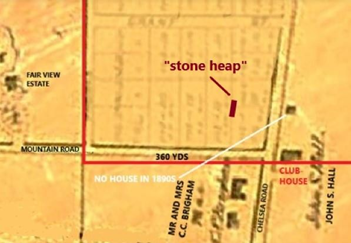
Figure 110 Annotated detail from 1887 Snow map.
Another account of the explosion which produced this stone heap notes that a house directly across from the building that blew up was also damaged by the explosion, and this house appears on the 1887 map seen to the left. This house was gone by the time Ricketts laid out the Chelsea Links.
I mark on this map (shown above left) the location of the “stone heap” created by an explosion in January of 1887.
The building that exploded and left the “stone heap” was not marked on this 1887 map: the building blew up on 14 January 1887 and so was omitted from the map that was printed later in the year.
In 1899, it took golfers three good shots to reach the putting green on the 2nd hole. It more often took four shots to reach the green, and so the hole had a Bogey score of 6. From a length of 325 yards in 1897, the hole had been lengthened to between 417 and 440 yards by 1899.
As we know, when Lyon set the course record at 79 (or 80) in September of 1899, it was said that “the tees were longer … than when the [previous record] 82 score was made” (Toronto Evening Star, 28 September 1899, p. 1). But it is not clear that it would have been possible to move the 2nd tee box from 92 to 115 yards further east of the Chelsea Road. On the one hand, the 1st fairway and 1st putting green were in this area. On the other hand, a tee box moved that far back from the Chelsea Road would have made it impossible for most golfers at the Club to carry the road with their drive.
My suspicion is that the 2nd putting green was moved further west up the hill in the direction of Fair View Estate. The original putting green may well have been laid out short of the marshy area that crossed the field from southwest to northeast. The “ditch” mentioned as a cross hazard on this hole may have been in this marshy area.
Part of this ditch and the beginning of the swampy area seem to appear on the 1933 aerial photograph shown below (unfortunately, the photograph reveals only a portion of the area where the 2nd and 3rd holes were laid out).

Figure 111 Annotated detail from 1933 aerial photograph.
Given that the 3rd hole paralleled the 2nd hole (both in close proximity to the same “heap of stones”), I presume that the “swampy and rough ground … before the tee” on the 3rd hole was an area that also had to be crossed with the approach to the putting green on the second hole (Ottawa Citizen, 26 September 1899, p. 6).
Note that shrubs and trees that were growing in 1933 in the swampy area where I have marked both a ditch and the lines of play for the 2nd and 3rd holes were not present from 1896-1903: in the days of the Chelsea Links, this part of the field was treeless.
The swampy area that the 2nd and 3rd holes crossed also appears on the 1925 aerial photograph shown below (which was unfortunately taken from a higher altitude and with a lower degree of resolution).

Figure 112 Annotated 1925 aerial photograph.

Figure 113 Annotated version of a map of the geological resources of the International Portland Cement Company published in the Ottawa Citizen, 27 July 1903, p. 5.
Seen to the left is a geological map produced by the International Portland Cement Company that purchased this property from the Ottawa Golf Club in the fall of 1902.
It suggests that the swampy area across which the 2nd and 3rd holes were routed coincided with (and was perhaps cause by) the meeting point beneath the turf of a distinct sand formation and a distinct limestone formation.
Finally, note that the 2 nd hole was played uphill into the prevailing wind, which meant that its 417 to 440 yards usually played considerably longer than the 410 yards of the parallel 3rd hole, which played downhill and down-wind in the opposite direction.
Hole 3: Elm Tree
Name: Elm Tree
Original Length: 364 yards
1899 Length: 410 yards
1899 Bogey Score: 5 or 6 (voted 5 in 1901)
1899 Average Score (played 10 times by 3 top players): 6.5
Perhaps because the 3rd hole was played downhill and down wind, the Club debated whether its Bogey score should be the same as that of the parallel 2nd hole (6) or one stroke less.
The 3rd hole was lengthened substantially before the 1899 Canadian Amateur Championship. Like the 2nd green, the 3rd tee seems to have been moved further up the hill and beyond a marshy area connected to a ditch crossing the new 2nd fairway.
A description of the 3rd hole published in advance of the 1899 Canadian Amateur Championship reads as follows: “The third hole is 410 yards; swampy and rough ground lie before the tee; the Chelsea Road and [the] same ruins [lie] before the second stroke” (Ottawa Citizen, 26 September 1899, p. 6). This description is accurate in indicating the three cross bunkers on the hole but it is inaccurate in representing the order in which the cross bunkers are encountered – swampy and rough ground facing the first shot, then the ruins facing the next shot, and finally the Chelsea Road facing the approach shot (as in Irwin’s painting).
The heap of stones was part of a hazard field that seems to have been broader than is suggested by the image of the stones shown in Irwin’s painting of this part of the golf course. The explosion of the house whose remaining wall formed the most substantial part of the “stone heap” seems to have spread stone debris over a large area. A day after the explosion, for instance, a reporter from the Kingston Daily News who visited the site noted that there was a second debris site: “One of the walls was blown thirty feet in a solid mass before breaking” (Kingston Daily News, 15 January 1887, p. 1). Three months after the explosion, an Ottawa reporter noted: “The ruins of the recent explosion on the Chelsea road have not been touched in the form of cleaning up since the disaster took place” (Ottawa Journal, 7 April 1887, p. 4). The debris field may not have been cleaned up until after the Club sold the property.
It may have been into some such secondary debris field that Vere Brown hit a shot when he played the 3rd hole as the 15th hole of his match with Gillespie: “Brown’s second carried the stone wall on a short cut to left of the line and lay badly close to a bunker” (Globe [Toronto], 30 September 1899, p. 25). The word “bunker” here, we know, did not necessarily refer to a sand bunker; the phrase may well have referred to an area of turf with a relatively high concentration of stones within it. Note, for instance, that there was an area called a “stone bunker” on the 4th hole – obviously not a pit dug and filled with stones (Globe [Toronto], 30 September 1899, p. 25).
The Ottawa Citizen’s 1899 description of the hole is inaccurate in implying that the second stroke could carry both the ruins and the Chelsea Road and thereby make it to the green in two shots – a task that neither Colonel Bogey nor anyone at the Ottawa Golf Club (whether amateur or professional) could accomplish. Because “par play” was said to be “5 or 6,” we know that to reach the putting green with three good shots was considered excellent play (and that to plan to reach the green with four shots was perhaps more prudent).
The “stone heap” hazard mentioned above in connection with the 2nd hole was the most feared cross bunker on the 3rd hole. And thereby hangs a tale – a very sad one.
According to Horsey:
The shapeless heap of broken stone directly … across the roadway [from the clubhouse] is all that remains of the blacksmith shop of the estate – which a few years ago was razed to the ground by an explosion of dynamite which was stored there.
This shattered heap overrun with weeds, together with the adjacent fence and stone wall [respectively] on either side of the roadway, constitute the hazard of despair when playing down the course from tee No. 3.
(Ottawa Journal, 15 October 1898, p. 12)
Curiously, although the 1st hole was named “Barn” after its dramatic cross bunker, and although the 2nd hole was named after its 1st cross bunker, “Chelsea Road,” the 3rd hole was not named after what seems to have been the most fearsome cross bunker on the entire golf course – its hazard of “despair.”
Instead, the hole was named “Elm Tree” – and I can find no explanation why.
Was it because one of the rare elm trees on the property was somehow related to the hole? Perhaps an elm tree marked the place where the teeing ground was located. Perhaps an elm tree was in a position where it had to be avoided with one of the shots on the hole. Was there an elm tree in the distance that indicated the line of play on this hole – perhaps the elm tree in the paddock below the clubhouse?
As Horsey observes, the elm trees on the property were rare, and all the more noticeable for their rarity:
[Once,] all about [the clubhouse] was virgin forest of pine, oak, elm, cedar and other kinds of timber in which lay the wealth of this vast domain which bountifully enriched its first possessors.
They, as well as the forests, have long since vanished.
Now there are green undulating fields with only here and there a clump of cedars or a lordly elm standing in majestic loneliness, the last of their race – the sole survivors of a royal line long since ended.
(Ottawa Journal, 15 October 1898, p. 12)
Yet Horsey also notes that elm trees lined the Chelsea Road as he walked up to the clubhouse from Hull: “Passing through Hill, we soon find ourselves on the Chelsea Road where, half a mile beyond in a slight curve in the road, through an avenue of overhanging elms, we see flying from its staff the flag of the Ottawa Golf Club” (Ottawa Journal, 15 October 1898, p. 12). Although in Irwin’s painting. no elm trees appear along the Chelsea Road near the golfers about to play across the road, it is possible that there was an elm tree to their left (to the north) that prompted them to keep right of it.
As mentioned above, the fact that the Bogey score for this hole was said to be “5 or 6” suggests that there was debate amongst the Club members as to whether Colonel Bogey should reach the putting green with three or four shots.
Some people played a drive over the swampy area, then a second shot short of the stone heap, then a third shot short of Chelsea Road, and finally an approach shot onto the putting green. When the Club decided that this was the way Colonel Bogey would play the hole, the Bogey score for the hole would be 6. Others played as long a drive as possible, then played a long shot over the stone heap, and finally played an approach shot onto the green. When the club decided this was the way Colonel Bogey would play the hole, the Bogey score for the hole would be 5.

Figure 114 J. Stuart Gillespie, 1898. Newman, Official Golf Guide 1899, p. 312.
On one occasion, Gillespie and Brown played this risk-reward hole by very different strategies and achieved very different results: “Both got fair drives, but Gillespie played safely, not being sure of carrying the stone fence [that is, what Horsey calls the “stone heap”], while Brown tried for it, but failed, losing three more in getting over and taking 8 to lose out to his opponent’s well played 7” (Globe [Toronto], 30 September 1899, p. 25).
This was probably the last time in reporting on the Canadian Amateur Golf Championship that a journalist ever referred to a “well played seven”!
Hazard of Despair
It turns out that the story of the creation of “the hazard of despair” on the 3rd hole of the Chelsea Links was much sadder than Horsey revealed.
And the “despair” was greater.

Figure 115 The only known image of the remains of the house on the Chelsea Road that exploded in 1887. An enlarged detail from Irwin's undated painting of the Ottawa Golf Club’s clubhouse. This image courtesy of Jennifer Mirsky.
In the dead of winter, on the evening of 13 January 1887, the future site of the Chelsea Links was literally shaken by an explosion:
A most terrific explosion occurred last evening on the Chelsea Road, about 10 o’clock, when a large store house on the old Brigham farm, on the Chelsea Road about a mile and a half from the City of Hull, and occupied by a [27-year-old] man named John Patton and his family, was blown to atoms by an explosion of 50 lbs. of giant powder [that is, dynamite].
(Ottawa Journal, 14 January 1887, p. 4)
The events of that night were reported in newspapers from coast to coast in Canada.
The following extensive account, from the Ottawa Journal, is based on John Patton’s own account of what happened:
John and Samuel Patton have been engaged for some time in running a dynamite factory on the Chelsea Road, about three miles from Hull [on the estate of Captain Joshua Wright, a nephew of Thomas Brigham].
Last evening, after the closing of the factory at six o’clock, Patton, accompanied by his brother Samuel, proceeded to his residence, which is situated near the old Brigham residence, taking with him a case containing fifty pounds of giant powder [dynamite] which had been manufactured for Messrs McDougal & Cuzner [of Ottawa], and which he intended to take to the city that evening.

Figure 116 An undated advertisement for the Giant Powder Company. In 1869, the Giant Powder Company of California became the first company in North America licensed by Alfred Nobel to manufacture dynamite, which he had invented in 1867. In due course, the company's name became a synonym for dynamite.
On arriving at his house, however, he was persuaded by his wife [19-year-old Mary] not to go to the city owing to the stormy state of the weather, so he placed the case of giant powder in a back room of the house which has been used as a store room.
The family had their supper, when Patton and his brother began to make an experiment for the purpose of manufacturing some very fine powder which he intended to use with nitro-glycerine.
Meantime, the family, consisting of Mrs. Patton, wife of John, and her two children, went to bed in a room just off the kitchen.
Patton placed a wash tub in the kitchen and began to mix up some materials when his brother Samuel, who was assisting him, and who was smoking a pipe, accidentally let a spark from his pipe fall into the tub in which the mixture was.
In an instant, the whole room was filled with a blue flame and heavy sulphurous smoke.
Patton, followed by his brother, made a dash for the bedroom where his wife and two children were sleeping, followed quickly by the flames and heavy, suffocating smoke.
As the door between the kitchen where the accident occurred and the bedroom had been taken off its hinges, it was impossible to shut out the fire and smoke.
So Patton called to his wife, seized the youngest child Eva (aged ten months), and, putting his hand through the [glass of the] window, jumped out into the snow. He was quickly followed by his wife, who, in her hurry, grabbed what she supposed was the oldest child, Myrtle (aged three years and a half), and [then] by his brother Samuel.
They then made their way through the snow until they were about a hundred yards away from the house. All this time, [John] Patton was bleeding from a wound in the wrist which he received breaking the window…. [Then] Mrs. Patton, with a shriek, told her husband that the eldest child was [still] in the room and that she had brought [out] a bundle of bedclothes which in her hurry she thought was the child.
Patton immediately made his way towards the bedroom window out of which was now pouring a heavy volume of smoke, occasionally lit up with a tongue of blue flame. But, owing to the loss of blood from his wrist, where he had severed an artery, he fainted. But [he] recovered and again pushed on to the window of the room where his child was.
When about two feet from the opening, a slight explosion took place which put out the fire and enabled him to see into the apartment. There, a terrible sight greeted his eye. The bed upon which his child had been sleeping was overturned and a large quantity of lath and plaster had fallen from the ceiling – under which the little girl was lying. He jumped into the room, grasped hold of his child, and hurried as fast as he could through the window into the snow. [Patton stated that had it not been for the first slight explosion, which had put out the sulphurous flame in the bedroom, and the lighting of a bundle of rags, which afforded him light to see, the little girl would have perished. Their escape was simply miraculous.]
He heard the flames crackling in the house [behind him] and with redoubled energy, his child in his arms, he followed his brother and wife, who, in her night clothes, was making her way with the youngest child in her arms through the deep snow to the residence of Mrs. Brigham about half an acre away [Mrs. Brigham was Alicia Morrison, widow of Christopher Brigham, who was the first cousin of neighbour Captain Wright].
Patton caught up and hurried his almost fainting wife along and at last reached the house, when he fell in a dead faint upon the ground.
They were all taken into the house.
It had taken them about twelve minutes to reach Mrs. Brigham’s house, and after Patton and his family had been in the house about three minutes, a terrific shock occurred. This was the 50 lbs. of powder in the room of the destroyed house.
One of the men who was in the yard of Mrs. Brigham’s house when the explosion occurred said:
“I was coming up to Mrs. Brigham’s house [and] did not know that there was anything wrong at Patton’s when all at once a terrific shock occurred which threw me on my face. I looked up and saw a mass of flame fly through the air and strike the ground sixty to 100 feet away. The shock was awful. It shook the ground. I looked for Patton’s house but could not see it.”
The windows in the house opposite [to Patton’s on the other side of Chelsea Road] fell in with a crash and several windows in Mrs. Brigham’s house were broken.
About two minutes after the explosion, which occurred exactly ten minutes before ten o’clock, Patton came to and said, “Did it go off yet?” and was told yes. He fell back in a swoon with the exclamation, “Thank God!”
(Ottawa Journal, 14 January 1887, p. 4)
As mentioned above, Alicia C. Morrison (1830-96), the “Mrs. Brigham” in question, was the widow of Thomas and Abigail Brigham’s son Christopher Columbus Brigham (1824-84), who served as mayor of Hull in 1877.

Figure 117 Annotated detail from the 1887 Snow map.
The farm of “Mr. and Mrs. C.C. Brigham” is marked on the enlarged detail from the 1887 map shown to the left, as is the clubhouse Brigham Hall (then owned by John s. Hall). So is the house across Chelsea Road from Patton’s house (which had disappeared by the time Ricketts laid out the Chelsea Links). A “stone heap” was that remained of the Patton’s house.
On the west side of Chelsea Road just south of the latter’s junction with Mountain Road, Christopher Brigham had built a house and barn almost directly opposite his mother’s Brigham Hall.
At the time of the explosion, his widow Alicia lived in this house with her 26-year-old niece Florence Brigham, who ran the Dissentient school for Protestant children (Florence seems to have inherited this property from her aunt when the latter died in 1896, for she shortly afterwards resided here across from Brigham Hall with her husband Michel Lafranchise, Jr, whom she married in 1895).
Although Mrs. Brigham’s house, Brigham Hall, and the house across the Chelsea road from Patton’s house were the same distance from the explosion, only her house suffered no damage from the concussion caused by the explosion.
The concussion was felt in Hull, and the bright light the explosion caused was seen across Ottawa. Indeed, one Ottawa resident happened to see “the glare of the giant powder flying through the air …. He was astonished by its singular experience” (Ottawa Journal, 14 January 1887, p. 4).
Thus was formed “the hazard of despair” on the 3rd hole of the Chelsea Links.
Reporters visited the destroyed house the next day. As mentioned above, a Kingston reporter noted that “one of the walls was actually blown thirty feet in a solid mass before breaking” (Kingston Daily News, 15 January 1897, p. 1). The Ottawa Journal reporter “was struck with the completeness of the destruction”:
The house was a substantial stone structure which had stood time and weather for upward of fifty years, and now only about 20 feet of one of the walls, five feet in height, is left standing….
Furniture and everything else belonging to the unfortunate family has been blown to atoms and strewn about the fields as far as 250 feet away.
(Ottawa Journal, 14 January 1887, p. 4).
Three months later, it was reported that the things remained unchanged since January: “The ruins of the recent explosion on the Chelsea Road have not been touched in the form of cleaning up since the disaster took place” (Ottawa Journal, 7 April 1887, p. 4). Indeed, it seems that the debris remained where it fell -- waiting to cause despair in golfers who ran afoul of it nine years later.
But there were other consequences of the explosion.
A doctor named Cook was brought to the scene from Hull to tend to the injured father and daughter: “upon arriving, he administered a restorative to the unfortunate man who recovered consciousness and immediately asked for his little girl” (Ottawa Journal, 14 January 1887, p. 4).
Myrtle’s condition was not good:
His little girl …. was lying in the next room in a terrible condition.
Her face and body were badly burned and blackened by the sulphurous flames which had enveloped the bedroom.
Dr. Cook stated to a Journal reporter that he had grave fears of the little girl’s recovery as she had not only been badly burned but had also inhaled a quantity of the sulphurous smoke.
(Ottawa Journal, 14 January 1887, p. 4)
The next day, however, Dr. Cook was quoted again:
The Chelsea Road Explosion
The condition of the little child injured by the Chelsea road explosion is much improved today.
Dr. Cook, who has been attending her, states that there is every hope of her recovery, although her face and hands will be scarred.
A subscription has been started by Capt. Wright for the benefit of the family.
(Ottawa Journal, 15 January 1887, p. 1)
Then there was another report: “The condition of the little child injured in the recent explosion on the Chelsea road is somewhat improved. The poor little thing is constantly suffering” (Ottawa Journal, 19 January 1887, p. 4). And then another: “STILL SUFFERING – The little girl who was so seriously injured at the late dynamite explosion on the Chelsea Road is said to be still suffering very severely, although considered out of danger” (Ottawa Daily Citizen, 20 January 1887, p. 3).
One week to the day after the accident came the worst news:
RESULTED FATALLY
Myrtle Patton Dies From the Injuries Received in the Chelsea Road Explosion
Little Myrtle Patton, the 3 year old daughter of Patton whose house was destroyed at the explosion on the Chelsea Road on Thursday night last, succumbed at an early hour this morning to the injuries received on that occasion.
Immediately after the explosion, Mrs. Christopher Brigham very kindly had the little girl and her mother removed to her own residence where the sufferer breathed her last today.
From the time Dr. Cook, of Hull, told the poor mother of the probable fatal result, she has been completely distracted and now is in a pitiable condition.
Capt. Wright, of Hull, came to the city this morning to make arrangements for the funeral of the little child, which will take place this afternoon in Hull Cemetery.
(Ottawa Journal, 20 January 1887, p. 4)
“Patton’s injuries are not at all dangerous,” it was first reported, “but he is badly shaken up by the accident” (Ottawa Journal, 14 January 1887, p. 4). The next day, there was an even more optimistic report: “Patton is recovering all right and will resume his business at once” (Ottawa Journal, 15 January 1887, p. 1). But two weeks later, the news was different: “Patton, who was injured by the explosion of the Chelsea road, is still far from recovery. The wound he received in rescuing his wife is still very troublesome” (Ottawa Journal, 29 January 1887, p. 4).
Not surprisingly, the explosion echoed for many years in the lives of the Pattons.
The family moved into Hull after the accident, and then they moved into Ottawa. Patton resumed his business at his explosives factory on Captain Wright’s estate just off the Chelsea Road.
Patton and his brother were criticized, of course, for their carelessness. Ottawa newspapers were restrained in their reporting, but a Montreal newspaper pulled no punches: “great damage and injury was done, and possibly life lost …, owing to the criminal and almost incredible carelessness of a couple of foolish men” (Canadian Gleaner [Montreal], 20 January 1887, p. 3).
And Mary Patton could tell that people never forgot what happened: “Since that unfortunate accident when our old place on the Chelsea Road was blown up, we have been regarded with suspicion by lots of people” (Ottawa Daily Citizen, 10 April 1890, p. 1).
Their neighbours were always nervous about living next to an explosives manufacturer, a fact brought home to the couple when they were living on Wellington Street in Ottawa in 1890 and one of the companies to whom John Patton delivered dynamite from his Chelsea Road factory returned surplus dynamite not to the factory but to the family’s home. Neither John nor Mary was home when the carters arrived, so they left the explosives in the kitchen.
Dynamite powder in a kitchen! Where have we seen that before?
Apoplectic neighbours called the police.
The situation was resolved by the removal of the dynamite to the Chelsea Road factory, but John and Mary had some explaining to do to their neighbours. John said, “If I had been at home, I would have made him take it out to the factory” (Ottawa Journal, 10 April 1890, p. 1). A reporter for the Ottawa Daily Citizen interviewed Mary about the matter in her kitchen. One can hear in her statement that she recognized the irony of the explosive’s being left in that room: “if I had been in when the powder came,” said Mrs. Patton, “I would have ordered the stuff to be taken back to the contractor or out to the factory. I wouldn’t have let it be put in here, anyway” (Ottawa Daily Citizen, 10 April 1890, p. 1).
The neighbours knew that she did some sort of work for the company in the home, so she was at pains to explain to the reporter that she did not work with explosives:
Sometimes I make the cartridges that the dynamite is put it; that is when they are busy at the factory.
The cartridges are made of paper and paste, and there is never a bit of dynamite around the house. Mr. Patton has a large factory on the Chelsea Road, on Mr. Joshua Wright’s place, and there’s where all the powder is made.
There are four buildings out there with plenty of room to make the dynamite and to store it, too, and there is no need of keeping it in the house here.
(Ottawa Daily Citizen, 10 April 1890, p. 1)
The Pattons’ explanations notwithstanding, the landlord asked them to move, and so we next find them on Albert Street.

Figure 118 Ottawa Journal, 29 May 1894, p. 6.
Patton’s factory was prospering and so, in January of 1891, he incorporated with two partners as the Ottawa Powder Company, which supplied a wide variety of explosive materials to companies in the Outaouais and Eastern Ontario.
Less than two months later, Patton’s factory on the Chelsea Road again blew up, causing an earthquake that was felt 30 miles (50 km) away and that broke dozens of windows in downtown Ottawa.
A fire broke out at the plant, and this led to the explosion of all kinds of explosive materials made and stored there.
It left a twenty-foot-deep crater surrounded by flattened trees. Fortunately, Patton acted quickly to evacuate the plant and no lives were lost. In fact, no one was even injured.
Patton was at a loss to explain the cause of the fire, but from the speculation that he shared with a reporter about a possible cause, one can see that his mind had been taken back to the explosion sparked in his old home by his brother’s pipe:
Yesterday afternoon, Mr. Patton, with two hands, was engaged in packing dualine whilst one man was employed upstairs in a room where nitrate of soda and pulverized charcoal were stored and scattered around.
Everywhere in the building were notices that smoking was strictly prohibited, but Mr. Patton surmises that this man, being alone, took it into his head that he would enjoy a surreptitious pipe, and he must have dropped some hot ashes into the dust of soda and charcoal lying around.
(Ottawa Journal, 19 March 1891, p. 4)
Patton’s new company had the financial wherewithal to rebuild the Chelsea Road factory immediately.
And it was rebuilt after an even bigger explosion in 1895.
But after the biggest explosion of all in 1898, which caused several fatalities, lumber for rebuilding the factory was sitting on site when the Hull City Council finally forbade the Ottawa Powder Company from operating within the city.
So the company crossed the river to the Ontario side, where factory explosions continued.
But it seems that Patton left the business a few years before the worst of the explosions on the Chelsea Road. We find him operating in Ottawa as a real estate agent in 1896. After 1898. I can find no further references to the Pattons in Canada, let alone in Ottawa. John and Mary Patton had both been born in the United States; perhaps they moved back home. Whatever the case may be, the Pattons seem to have left the Ottawa area around 1898. I wonder if they knew that by then people were lofting golf balls over the ruins of their old home on the 3rd hole of the Chelsea Links.
Of course, Myrtle’s parents never forgot that terrible winter night in 1887, and they never forgot Myrtle. They had two more children – Herbert in 1889 (he sat on his mother’s lap when the reporter interviewed her about the dynamite delivered to her kitchen in 1890) and another boy was born in the1890s, neither of whom knew their sister Myrtle, of course. Ten-month-old Eva had been loved by her big sister, but she could not remember her.
The newspapers wrote of Eva in 1895, when the now nine-year-old girl won awards at her Ottawa school in a fashion contest for dolls: “The recent competition held in Victoria Ward School for the prettiest and best-dressed doll has been won by Miss Eva Patton (the daughter of John F. Patton of Albert Street), who won all three prizes offered” (Ottawa Journal, 9 December 1895, p. 8).
I am sentimental: I like to think that Eva named her doll Myrtle.
Myrtle, alas, was fading from local memory. When reporting on the storage of dynamite powder at the Patton home in April of 1890, a reporter who interviewed Mary Patton recalled: “It is about three years since Patton’s dynamite factory on the Chelsea Road was blown to atoms and their boy, a bright child, so badly burned that he died in a few days” (Ottawa Daily Citizen, 10 April 1890, p. 1). And when reporting on the destruction the Ottawa Powder Company’s factory on Chelsea Road in March of the following year, a reporter who interviewed John Patton recalled: “About four years ago, his factory on Chelsea Road was blown up and his little son so severely burned that he died soon after” (Ottawa Daily Citizen, 19 March 1891, p. 4).
The reporters had almost remembered the bright little girl named Myrtle, but they forgot her gender and they forgot her name.
When the Pattons left Ottawa, Myrtle, of course, remained behind in the Hull Cemetery.
Could Myrtle Patton have been the ghost of Brigham Hall – her spirit, loathe to leave the little world along the Chelsea Road where her life had only just begun, attracted to the clubhouse whenever she heard groups of men and women regaling each other with tales of tribulations at the ruins of her old home: “the hazard of despair”?
The Prodigious Poke of P.D. Ross

Figure 119 P.D. Ross seated beside the Ontario Hockey Association Cosby Cup, after the Ottawa Hockey Club defeated the Toronto St George’s club to win the 1891 championship.
Perhaps because he was a natural athlete who had played various rough-and-tumble team sports at a very high level, Ottawa Journal owner Philip Dansken (P.D.) Ross initially disparaged golf as not a proper sport for men when he tried it in 1897.
But in 1898, when he was persuaded to try the game again, he changed his mind about it because on the 3rd hole of the Chelsea Links, he hit a perfect drive that left him hooked.
For four decades, he would play in Club tournaments and serve on important committees. He twice finished runner-up in club championships. Perhaps most importantly, he was Club President when the clubhouse burned down in 1909 and immediately led the effort to rebuild it.
In addition to playing sports, Ross became an organizer and financial benefactor of several sports at local, provincial, and national levels. He captained the McGill football team that beat Harvard in the late 1870s, he was a champion rower, and he helped to found the Ontario Hockey Association in 1890. He was named by Lord Stanley a trustee of the Stanley Cup in 1893 – a position he held until his death in 1949, shortly before which he delegated authority over the Cup to the NHL. He is a member of the Hockey Hall of Fame.
Sharing a passion for the Ottawa Hockey Club with his friend Nicholas Charles Sparks, he had yielded to the latter’s invitation in 1897 to try the game. Alas, the experience not only disappointed Ross; he responded by trashing the game:
“The game is not active enough for me. I want something with more pep to it,” said P.D. Ross back in 1897 when his old friend and early backer in the newspaper business, Charles Sparks, asked him to join the Ottawa Golf Club….
The tall, lithe lover of nearly all forms of outdoor sport then in the last year of his thirties, who only a few years previous had relinquished his place on the forward line of the Ottawa Hockey Club, laughed at the idea that golf could ever have any fascination for him.
One lovely summer afternoon they persuaded him to give the game a try.
The initial attempt wasn’t a success. He spent a lot of time in the bunkers, dubbed drives galore and at the “19th” hole shocked devotees by regretting the loss of an afternoon’s rowing.
It was just an “old ladies’ game.”
(Ottawa Journal, 8 July 1949, p. 19)

Figure 120 P.D. Ross. Ottawa Journal, 8 July 1949, p. 19.
The next year, however, Sparks and his friends at the Ottawa Golf Club coaxed Ross back out to the Chelsea Links to give the game a second chance.
This time, things were different:
He was persuaded to have another try.
On the third tee, he “connected.”
Like a shot from a gun, the ball went straight down the fairway for 200 yards.
That was the start of 40 years’ devotion to what he eventually called “the greatest game invented by man.”
(Ottawa Journal, 8 July 1949, p. 19)
Within a few years of that prodigious drive on 3 rd hole, Ross came to be regarded as a master of the Chelsea Links:
He became a first-class club performer, one who could play in any company, turned in cards regularly in the eighties and not infrequently in the late seventies.
He developed a thoroughly correct style, seldom had an off day, did not lose his head and “got back” on his game at once.
On the old Chelsea Links, the comparison “as steady as P.D.” passed into common parlance.
(Ottawa Journal, 8 July 1949, p. 19)
Hole 4: Mound
Name: Mound.
Original Length: 153 yards.
1899 Length: 175 yards (Ottawa Citizen), 154 yards (Toronto Evening Star and Globe).
1899 Bogey Score: 4.
1899 Average Score (played 8 times by 3 top players): 4.3
As a 153-yard hole, the 4th hole would have been regarded as a one-shotter. But playing at 175 yards in length, as it probably did during the 1899 Canadian Amateur Golf Championship, it was regarded as a two-shotter.
We find that during the 1899 tournament, the hole played to a score of 4.3 – slightly higher than its Bogey value. The average score made by Brown and Gillespie was even higher: 4.5 (they played the hole six times, Brown making three 4s, Gillespie making 4,5, and 6).
With regard to distance alone, a 175-yard hole should have been a relatively easy two-shotter. The man who would win the USGA’s inaugural Amateur Championship in October of 1895, Charles Blair Macdonald, won a long driving contest a few weeks before this tournament at the International Golf Tournament at Niagara-on-the-Lake with a drive of 179 yards. A good drive could have reached the 4 th green of the Chelsea Links.
Note, however, that Macdonald’s 179-yard drive had not carried nearly that far: it had rolled a considerable distance.
And so, were a 175-yard hole to be guarded by intervening rough ground, a swamp, a ditch, or similar cross bunkering, a drive such as MacDonald hit at Niagara Falls would not reach a green well-guarded by such hazards.
Similarly, were the putting green on a 175-yard hole elevated well above the level of the surrounding ground, rolling a ball onto the green surface with the driver and staying there would have been difficult.
The 4th green was protected in each of the ways described above. In 1899, the Ottawa Citizen reported: “hole on top of mound, surrounded by rough ground” (Ottawa Citizen, 26 September 1899, p. 6). Alas, the height of the mound on which the green was placed is not clear, but we know that it was not sufficiently high to have been marked on the 1906 topographic map of this area.
And we know that the “rough ground” on the hole comprised not just “long grass,” but also a significant population of stones.
We can tell from reports of the way Brown and Gillespie played the hole that the stones surrounding the elevated putting green could impose a big penalty on golfers who found themselves next to one: “Both pulled their drives, Brown getting a good lie, but Gillespie got against a stone and took two to get clear”; on another occasion, “Gillespie miss[ed] his drive … getting into the stone bunker, from which he had to play back” (Globe [Toronto], 30 September 1899, p. 25).
Recall that in the 1890s, the word “bunker” was used as a synonym of “hazard”: the phrase “stone bunker” refers here not to a pit filled with stones but rather to an area of rough ground with a high density of stones.
And these stones caused golfers to consider carefully whether they should risk injury by striking a ball lying close to one:
While playing through the green, Mr. [E.] Piddington drove a ball against a stone. It rebounded and struck him in the eye, causing a hemorrhage.
Luckily, Dr. Horsey happened to be on the links and his timely attention probably averted what might have been a disastrous accident.
(Ottawa Citizen, 5 May 1902, p. 6)
The better part of valour might have been discretion – that is, taking a penalty stroke for an unplayable lie.
Hole 5: Horse Shoe
Name: Horse Shoe
Original Length: 226 yards
1899 Length: 260 yards (Ottawa Citizen); 227 yards (Globe); 277 yards (Toronto Evening Star)
1899 Bogey Score: 4
1899 Average Score (played 8 times by 3 top players): 4.6
The Ottawa Citizen reported two cross bunkers on this two-shotter: “swamp and rough ground in front of tee. Putting green surrounded or guarded by rocks” (Ottawa Citizen, 26 September 1899, p. 6).
We recognize the cross bunkers prescribed for a two-shot hole by penal golf course architectural theory: one of them – swamp and rough ground – was to be carried by the drive; the other one – rocks – was to be carried by the approach shot.
The “swamp” in front of the tee may not have been very substantial. On the one hand, on the first topographical survey of the area made in 1906, no swamp is marked anywhere on the Club’s property. On the other hand, on one occasion, Gillespie and Brown “both got short drives” on this relatively short two-shot hole, yet neither became bogged down in “swamp and rough ground in front of the tee.” I doubt that the “swamp” across which the 5th hole was routed was anything more than an area where the soil was occasionally saturated with water.
As I have argued above, it is quite likely that the 5th green was in the vicinity of the clubhouse. For after golfers had played holes 1 to 5 again as holes 13 to 17, they proceeded from the 5 th/17th green to the tee of the 18th hole and from there played about 160 yards to a putting green located between the old barn on their right (north) and the wall and outbuildings alongside the clubhouse on their left (south).
Why the hole was named “Horse Shoe” is not clear.
Was the line of play to the hole in the shape of a horse shoe?
Although in the 1890s, golf holes were laid out in straight lines (the dogleg design was not invented until the early 1900s), it is possible that the swamp and rough ground in front of the tee presented sufficient danger of bad lies to prompt golfers to play to the side of this trouble. If golfers did indeed play to the side of the swamp and rough ground, I suspect that play went around the right side of this troublesome area, for Gillespie sliced a drive on this hole and encountered neither swamp nor rough ground as a result.
Similarly, if aimed right of the swampy area of rough ground, the short drives of Gillespie and Brown would have avoided the swamp despite their shortness.
Or perhaps to golfers standing on the 7th tee, the swamp over which they were about to play appeared to have the shape of a horse shoe.
Who knows?
Hole 6: Swamp
Name: Swamp.
Original Length: 203 yards
1899 Length: 210 yards (Ottawa Citizen); 204 yards (Toronto Evening Star, Globe).
1899 Bogey Score: 4
1899 Average Score (played 3 times by 3 top players): 4.3
Like the 5th hole, the 6th hole was laid out in relation to a swamp: “The sixth hole. 210 yards, swamp and rough ground right up to the hole” (Ottawa Citizen, 26 September 1899, p. 26).
I presume that the swamp hazard on the 6th hole was the same swamp that factored on the 5th hole.
If it is the case that the name of the 5th hole, “Horseshoe,” acknowledges that there was a way to play around this swamp, the name of the 6th hole, “Swamp,” perhaps acknowledges that there was no way around this hazard: “swamp and rough ground [run] right up to the hole.”
Yet when “Brown here topped his drive” in September of 1899, the consequence was not getting into swamp; rather, the result was “getting in among stones” (Globe [Toronto], 30 September 1899, p. 25). Since the hole was no more than 210 yards long, one might have expected even a topped drive to have reached at least a wet area – especially since the heavy rain that had preceded the tournament, and that continued to plague play during the tournament (especially the day Brown and Gillespie played their 36-hole championship match), will have made the “swamp” as large and as wet as it tended to get.
Again, I doubt that the “swamp” across which the 5th and 6th holes were laid out was anything more than an area where the soil was occasionally saturated – and perhaps only in the spring after the snow melt.
Hole 7: Railway
Name: Railway
Original Length: 253 yards
1899 Length: 260 yards (Ottawa Citizen); 267 (Toronto Evening Star; Globe)
1899 Bogey Score: 4
1899 Average Score (played 5 times by 3 top players): 4
The 7th hole was unusual among holes on the Chelsea Links insofar as it had no cross bunkers – at least none worth mentioning in the newspapers. All dangers were along the sides of the fairway, with “railway on right and rough ground on left of line to hole” (Ottawa Citizen, 26 September 1899, p. 6).
In the 1929 photograph below, a train runs from north to south along the railway in question.

Figure 121 Library and Archives Canada. Clifford M. Johnson fonds. Canada Cement Co. Plant No. 3, Hull, P.Q. Box number: RV4 141.AC. 1929 photograph.
The photographer looks from west to east across the terrain where the 7th fairway ran from south to north parallel to the tracks. The turf that we see in this photograph was where the 7th putting green was laid out.

Figure 122 Annotated detail of an undated aerial photograph circa 1930s/1940s.
The photographs above and to the left show the cement plant sitting on the east side of the tracks where the 8 th fairway ran down to Lac Leamy and where the 9 th fairway ran from north to south.
In the photograph above, the locomotive and train cars, on the one hand, and the base of the cement plant buildings, on the other, show that the land on the west side of the tracks was well above the land on the east side of the tracks.
The two photographs shown here allow us to understand how, on at least one occasion, a golf ball misplayed out over the railway was lost in an unusual way. According to Madge Macbeth:
The links on the Chelsea Road were interesting, if not exactly easy ….
Stone fences constituted most of the hazards. But not to be discounted were the trains that ran puffily at the end of the course.
One day, a powerful drive carried a golf ball into the cab of the engine, much to the annoyance of the occupants.
(Ottawa Citizen, 12 January 1952, p. 34)
Examining the photograph above, one can see alongside the train tracks wooden posts that anchored a wire fence. Since animals grazed on the Hall property when the club began play in 1896 (as we know from a stipulation in the original lease), a fence of this sort to keep animals off the tracks must have existed when the Club first began play on the course.
Since Brown and Gillespie had no trouble on this hole, we know that neither of them was the one who hit a ball into the cab of a passing train.
Look Both Ways
The CPR tracks were treated as a hazard.
And so, golfers played the ball as it lay. And one could not ground the club. If the ball was unplayable, the usual penalty was applied for taking relief from an unplayable lie.
But if one was not paying attention, the railway presented a hazard of a different sort.
In 1898, the Club’s golf professional, Joseph Baizana, was nearly hit by the CPR’s Sault Ste Marie passenger train while working near the train tracks:
STRUCK BY THE “SOO”
Narrow Escape of the Caretaker of the Golf Grounds
Joseph Baizana, caretaker of the Ottawa Golf Club grounds, had an experience this morning which he will remember for some time.
He was walking along the railroad track and had charge of a horse pulling a grass roller. The “soo” train came along suddenly and struck Mr. Baizana, the horse and the roller.

Figure 123 Circa 1900, an unidentified young man at work with a horse-drawn roller.
The man and the horse came out of the collision with a shaking up, but the roller is badly smashed.
(Ottawa Journal, 2 August 1898, p. 7)
One might think that Baizana was extraordinarily inattentive in being hit by a train. Yet four years before, an almost identical situation occurred in this area:
A man who was drawing a load of provisions up the Gatineau for one of the city lumber firms narrowly escaped being killed yesterday on the Chelsea Road.
While [he was] passing over the railway crossing, a train came along and struck the hind part of his sleigh.
He just managed to jump in time, for the sleigh was badly smashed and its contents strewn around the road.
The horses escaped uninjured. (Ottawa Daily Citizen, 3 January 1894, p. 8)
And the danger presented by these grade crossings on the CPR line near the golf course endured for decades. In 1929, for instance, a writer for the Ottawa Citizen observed that “today, two railroad tracks cross the [Leamy] road within the first half mile [from Chelsea road] and one using the road must be very careful” (Ottawa Citizen, 31 August 1929, p. 36).
By 1899, Josph Baizana had left the Ottawa Golf Club and become a motorman for the Ottawa Electric Railway Company: for the next three decades, he would ride the tracks rather than cross them.
Hole 8: Lake
Name: Lake.
Original Length: 246 yards.
1899 Length: 250 yards (Ottawa Citizen); 249 yards (Toronto Evening Star); 240 yards (Globe)
1899 Bogey Score: 4.
1899 Average Score (played 5 times by 3 top players): 4.6
On the 1906 topographic map of this part of the golf course, the contour lines are farther apart than lines anywhere else on the map of the course area, which indicates that the slope from the 8 th tee down to the 8th putting green was the gentlest on the course.
The lake for which the hole was named was then commonly known in English as “Leamy’s Lake” – more usually known these days as “Lake Leamy” or “Lac Leamy” Horsey refers to it as “the little lake known as Leamy’s” and says that it was “at the northern limits of the links” (Ottawa Journal, 15 October 1898, p. 12).
As can be seen in the sketch below, the land dropped steeply at the shore of Lac Leamy.

Figure 124 Detail from bird’s-eye view of the cement plant. From Industrial and Picturesque Ottawa (Ottawa: City of Ottawa Publicity Department, undated).
Indeed, the edge of the lake seems to have been marked by a little cliff about three to four yards high (the cliff is today thoroughly covered by small trees).
But golfers were in no danger of hitting a golf ball into the lake. The distance from the west side of the CPR tracks where the 8th tee was located to the nearest point of the shore of the lake was about 400 yards, whereas the 8th hole was at most 250 yards long – meaning that the lake was more than 100 yards beyond the 8th putting green.
The ground on the west side of the tracks where the 8th tee was located was higher than the 8th putting green, as can be seen in the photograph below, which shows the approximate location of the 8th tee and also shows how the cement plant buildings sit on ground well below the land on the west side of the CPR tracks.

Figure 125 Detail from 1929 photograph. Library and Archives Canada. Clifford M. Johnson fonds. Canada Cement Co. Plant No. 3, Hull, P.Q. Box number: RV4 141.AC.
There were no trees in this area in the late 1890s and early 1900s, so the view of Lac Leamy from the 8 th tee, 8 th fairway, and 8th putting green must have been quite attractive. The aerial photograph below hints at the view in question.

Figure 126 Circa 1930s/1940s aerial photograph. Note that in the late 1890s and early 1900s, the lake was full of logs at certain points during the year. When the lake froze, it was used as a harness-racing track (called the “Winter Trotting course” on the 1887 Snow map).
The cement plant that we see above would be built on the site of the 8th fairway and 8th putting green beginning in May of 1903. Just before the first shovels went into the ground on May 8th, this terrain was described as “a high and dry level tract overlooking Leamy’s Lake” (Ottawa Citizen, 12 May 1903, p. 9)
Although it was “high and dry” relative to the lake, the 8th putting green nonetheless marked the lowest part of the golf course. At 150 feet above sea level, it was about 75 feet lower than the clubhouse, which was about 40 feet lower than the 2nd green at the western boundary of the golf course – making about a 115 foot drop from the top to the bottom of the course.
Horsey observes that Leamy’s Lake was “close to the teeing ground and hole no. 8” (Ottawa Journal, 15 October 1898, p. 12).
His phrase needs to be unpacked.
By “hole no. 8,” he means the literal hole cut into the 8th putting green (he does not mean the entire stretch of hole 8 from tee to green, as we generally do today when we speak of a golf hole). And since the drive from the 8 th tee crossed the CPR tracks 250 yards west of the 8th “hole” (or green), when Horsey says that the lake was “close to the teeing ground,” we know that the “teeing ground” in question was not the 8th tee, but rather the 9th tee.
As “picturesque” as the view might have been from the 8th tee down to the 8th green and 9th tee, there were also within view of the tee a considerable number and variety of cross hazards to be carried on the way to the 8th green: a “railway, a road and fences face drive” (Ottawa Citizen, 26 September 1899, p. 6).
It is not clear whether the road crossing the line of play on the 8th fairway was Brigham Street or some other road.
But it seems unlikely that the road facing play on the 8th hole was Brigham Street, which ran between the northern limit of Hall’s land (property on the north side of the road belonged to the Leamy family) but then turned southeast at Lac Leamy, at which point it became Cemetery Road. The International Portland Cement Company was granted permission in April of 1903 to build its cement plant in the middle of Brigham Street on condition that it open a new Brigham Street “from Mountain Road through to Cemetery Road”: it would run east from Brigham Hall across the southern boundary of the golf course and then below the cement plant’s quarry to join up again with Cemetery Road (Ottawa Journal, 22 April 1903, p. 2).
Hull City Council built the original Brigham Street across John Hall’s property in 1877 and agreed to maintain a fence along his side of the road so long as Hall owned his land to the south of the road. The 8th hole ran parallel to Brigham Street, so it seems it could not have been the road crossing the 8th fairway.
It is more likely that there was a service road on Hall’s property running up to Brigham Street on a north-south axis. The only grade crossing of the CPR tracks was on Brigham Street, so a road running south from this street onto Hall’s property east of the CPR tracks would have been necessary to provide access to this part of his property for horse-drawn wagons and other agricultural vehicles.
Recall that Joseph Baizana was hit by a train while “walking along the railroad track”: he may actually have been walking up to the grade crossing on Brigham Street. After all, he was leading a horse that was pulling a lawn roller – hardly something to drag along the tracks themselves.
The biggest hazard on the 8th hole might have involved walking across the grade crossing on the way from the tee box to the 8th fairway on the other side of the tracks!
Note that as late as 1929, a person using the grade crossings on Leamy Road (just a couple of hundred yards from the level crossing on Brigham Street) observed: “railroad tracks cross the road within the first half mile and one using the road must be very careful” (Ottawa Citizen, 31 August 1929, p. 36).
A Second Railway
Note that in the sketch of the Lac Leamy shore in the preceding chapter, there is a railway other than the CPR depicted. It is that of the Ottawa and Gatineau Railway Company, which became in 1901 the Ottawa, Gatineau, and Western Railway Company, which became in 1903 the Ottawa Northern and Western Railway. This new line opened in 1901, but planning for it began in 1897 while the Club was in residence along the Chelsea Road.
Up to 1897, O & GVR track came down alongside the Gatineau River and joined the CPR line just to the north of the golf course, but it would soon run all the way into Hull. The new tracks would “cross the property now owned by the Grey Nuns to Messrs. J.S. Hall & Sons’ land on the Chelsea Road near Mr. Brigham’s property” (Ottawa Journal, 10 November 1897, p. 7).
Well before the end of the 1897 golf season, property for a new O & GVR track along the eastern-most edge of the Club’s golf course had been “expropriated on satisfactory terms with the owners” (Ottawa Daily Citizen, 8 October 1897, p. 8). And so, imminent construction of a new railway along the eastern-most boundary of the golf course was well known to the Club as it negotiated the purchase of the golf course and clubhouse in 1899.
To fulfill the O & GVR’s plans, its tracks coming down the Gatineau River would have to cross over the CPR tracks at the northeastern corner of the golf course close to the 7th green and 8 th tee: “In changing the entrance of this railway into Hull, an underhead crossing will be built at Leamy’s Lake” (Ottawa Daily Citizen, 8 October 1897, p. 8). The “underhead crossing” appears in the Company’s early illustration of what the completed industrial site would look like.

Figure 127 Annotated detail of the circa 1903 bird's-eye view of the projected cement plant. From Industrial and Picturesque Ottawa (Ottawa: City of Ottawa Publicity Department, undated).
Hole 9: Baseball
Name: Base Ball
Original Length: 252 yards
1899 Length: 275 yards (Ottawa Citizen); 272 yards (Toronto Evening Star; Globe)
1899 Bogey Score: 5 (voted 4 in 1901)
1899 Average Score (played 5 times by 3 top players): 4.6
The tee shot on the 9th hole faced a number of cross bunkers: on “the ninth hole, … rough ground, road and fences lie before the tee” (Ottawa Citizen, 25 September 1899, p. 6). One does not know, but it is possible that the road and fences in question were a continuation of the road and fences crossing the 8th fairway.
The fairway along the right (west) side of the 9th hole presumably paralleled the CPR tracks. Yet these tracks seem to have been far enough right of the line of play so as not to have been a factor on the hole. Note that right-handed “Gillespie sliced his drive badly” here, but there was no mention by the reporter for the Toronto Globe of his having come anywhere close to the tracks.
When Gillespie and Brown played this hole several times in September of 1899, the O & GVR tracks paralleling those of the CPR (along the eastern boundary of the club’s property about 300 yards from the existing tracks) had not yet been built. There was plenty of room for Ricketts to have laid out the 9 th fairway sufficiently east of the CPR tracks and sufficiently west of the property boundary for the new tracks never to have become a factor for golfers to consider when playing any shot on this hole.
The 9th hole’s claim fame may reside in the nature of its second cross hazard: “Putting green guarded by ditch and bank” (Ottawa Citizen, 25 September 1899, p. 6). If this “ditch and bank” is an example of the artificial hazard known as a “cop bunker,” this hazard was the only one of its type on the Chelsea Links and also the first of its type in Ottawa.
Gillespie’s interaction with this bunker contains hints that it may indeed have been a cop bunker. He played this hole twice on 29 September 1899 and tangled with this hazard each time.
The first time, after a badly sliced drive, “Gillespie only got 25 yards on his second, and playing two more ran into the bunker, but fortunately for him, jumped out again” (Globe [Toronto], 30 September 1899, p. 23). This fourth shot not only jumped out of the bunker but also then ran onto the green. We learn no particular details of the bunker in this description of it.
But the second time he played the hole, after his drive, “Gillespie’s ball lay badly and he played his second shot off the bunker” (Globe [Toronto], 30 September 1899, p. 23). The idiom “played his … shot off the bunker” is interesting, for the preposition “off” indicates that there was an elevated part of the bunker that a ball could hit and from which it could ricochet. Was this raised part of the bunker the turf dyke of a cop bunker?
Since the reporter does not indicate that Gillespie’s approach shots were pulled or sliced, it may be that the reason his poorly executed approach shots encountered this bunker each time he played the 9th hole was because he hit low shots that rolled directly long the line of play towards the putting green and thereby a cop bunker crossing the fairway from side to side.

Figure 128 The Golfer, vol 14 no 1 (January 1904), p. 27.
The Ottawa Citizen’s description of this bunker as a “ditch and bank” fits the way a cop bunker was made. See to the left a late 1890s example of what might be called a ditch-andbank cop bunker at the Choppequonsett Golf Club near Providence, Rhode Island.
Tom Dunn’s invented this style of hazard in 1891 – the first example of which is seen below.

Figure 129 Tom Dunn's original 1891 cop bunker zigzags through the lower left quadrant of this postcard dating from 1904.
Two years later, Willie Dunn, Jr, introduced this cop bunker to North America. Having apprenticed under Tom and worked with him on the celebrated course at Biarritz, France, in the late 1880s and early 1890s, Willie was hired to work as the golf professional at Shinnecock Hills in May of 1893. That year, he introduced cop bunkers to his layout at Lakewood, New Jersey, as seen in the photograph below.

Figure 130 Undated photograph showing the Lakewood, New Jersey cop bunkers (also called turf dykes) designed by Willie Dunn, Jr, in 1893.
Ricketts probably encountered Tom Dunn’s cop bunkers on courses he played in the London area before coming to Ottawa in March of 1893. And we recall that Ricketts had been ambitious to play in a professional tournament in the United States in the summer of 1894: the first at Newport, Rhode Island, in August of 1894; the second in New York. As it turned out, he played in neither tournament, but it is possible that during his years in Ottawa he visited the United States and saw the kind of hazards that Willie Dunn and his nephews were building.
We know, of course, that cop bunkers featured on Ricketts’ course designs for the Country Club of Rochester and that city’s Genessee Valley Golf Club.
Why the 9 th hole was called “Base Ball” is a mystery.
It is possible that baseball games had been played on this part of the old Brigham farm, for, as was common in the nineteenth century among farmers with property close to villages and cities, the Brigham family allowed clubs to use the farm property for sporting events.
There was horse racing: “The annual steeplechase of the City Carters came off last Friday on Mr. Brigham’s farm near the Village of Hull” (Ottawa Daily Citizen, 27 October 1863, p. 2). There was lacrosse: “The disputed lacrosse match between the ‘Shamrocks’ of Ottawa and the ‘Maple Leafs’ of Hull was played on the Brigham estate, Chelsea Road, on Saturday afternoon. There was a large attendance” (Ottawa Daily Citizen, 4 June 1877, p. 4). On the Victoria Day weekend in 1875, a picnic may have been arranged in the area where the 9th hole would be laid out – the closest approach of the Chelsea Links to Brigham Creek: “Several picnics have been arranged … one on Bank Street road, another up Brigham’s Creek, and a third somewhere on the canal” (Ottawa Daily Citizen, 22 May 1875, p. 1).
Perhaps the home plate, bases and base paths of an old baseball diamond were still discernible where the 9th hole was laid out in the mid-1890s.
Hole 10: A Nameless Wonder
Name: Unknown.
Original Length: 236 yards
1899 Length: 260 yards (Ottawa Citizen); 250 yards (Toronto Evening Star; Globe)
1899 Bogey Score: 4
1899 Average Score (played 5 times by 3 top players): 4.4
On the east side of the CPR tracks, the 9th hole paralleled the 7th hole for 275 yards. It was at least 15 yards longer than the 7th hole, an increase in length that was architecturally helpful. Ricketts had to move golfers to a 9th green sufficiently south of the 7th tee that when golfers went from the 9th green to the 10th tee, he could turn the 10th fairway 90 degrees right to lead golfers back from east to west across the CPR tracks.
The name of the 10th hole was omitted from Newman’s 1898 essay, “Golf in Canada.” It could appropriately have been called “Railway Crossing,” for the CPR tracks constituted the main cross bunker on the hole.
The 10th hole was 260 yards long, with the drive proceeding slightly uphill towards the train tracks. Brown and Gillespie “both got good long drives” on this hole (which probably means they hit drives up to 180 yards in length), yet neither reached the train tracks.
Given that penal golf course architecture generally placed cross hazards perpendicular to the line of play, it seems likely that the tee for the 10th hole was about 200 yards due east of the CPR tracks. Assuming that the width of tracks, cinders, and rough ground on either side of the tracks added up to about 20 yards, one supposes that the 10th putting green was about 40 yards due west of the tracks.
Ricketts clearly routed the hole so that the train tracks would serve as a cross hazard to be carried by the approach shot: “Gillespie drove to the right and played the [next] … over the railway to the edge of the green” (Globe [Toronto], 30 September 1899, p. 25).
Shown below is a greatly enlarged detail from a 1930 aerial photograph showing where the 10th fairway crossed from east to west back over the CPR tracks.

Figure 131 Annotated detail from 1930 aerial photograph. National Air Photo Library. A2199 Photo No 66.
In the photograph above, one can see the train tracks, the cinder bed, and another dark area at least as wide as the cinders that stretches out to a fence paralleling the tracks. This cross bunker seems to have been at least 20 yards wide.

Figure 132 An improvised grade crossing in the Hull area circa 1900.
There are no reports of how golfers made their way across the two fences, up the banks of cinders, and then over the tracks. Were there gates on the fence, or were stiles built? Was there some sort of grade crossing built to facilitate the crossing of the tracks by people, horse-drawn green rollers and fairway mowers, wheelbarrows and carts, and so on?
Hole 11: Plateau
Name: Plateau.
Original Length: 172 yards
1899 Length: 175 yards (Ottawa Citizen); 172 yards (Toronto Evening Star; Globe)
1899 Bogey Score: 4
1899 Average Score (played 5 times by 3 top players): 4.2
I suggested above that the 11th hole ran alongside the 7th hole in approximately the same direction as the latter. Since its name, “Plateau,” seems likely to have indicated a geographical feature of the hole, I draw attention to a land formation shown in the 1929 photograph below.

Figure 133 Annotated detail from 1929 photograph. Library and Archives Canada. Clifford M. Johnson fonds. Canada Cement Co. Plant No. 3, Hull, P.Q. Box number: RV4 141.AC. 1929 photograph LAC.
We see beside the 7th fairway an elevated, relatively level area of turf that I label “Plateau.” Although part of this formation has been excavated at its north end, we can see enough of the “plateau” area to appreciate that it might have made an excellent natural green site for the 11th hole.
Nominally 172 to 175 yards in length, the 11th hole had a putting green that was ostensibly within reach of a good drive in the mid-1890s. But, like the 4th hole (which was the same length), the 11th hole was accorded a Bogey score of 4 – indicating that Colonel Bogey was expected to reach the green in two shots and then take two putts.
Note that this hole played longer than its yardage, perhaps because it was routed uphill: “The eleventh hole, 175 yards, rough ground and hill to be covered” (Ottawa Citizen, 26 September 1899, p. 6).
Playing the hole four times on the same day in September of 1899, neither Brown nor Gillespie ever reached the green with their first shots. Indeed, the second time they played the hole, neither was able to get on the green with his second shot! They halved the hole with fives.
Hole 12: Another No Name Hole
Name: UNKNOWN
Original Length: 320 yards
1899 Length: 350 yards (Ottawa Citizen); 344 yards (Toronto Evening Star; Globe)
1899 Bogey Score: 5
1899 Average Score (played 5 times by 3 top players): 5.2
We know that the “putting green” for the 12th hole was not far from the roofless barn over which the tee shot was played on the 1st hole, for Gillespie played a second shot toward the 12th green but sliced his ball into the barn through its open door.

Figure 134 Annotated detail from Irwin's undated painting of the roofless barn.
Fortunately, Gillespie then played a miraculous third shot from inside the barn, back out through the door and onto the putting green and thereby managed to win the hole with a score of 4!
As usual in penal golf course architecture, the two-shot 12th hole required a cross bunker to be carried by the drive and a cross bunker to be carried by the second shot: “The twelfth hole, 350 yards, rough ground faces drive, stone wall lies before second stroke” (Ottawa Citizen, 26 September 1899, p. 6). A stone wall appears on a 1933 aerial photograph that shows the area where I suggest the 12th hole was laid out.

Figure 135 Annotated detail from 1933 aerial photograph. National Air Photo Library (Canada). A4572. Photo no. 59.
In 1899, the average score made on this approximately 350-yard hole by Brown, Gillespie, and Lyon was 5.2 – which suggests that the Bogey score of 5 was proper.
Hole 18: Home
Name: Home
Original Length: 154 yards
1899 Length: 165 yards (Ottawa Citizen); 154 yards (Toronto Daily Star; Globe)
1899 Bogey Score: 3
1899 Average Score (played 3 times by 3 top players): 3.3
In the late 1800s and early 1900s, the name for this hole – “Home” – was the most popular name for the final hole on golf courses around the world.
The 18th hole was the only hole on the course with a bogey score of 3. It seems to have been the easiest of the 13 holes on the Chelsea Links. Brown and Gillespie played it just once during their 36-hole match (since Brown defeated Gillespie 5 & 3, there was no need to play the last hole a second time): they each scored 3.
Others, however, managed to make high scores on the hole, and Lyon made 4 when he set the course record.
There were two cross hazards on this short hole: “The eighteenth hole, 165 yards, rough ground and ditch before drive” (Ottawa Citizen, 26 September 1899, p. 6).
Supplementing whatever difficulty these cross bunkers may have represented was the fact that the hole played uphill: the ascent to the 18th green represented one of the steeper grades on the course, as indicated by the contour lines on the 1906 topographic map of this area.
Note also that the prevailing west and southwesterly winds would have been against the direction of play, making the tee-shot play longer than its yardage.
A Club of One's Own: Ottawa's Ladies
A special course for women had been laid out in Sandy Hill by the spring of 1892, and women regularly played golf for prizes, and they conducted women’s championships from 1892 to 1894, but not until the beginning of 1895 did talk of forming a club of their own became serious:
The ladies, it is said, intend to form this year, as in other places, a club of their own, elect their own committee and control their own matinees.
They play over the course every day, except holidays and special match days. Friday is specially ladies’ day.
Miss S. Sparks was the ladies’ champion last year, winning the handsome broach presented by Mrs. C. Eliot.
(Ottawa Journal, 13 April 1895, p. 7)

Figure 136 This photograph of Mary Scott may have been taken 7 June 1895 when the Governor-General’s wife, the Countess of Aberdeen (who in April had been asked by the newly formed Ottawa Ladies’ Golf Club to serve as patroness), attended a tea at the Ottawa Golf Club’s clubhouse at the corner of Russell Avenue and Osgoode Street. There were showers during the afternoon and I note that two women are holding umbrellas. Ottawa Citizen, 12 January 1952, p. 34.
On 22 April 1895, the Ottawa Ladies’ Golf Club was formed with Mrs. D.T. Irwin chosen as president and with a series of monthly handicap matches planned.
Alas, I can find no evidence that any of these monthly handicap matches occurred.
During the 1895 season, the only references to activity by the Ladies’ Golf Club involve Friday teas. The first was scheduled for May 10th: “On Friday, the ladies have an afternoon tea on the grounds” (Ottawa Journal, 6 May 1895, p. 3). The last tea of the spring occurred on June 15th: “The ladies of the Golf Club give their last tea of the season this afternoon. An approach and putt competition will take place” (Ottawa Daily Citizen, 14 June 1895, p. 5).
Local newspapers contain no reference to women playing full rounds of golf on the Sandy Hill links in 1895, and neither is there reference to play by women at the Chelsea Links in 1896 – the season of the move from Sandy Hill to the Chelsea Road. The only sign in 1896 that the women’s Club still existed was an item in a Kingston newspaper in the fall of 1896:
“The ladies [of the Kingston Golf Club] have challenged the Ottawa Ladies’ Golf Club to play a friendly game” (Kingston Daily News, 28 September 1896, p. 4). There was no report of any such match being played in 1896, but one of the first acts of the reinvigorated Ottawa Ladies’ Golf Club of 1897 was to announce that “the Ottawa Ladies’ Club will likely invite the Kingston Ladies’ club to send a team” for a match on the Chelsea Links on Victoria Day (May 24th).
After it was created in 1895, the Ottawa Ladies’ Golf Club continued to exist, but it did not flourish. The following report by a person writing about fashionable society in Ottawa describes golf as on life support in 1895 and 1896:
Since the spring of 1895, the noble game of golf has languished in Ottawa.
It has never been given up as dead, but it has languished until it became so weak that most people forgot that such a golf club ever existed among the members of Ottawa society.
The reason of the decline of interest in the most fashionable pastime of the day was that the golf club saw fit to move the links from the pretty green shores of the Rideau River, where the players found themselves in disagreeable proximity to the sharpshooters on the Rideau ranges, and where civilization had commenced to make inroads in the way of opening up new streets.
(Montreal Daily Star, 15 May 1897, p. 15)
What is the basis of this claim that “most people forgot that such a golf club ever existed”?
The Club hosted the first Canadian Amateur Championship in June and many Ottawa men competed in the various contests; after their customary July and August time away from the course at summer resorts, men continued to play golf in the fall: a men’s team visited Kingston in mid-October for a match; various regular weekly competitions continued until mid-November; and the last round of the year occurred on Christmas Day (Ottawa Journal, 3 December 1910, p. 2).
The men who enjoyed the game were certainly not the people who “forgot that such a golf club ever existed.” In fact, in April of 1896, we learn that they were chomping at the bit to get going at golf again:
GOLFERS ARE IMPATIENT
Members of the Golf Club are impatient to get at the game again.
They were playing this time last year, but it is hardly likely that the ground will permit play before ten days or two weeks.
(Ottawa Journal, 10 April 1896, p. 5)
The report about a languishing interest in golf refers to women:
GOLF MATTERS
The Ladies’ Club Re-Organized in a Flourishing Way
The ladies this year are showing no less enthusiasm in golf than the gentlemen.
The ladies’ club, which had been in a languishing condition for a year or two, has been re-organized and an active committee formed.
A series of weekly handicap matches are to be played and the captain, Mrs. J. Travers Lewis, desires the members to send her … the handicaps they formerly received.
(Ottawa Journal, 15 May 1897, p. 6, emphasis added)
One finds between the lines in the passage above a hint that the reason the women’s Club languished was because its committee was not sufficiently “active.”

Figure 137 Harriet Augusta Hinsworth (1846-1926), alias Mrs. H.K. Egan. Hamilton Spectator, 23 March 1926, p. 5.
The 1897 committee would prove to be very active, indeed.
President of the Ottawa Ladies’ Golf Club from 1897 to 1899 was Mrs. Henry Kelly Egan, alias Harriet Augusta Himsworth (1846-1926).
She was a good golfer, she was a serious golfer, and she played the game as long as she could. As she approached her 60th birthday in the early 1900s, there were only four women at the Club with lower handicaps. She not only revived a moribund Ladies’ Golf Club in 1897; in the 1920s, she helped to establish the Canadian Senior Women’s Golf Association, being elected to the Executive Committee in 1923.
On Saturday, 8 May 1897, to inaugurate the 1897 season, she hosted a “tea” in the clubhouse.
Her plan was to begin the season by making it clear that women’s golf was back, and she seems also to have had recruitment of new women golfers in mind. 300 invitations to the tea were issued:
Last Saturday, the first tea of the season was given by Mrs. H.K. Egan, the president of the Ladies’ Golf Club.
Ladies and gentlemen who did not belong to the club were invited to this tea.
It was a large and distinguished gathering, very pretty to look at in the bright afternoon sunshine, and all about the soft green coloring of May. The ladies wore their prettiest spring gowns and hats. Those who played, and there were many, added picturesqueness to the scene by the bright color of their shirtwaists. The red coats of the men were delightful touches in the picture.
Tea was served in a marquee under the trees on the sloping lawn at the back of the house; chairs and benches were arranged about among the trees.
It was a very lovely scene and a very gay one as carriage after carriage rolled along the white dusty Chelsea Road and deposited its fair freight at the club house.
People rode out on horse back, some wheeled out, and one or two, I am told, came by way of the river – paddling up Brigham’s Creek, a picturesque little stream swollen now by high water into quite a little river.
Madame Laurier [ whose husband was Prime Minister] honored the occasion by her presence. Mr. and Mrs. Edgar were there with their two daughters [James Edgar was Speaker of the House of Commons], who, in addition to numerous other accomplishments, are most successful at golf. Colonel and Mrs. Irwin were among the patrons of the game present at the tea, as well as numerous other prominent Ottawa people.
Any amount of youth and beauty, both local and foreign, and judging from the fine frocks and smart equipages, the representative rich people of Ottawa were among the guests at this most charming May afternoon tea.
(Montreal Star, 15 May 1897, p. 17)
There were signs of renewed interest in the game well before this tea and well before the new executive committee was elected in May. On the one hand, the Ladies’ Golf Club received two new applications for membership before the snow had melted – probably from the Edgar sisters. On the other hand, women were out playing golf alongside the men as soon as the course opened in April: “yesterday [16 April 1897] was a perfect day for golf and members – both ladies and gentlemen – took advantage of it, turning out in large numbers” (Ottawa Journal, 17 April 1897, p. 7).
Less than a week after Egan’s tea at the beginning of May, a column about the “Social World” in Ottawa observed that golf was becoming fashionable for young women: “Nearly all the young people of the city have acquired an extraordinary fascination from the golfing links and now, although there are quite a few who are still adherents to the wheel [cycling], yet the majority are finding more amusement in golfing” (Ottawa Journal, 13 May 1897, p. 5).
The more active committee of the reorganized Ladies’ Golf Club was succeeding in raising the profile of golf among society women, but it also needed to revive interest in the game as a competitive sport, and the Secretary and Captain – each whom had been a competitive player on the Sandy Hill course and each of whom had been a member of the founding committee in 1895 – were important in this work.

Figure 138 Mrs. Crombie (alias Elizabeth Jane Pendleton Gwynne), MBE. Ottawa Journal, 11 January 1964, p. 38.
The Secretary was “Mrs. Crombie” – Elizabeth Jane Pendleton Gwynne (eldest daughter of Supreme Court Justice John Wellington Gwynne), widow of lawyer Ernestus Crombie. It is probably her voice that we hear in the Ottawa Golf Guide 1899:
OTTAWA LADIES’ GOLF CLUB – This is a separate organization [from the Ottawa golf club], though the ladies use nine holes on the men’s course for play and have four afternoons in the week and every morning, with the exception of Saturday, set apart specially for them. Friday is known as “Ladies’ Day” and during the season, many members and their friends take tea at the clubhouse on these occasions. There are 50 active and 25 associate members. Mrs. Sidney Smith is the present holder of the President’s Championship Prize.
(Official Golf Guide 1899, p. 318)
Recall that Newman recycled his 1897 information about the men’s Club in this Guide but published information about the Ottawa Ladies’ Golf Club’s 1898 season – which suggests that Secretary Crombie had responded to Newman’s request in November and December issues of Golf for information about all North American clubs.
Captain Travers Lewis, alias Mary Ethel Schreiber, later remembered as “one of the Capital’s most distinguished ladies,” had been “one of the earliest members” of the Ottawa Golf Club (Ottawa Citizen, 16 January 1943, p. 2; 13 January 1943, p. 3). She won “the ‘St. Aubyn’ prize” in May of 1893 with a score 58 over the nine-hole ladies’ course in Sandy Hill (the other scores were 59, 67, 70, 72, 76, 82, 84, 19 and 118) (Ottawa Daily Citizen, 27 May 1893, p. 8). Like Crombie, she was one of the people who provided continuity between the original committee elected in 1895 and the committee that reinvigorated the Ladies’ Club in 1897: she was elected Captain on both occasions. Although in Britain, the position of Captain was the equivalent of the position of president in North American golf clubs, in a Canadian golf club led by a president, the position of captain was often understood to be an office held by the best golfer.
The 1897 committee certainly succeeded in reinvigorating women’s golf in Ottawa. The 1897 Ladies’ Golf Club championship match-play tournament attracted 12 entrants (Ottawa Journal, 7 October 1897, p. 8). There were 20 entrants in the 1898 contest (Ottawa Citizen, 4 October 1898, p. 7). Thereafter, the number of entrants increased every year at the Chelsea Links.
And the Ladies’ Golf Club formed a competitive team for matches against other clubs. Home and away matches between the women of the Ottawa Ladies’ Golf Club and the Quebec Ladies’ Golf Club were held in 1897: the first match was in Quebec City in May; the second match was on the Chelsea Links in October. Support for the Ladies Golf Club within the Club as a whole, on the one hand, and curiosity amongst society folk about women’s golf, on the other, combined to bring out a great crowd:
The links on the Chelsea Road presented a very gay appearance Friday afternoon, the occasion being a match between the Quebec Ladies’ Golf Club and the local Ladies’ Club.
Several hundred spectators were present and all enjoyed the play and the tea given in honor of the visitors.
Although the Ottawa players had to submit to defeat, still they made a very creditable showing, considering that this has been the first year of serious golf among the ladies of Ottawa and that it was their first outside match.
Their play was not a whit behind that of the visitors, but they lacked the steadiness that can only be acquired by practice and experience. When the steadiness has been attained, the Ottawa lady golfers will be able to hold their own against all comers.
(Ottawa Journal, 18 October 1897, p. 6)
And the women of the Ladies’ Golf Club were loathe to let the momentum established during the 1897 golf season lapse with the arrival of snow, and so, they worked hard to keep the esprit de corps alive through the off-season.
Beginning in the winter of 1897, the Ladies’ Golf Club decided to host a “Domino Ball” (that is, a masked ball) during the winter: “At a meeting of the Ladies Golf Club held Thursday last at the house of the president, Mrs. Egan, it was decided that the Domino Ball, under the auspices of the Club, will be held on 12th Night” (Ottawa Daily Citizen, 15 December 1897, p. 7). It was “to be given exclusively by the ladies” (Ottawa Daily Citizen, 8 December 1897, p. 8). Lady Laurier agreed to serve on the reception committee.
Golf themes were evident in dress and decorations. Secretary Crombie wore the Club’s colours: “Mrs. Crombie’s [domino gown] was quite the most effective in the room”; “Mrs. Crombie’s costume was very pretty and appropriate, a red and white striped gown forming the golf colors” (Ottawa Citizen, 8 January 1898, p. 6; Ottawa Journal, 7 January 1898, p. 8). Similarly, “the long table … carried out the idea of the golf colours in its decorations and looked very pretty. A strip of red was laid down the whole length and on it were flowers placed – red carnations and white roses ….” (Ottawa Journal, 7 January 1898, p. 8). The cake also seems to have maintained the golf theme: “Over it [the cake], two small red flags floated, the inscription on one being: ‘May friendship’s chain ever be adding to its links’” (Ottawa Journal, 7 January 1898, p. 8). The word “links” may include a punning reference to the golf course and the friendships made there.
In the years that followed, presidents of the Ladies’ Golf Club continued to hold events during the winter to keep the game and Club life alive in people’s minds. At her home at the beginning of March in 1900, for instance, soon-to-be-elected-president Mrs. G.H. Perley (Annie Hespeler Bowlby) made golf the theme of her luncheon:

Figure 139 Annie Perley, 1896.
Yesterday, Mrs. G.H. Perley was the hostess at a very bright and merry luncheon party.
It was a golf lunch and all the guests wore the costumes in which they distinguish themselves on the links – red coats, etc.
The table was decorated in an original way in red and green, with golf sticks, bunkers, etc., made of candy, scattered over the “Links” of the table cloth ….
(Ottawa Journal, 2 March 1900, p. 5)
A Course of One's Own
Josiah Newman reports the following in his 1898 essay about golf in Canada: “Ottawa Ladies’ Golf Club, Ottawa. This is a separate organization to the above [Ottawa Golf Club] and the ladies have a suitable nine-hole course” (Golf [New York], vol 2 no 4 [April 1898], p. 13). In his Official Golf Guide 1899, he reported: “the ladies use nine holes on the men’s course for play” (p. 318).
Newman’s phrase “suitable nine-hole course” requires examination.
As I explain in Ottawa’s First Golf Course, women had a course of their own in Sandy Hill by the beginning of the 1892 season, which is when the club decided to admit women as members: “It was decided at the annual meeting to admit lady players on payment of a nominal fee. A ladies’ course has already been laid out” (Ottawa Daily Citizen, 22 April 1892, p. 4).
I can find no description of this course that was already laid out in April of 1892 nor any description of play on it in 1892. Following the model of the Himalayas course at St. Andrews, it may have been no more than a very large putting green.

Figure 140 In the 1890s, two women play a match during a tournament on "The Himalayas" putting course at St. Andrews. Nearest the player about to putt is the match referee holding the scorecard and white-bearded, pipe-smoking Old Tom Morris.
But there was certainly a proper nine-hole women’s course in play by the spring of 1893.
We recall that scores for play on this course were reported in May of 1893 when Mrs. Travers Lewis won “the ‘St. Aubyn’ prize” in competition with nine other women (Ottawa Daily Citizen, 27 May 1893, p. 8). Her winning score was 58 (the other scores being 59, 67, 70, 72, 76, 82, 84, 19 and 118), and so she scored an average of almost 6.5 strokes per hole – a fact that suggests that the course was not a glorified putting green like the Himalayas at St. Andrews. And the fact that the best player’s average score was over six strokes per hole also suggests that the course was not just a pitch-and-putt layout. The scores above suggest that the holes required both drives from a tee and approach shots to a putting green.
We recall that when Alfred Ricketts arrived at the Club in March of 1893, he brought with him knowledge of the short nine-hole course laid out on the Wimbledon Common for the Wimbledon Ladies’ Golf Club: “The course is one of nine holes … and is about 1200 yards in length” (The Annual Golf Guide, 1891-92, p. 222). This 1893 Wimbledon course averaged just over 130 yards per hole. Since Willie Davis had built three extra holes in the spring of 1891 – “a novice link, consisting of three holes … where learners can receive their tuition in the noble game” – Ricketts may have divided these holes into thirds to create a “suitable” nine-hole course for women – a course, that is, of about the same length as the Wimbledon women’s course (Montreal Herald, 25 May 1891, p. 2).
Ricketts knew from the success of the women’s course at Wimbledon what might be appreciated by women playing the game in Ottawa. And according to a report in a Montreal newspaper, Ricketts seems to have instructed a good number of women beginners at Sandy Hill and so would have learned what local women golfers of the day were capable of doing on a golf course: “Several ladies here play rather well, but the greater number are only beginners, and the caretaker [that is, Ricketts], who knows all the intricacies of the game, is often called upon for lessons” (Montreal Star, 28 April 1894, p. 2).
But however “suitable” the women’s nine-hole course in Sandy Hill might have been as a test of golf, women judged it unsuitable in another way. A later report in a Montreal newspaper indicates that members of the Ottawa Ladies’ Golf Club had expressed dissatisfaction with their Sandy Hill course: women golfers in Ottawa “found themselves in disagreeable proximity to the sharp shooters on the Rideau ranges” (Montreal Daily Star, 15 May 1897, p. 17).
Navigating cross hazards was one thing; dodging bullets was another!
Quite understandable grumblings by women members that proximity to the shooting range made their course in Sandy Hill not “suitable” may have meant that Ricketts bore in mind the interests of women golfers when he laid out 13 holes on the old Brigham farm in September of 1894. That is, he may have been determined to make nine of the 13 holes “suitable” for women golfers.
Note that the idea had not yet occurred of building several tee boxes on a hole to allow players of different abilities to play a hole at a length suitable to their game, so men and women played the same holes from the same tee boxes. Consequently, holes that Ricketts laid out as “suitable” for women also had to be suitable for men.
So which nine holes made up the women’s course?
A feasible nine-hole circuit remained when holes 7 to 10 were skipped. As can be seen on the map below, after playing holes 1 to 6, players could have then played holes 11, 12, and 18.

Figure 141 Chelsea Links possible 9-hole ladies' course outlined in purple on the 1887 Snow map.
Coincidentally, the nine-hole circuit outlined in purple above remained intact (along with the 7th hole) when the International Portland Cement Company began to destroy the 8th , 9 th, and 10th holes as construction of the cement plant buildings got underway in the middle of May 1903.
But not just any nine holes would do. They had to be “suitable” to the women’s game. The length of the holes would have been an important factor in routing within the 13-hole championship course a nine-hole circuit “suitable” for women golfers.
Note that the three longest holes on the course (2, 3, and 12) could have been avoided by playing another viable nine-hole route: 1, 4, 5, 6, 7, 8, 9, 10, 18. Such a course would have been 2,145 yards in length, averaging just under 240 yards per hole.
And one could have added another short hole to this shorter circuit by replacing the 7th hole with the 11th (playing 1, 4, 5, 6, 11, 8, 9, 10, 18) – making a course of 2,070 yards, averaging 230 yards per hole.

Figure 142 Highlighted in green, a shorter possible nine-hole “ladies’ course” within the 13-hole Chelsea Links. Either the 7th hole or the 11th hole could have been used to get to the 8th tee.
A note in the 1899 Ottawa Golf Club booklet on Rules and Regulations implicitly acknowledges traffic management problems that arose on the Chelsea Links because of the routing involved in creating a ladies’ course within the 13-hole course: “Parties turning before going the whole round must let any two-ball match following the regular course pass them” (Rules and Regulations of the Ottawa Golf Club [Ottawa: Ottawa Golf Club, 1899], p. 23).
Of course, the rule cited above provides for situations that arose then and arise today whenever members of a golf club decide not to play the full regular course but rather to play holes out of proper sequence – perhaps because players do not have time to play the whole course, perhaps because the weather has turned bad and they want to head toward the clubhouse, and so on – but Ottawa Golf Club’s rule was especially necessary on the Chelsea Links in regulating play when men and women were on the course at the same time, for whatever the “suitable”
A Room of One's Own
The way a society reporter told the story, the key to renewing women’s interest in the game in 1897 was renovation of the clubhouse:
They moved the links across the river to the County of Ottawa to the gently sloping and fragrant fields that lie between the Chelsea Road and the Ottawa River.
It is a beautiful place when one once gets to it.
Many among the golfers were delighted with the new links, especially those enthusiastic golfers who play because they really like the game.
The ones who play because everyone else plays found it rather far from town.
The women never went near it at all and the lady members of the club were members in name only….
Now all that is changed.
A large, old-fashioned stone house has for years stood by the side of the Chelsea Road, just at the foot of what is called “the mountain road” …. The club have now … fitted it up as a club house.
It is quite admirable for the purpose and it has turned the tide of public favor toward the “cleek,” the “driver” and the “caddie” once again.
Everybody has suddenly grown enthusiastic.
The women are all going in for golf and the links seem much nearer town than anyone ever imagined.
(Montreal Star, 15 May 1897, p. 17)
Acquiring a room of its own at the beginning of the 1897 season, the executive committee of the Ottawa Ladies’ Golf Club immediately began to renovate the room: “there will soon be no longer a questionable floor, for strips of carpet will be laid and the room made more comfortable and convenient” (Ottawa Journal, 13 May 1897, p. 5). By the second week of May it was reported that “the ladies’ quarters in the clubhouse have been tastefully fitted up” (Ottawa Journal, 15 May 1897, p. 6).
In 1899, a woman using the pseudonym “Frills” wrote about the Ladies’ quarters in her newspaper column called “Vanity Fair”:
Notwithstanding the very threatening aspect of the weather this afternoon, the tea at the golf grounds was well attended and proved very enjoyable ….
As I entered the room now known as the ladies’ room, with its deep windows and its old log fires, and all made gay with turkey-red coloring and curtains, I had a tender thought of other days when about that cheerful hearth, other young and merry faces, now nearly all laid to rest, were wont to assemble there and enjoy the hospitalities of a noted home.
(Ottawa Citizen, 20 May 1899, p. 5)
Having been devastated by fire in October of 1899, the ladies’ dressing room was redecorated at the beginning of the 1900 season:
Everyone was charmed with the appearance of the ladies’ sitting room, which was very cool-looking and pretty with its green and white furnishings.
The renovations to the room have only just been completed and are very tasteful in effect.
There have been several gifts of chairs, a couch is placed on one side, and Mrs. Gill was the donor of a white desk.
(Ottawa Journal, 16 June 1900, p. 7)
When hosting teas or meals for visiting Ladies’ golf clubs, the Ottawa Ladies’ Golf Club did not use their own room but rather used either “the cozy dining room where a bountiful table was set” or a marquee set up on the lawn (Ottawa Citizen, 20 May 1899, p. 5). After a match between the Ottawa women and the Quebec Ladies’ Golf Club in October of 1899, for instance, the visitors were entertained inside:
The Quebec ladies were entertained at a charming luncheon in the clubhouse, at which about forty people were present.
The tables were beautifully decorated with a profusion of red and white roses and maidenhair fern.
(Ottawa Citizen, 14 October 1899, p. 7)
On the other hand, at a tea in June of 1900, “refreshments were served in a marquee on the grounds, the tea table being very attractively decorated with red poppies” (Ottawa Journal, 16 June 1900, p. 7).
And so, by the spring of 1897, women members of the club had a room of their own and they had social rituals of their own – especially the Friday afternoon teas. Initially, women who were more interested in the club’s social events than in its golf competitions were quite pleased that “that the gentlemen … resigned their sway in that portion of the building” dedicated to the use f ladies (Ottawa Journal, 13 May 1897, p. 5). But as time passed, there was resentment that most of the men at the Club were very interested in golf but not so much in the teas. In June of 1901, the Ottawa correspondent for Toronto Saturday Night let these men have it right between their middle-aged eyes:
At five o’clock there was a tea in the clubhouse at which the hostess was Mrs. John Gilmour.
The guests were chiefly members of the club. But there were a few outsiders who had been specially invited by Mrs. Gilmour….
There was a scarcity of men, for the masculine golfer in Ottawa is not a sociable person; in fact, he is outdoorish in his habits and does not frequent five o’clock teas, nor does he appear to look upon them with pleasure.
Needless to state, most of the Ottawa male golfers are of a certain age.
(Toronto Saturday Night, 8 June 1901, p. 6)
Ouch!
A Swing of One's Own
At the beginning of the 1896 golf season, in a series of observations about “Sports in General,” the Ottawa Journal reported that “the most conspicuous fault among women players is a stiffness or lack of freedom in swinging the club” (Ottawa Journal, 10 June 1896, p. 3).
Why might women have lacked freedom in swinging the golf club?
In 1890, Lord Moncrieff, a Law Lord (a member of the House of Lords performing its legal work), and a proficient devotee of the Royal and Ancient Game, laid down a law for the women’s game:
[women ought not to try to hit the ball further than 70 to 80 yards] not because we doubt a ladies’ power to make a longer drive, but because that cannot be done without raising the club above the shoulder.
Now we do not presume to dictate, but we must observe that the postures and gestures requisite for a full swing are not particularly graceful when the player is clad in female dress.
(Lord Moncrieff, cited by Tracy J.R. Collins in her unpublished early 2010s dissertation in the New Woman and Physical Culture)

Figure 143 Competition on "The Himalayas," St. Andrews, Scotland, 1886.
In fairness to the distinguished Lord (does he deserve fairness?), the “female dress” to which he referred impeded a full swing: it included a bustle and corset, as seen in the photograph to the left, which shows women playing in a tournament on “The Himalayas” putting green at St. Andrews in 1886.
A decade after Lord Moncrieff’s observation, Field magazine argued that it was time for women to have a championship of their own:
The movement to organise a Scottish championship for ladies is an eloquent rejoinder to the golfing cynic who declared that woman is incapable of a matured and seasoned interest in golf.
They have long shown that they have outgrown the restraints of the short holes at St. Andrews and North Berwick.
They have emancipated themselves from the badge of inferiority implied in the phrase of Lord Moncrieff that the ladies were confined to a kind of “Jews’ quarter” on the links.
Ladies’ play in these modern days of golf is a good and bold game; may their present undertaking prosper.
(Field [London], 22 November 1902, p. 884)
Between 1890 and 1900, confinement of women to short holes on the regular course or to a course that was no more than a glorified putting green was overcome. Liberation from this “golf ghetto” was related to escape from extremely constricting clothing, on the one hand, and to escape from equally constricting expectations regarding gentlewomanly decorum, on the other.

Figure 144 Madeline Mary Geale, Niagara-on-the-Lake, Ontario, circa 1895.
During the 1890s, women golfers began to raise the club above the shoulder on the back swing and follow through – a manoeuvre facilitated by the fact that the bustle had passed out of fashion by the mid-1890s. We see to the left the clothing worn on the golf course in the mid-1890s by Canada’s first international golf champion, Madeline Mary Geale (1865-1923), who won the women’s championship at the first playing of the International Golf Tournament at Niagara-on-the-Lake in 1895.
In the mid-1890s, however, free-swinging women golfers like Geale remained a novelty. In January of 1896, for instance, the Montreal Gazette found newsworthy a story of a freeswinging woman golfer in New England:
The most skilful woman golf player in New England at present is said to be Miss N.C. Sargent of the Essex County Club of Manchester, Massachusetts.
In nearly all the tournaments of the year [1895] at that club, she started even behind the scratch mark – that is, at the close of the game, a certain number of strokes was added to her score….
Miss Sargent is below medium height and of slender figure, but the power which she is able to put into her stroke is surprising.
Her drives are given with a full swing, which she accomplishes easily and without a trace of stiffness.
(Gazette [Montreal], 11 January 1896, p. 9)
I suspect that it was on the Chelsea Links that Ottawa’s women golfers for the first time made the full swing the norm in the local women’s game. As mentioned above, the “ladies’ course” laid out in Sandy Hill in the spring of 1892 may have been no more than a glorified putting green, and the nine-hole course that women played from 1893 to 1895 may have consisted of the three holes of Willie Davis’s beginner course divided up into nine holes – holes perhaps averaging less than 100 yards in length. If so, such a course could easily have been played with the half swing favored by Lord Moncrieff. On the Chelsea Links, however, women played nine of the holes that the men played, and they played them at the same length as the men played them. Playing such holes with a half-swing would have been very frustrating.
By the end of the 1890s, in advertisements in the Ottawa newspapers, we can see women golfers depicted as making a full backswing and follow through.

Figure 145 Left: Ottawa Citizen, 11 May 1900, p. 6. Right: Ottawa Citizen, 12 May 1900, p. 6.
Nonetheless, despite the freer movement provided by new fashion, at the Ottawa Golf Club in the late 1890s and early 1900s, as Madge MacBeth recalled, a woman golfer’s freedom of movement was still constrained “among the zealous golfers of the Chelsea Road days” by the high priority placed on modesty and decorum:
The men wore bright red coats and the women windmill hats, tight-fitting blouses, and long flowing skirts that had to be confined with elastic bands to prevent the wind from dealing indecently with them.
“Oh, my dear, don’t look just now! But, honestly, you can see her ankles!”
(Ottawa Citizen, 5 January 1952, p. 30)
On the Chelsea Links, physical freedom and comfort yielded to social requirements for covering the body.
In the photograph below of play at the 1908 Canadian Ladies’ Amateur Golf Championship at the Lambton Golf Club, we can see skirts confined with the elastic bands of which Macbeth speaks.

Figure 146 Left to right: Mis E. Gartshore, Hamilton Golf Club, putts, observed by Miss Cassils, Westmount Golf Club, at the 1908 Canadian Ladies' Amateur Golf Championship at the Lambton Golf Club. Rod and Gun, vol 10 no 8 (January 1909), p. 762. Perhaps because bending forward to putt pulls up on the back of the skirt, Gartshore seems to have hiked her elastic band above her thighs to enhance her comfort and efficiency. Yet she still managed to keep her ankles covered!
Note that the outfits we see in the images above were worn in the mild weather of the spring and late summer and early fall.
Few Club members played golf in the summer – certainly, there were no Club events scheduled for July and August – for most people fled the oppressive heat of the city for summer resorts along the Ottawa River or the St. Lawrence River. Note the following newspaper item from the summer of 1897: “Like the other golfers, the ladies have been away summering, but in a few days, it is likely that the regular matches on Friday will be resumed” (Ottawa Journal, 14 August 1897, p. 2).

Figure 147 A woman in red top and dark skirt appears in Irwin's painting of the ruined barn.
In colder weather, when women appeared on the course in April, for instance, or when they prolonged the golf season late into the fall, they added another item to their outfit: the traditional red jacket worn by golfers everywhere by the 1890s (golfers had worn them at St. Andrews as early as the 1750s).
In the late 1890s, the red coats worn by Ottawa Golf Club members were remarked upon by everyone who visited the course, especially the society gossip columnists, such as the one using the pseudonym “Frills”:
It certainly is a most pleasant and agreeable change from the city to find oneself in that exceedingly pretty bit of country known to old Ottawans as the Brigham homestead ….
The grounds were looking green and beautiful with the tender hue of early spring, and the games – which appeared to the uninitiated as a sort of go as you please – had all the usual fascination for the wearers of the scarlet jacket.
(Ottawa Citizen, 20 March 1899, p. 5)

Figure 148 A woman is depicted in a red golf cape on the cover of Newman's Official Golf Guide 1899.
Note that for members of the Ottawa Ladies’ Golf club, an alternative to the “scarlet jacket” was the red golf cape – made in a variety of materials and a variety of linings. The golf cape became such a fashionable item that non-golfers were fond of them: “No lady ought to be without a Golf Cape,” we read in an advertisement in the Ottawa Daily Citizen in November of 1895 (Ottawa Daily Citizen, 9 November 1895, p. 1). Ottawa newspapers advertised golf capes for sale from the mid-1890s to the early 1900s.
In 1898, an Ottawa Citizen columnist outlined the clothing options for the fashionable woman golfer:
Some women prefer the short, natty, red coat with brass buttons to either the plaid golf cape or the gailylined wrap à la militaire.
I saw a golf suit for a wealthy girl made of bright red tweed, coat and skirt, and lined with white satin. A knitted waistcoat of white wool, with white taffeta sleeves, completed the costume.
The golf stockings were mixed brown wool with modest turned-over tops.
The shoes were low, brown, and stout.
Golf stockings of wool this year are subdued in colourings – not to quarrel with the capes, perhaps.
(Ottawa Citizen, 18 July 1898, p. 2)
Look good; feel good; play well – with a full swing.
A Competition of One's Own: Approaching and Putting
As at the Sandy Hill course, and as at women’s golf clubs across North America in the late 1890s and early 1900s, a staple activity was the “approach and putt” competition. Of course, the Club’s women golfers also organized regular handicap matches (five 18-hole scores were required to determine a handicap) and there were regular matchplay competitions (at the Chelsea Links, the championship of the Ottawa Ladies’ Golf Club was always determined by matchplay). But the approach and putt competition had a special role.
Of course, then, as now, the approach shot and the art of putting were among the most important skills to master, as a writer pointed out in the New York Tribune in 1895 as golf began to make inroads into the public’s consciousness:
Long driving is pretty, and all like to see or make – especially make – a long clean shot. But the long drive does not as a rule win a hole.
The approach is the more difficult and the testing shot.
Any experienced player will tell you the deadly part of the game is the approach and “putt,” and if you are weak in this department, … driving will help you little.
Specially, therefore, for young players, and old, too, for that matter, is recommended constant practice with the “iron” and “putter.” The half and quarter iron shots are the most difficult to gauge accurately and make successfully.
When you have conquered these two clubs, you are in a fair way to become a good sound player.
(New York Tribune, 30 June 1895, p. 21)
Beginning at the men’s Canadian Amateur Golf Championship at the Ottawa Golf Club in June of 1895, an approach-and-putt competition was conducted as part of this annual tournament for men: “Approach and putt, at distances of 30, 40, and 50 yards, over an obstacle; total score made in three trials, one at each distance to count. Two prizes valued at $15 and $10, respectively” (Manitoba Morning Free Press [Winnipeg], 14 May 1895, p. 5).
The “obstacle” over which the approach was made was one of the various types of the cross bunker required by penal golf course architecture. At the 1895 tournament in Ottawa, the obstacle might have been an existing cross hazard on one of the Sandy Hill holes, or it might have been an artificial cross bunker especially erected for the occasion. For instance, as part of the approach-and-putt challenge at the International Golf Tournament at Niagara-on-the-Lake in September of 1895, contestants were required to play their approach shots over a net strung across a fairway in front of a putting green: “Approach and putt at a distance of forty, fifty, and sixty yards over a net” (Inter Ocean [Chicago], 4 September 1895, p. 4).
Sometimes tennis nets were used for these competitions, but the holes in the net allowed balls to go through, often depriving the people who cleared the net of the advantage they deserved over the person who did not clear the net.
Competitions often consisted of each person playing three balls over the same cross bunker to the same green, the lowest total number of strokes determining the winner (with playoffs as necessary). A series of three approach shots might be played from three different distances from the hole. Sometimes, however, a single ball would be played by each competitor and successive approach shots would be required at several different holes. In 1898, for instance, at the Morris County Golf Club in Morristown, New Jersey, there was a four-hole approach-andputt competition (Golf [New York], vol 8 no 2 [December 1898], p 85).
What was the practise of the Ottawa Ladies’ Golf Club?
I find only an oblique indication that for a competition in 1901, more than one hole may have been used:
Yesterday, the approach and putting match at the golf links attracted a number of spectators, as well as players – there being about thirty contestants for the prizes given by [president] Mrs. G.H. Perley.
These prizes were won by Mrs. Egan and Miss Mary Scott.
After the match was over, Mrs. Perley herself went over the ground with one less stroke than the winner.
(Ottawa Journal, 29 May 1901, p. 5)
Talk of how many strokes Perley took as she “went over the ground” seems to suggest that this competition involved moving from hole to hole rather than playing balls over the same obstacle to the same green. But even if this interpretation of the news item above is correct, approachand-putt set-ups in Ottawa may have varied over the years.
Approach-and-putt competitions were attractive to ladies’ golf clubs not just as a way of practising skills fundamental to the game; they seem to have been regarded as the best way of including golf within a larger social event such as a tea.
For such a event, this form of golf activity could be located at a putting green close to the clubhouse where non-golfers at the tea could witness the competition without having to follow golfers around the course. And the event took much less time than a full round of the course. It was probably an approach and putt competition to which the following vague newspaper item referred in 1900: “The ladies of the golf club, to the number of about fifteen, held quite an interesting hour’s play yesterday” (Ottawa Citizen, 29 September 1900, p. 7). No full round of golf takes “an hour’s play.” An hour-long approach-and-putt competition could easily be incorporated within the rituals of an afternoon tea without taking over the event.
Although many such competitions took place on putting greens most convenient to the clubhouse, at the Newport Golf Club in the late 1890s, women ventured to the far side of the course to test approaching and putting skills because there was an existing cross bunker in a perfect place to require a lofted pitch of just the right length to reach green.
On the Chelsea Links, the 18th putting green was the one closest to the clubhouse, and the 18th hole may have had an existing cross bunker in an appropriate location for an approach-and-putt competition: “rough ground and [a] ditch [are] before [the] drive” (Ottawa Citizen, 26 September 1899, p. 6). Alternatively, the 3rd putting green was also nearby, and an appropriate approachand-putt competition could have been established with an approach to be played across the Chelsea Road and its bordering fence and stone wall.
After she assumed the presidency of the Ladies’ Golf Club in 1900, Annie Perley personally promoted this form of competition by donating a variety of valuable prizes for winners and runners-up, including a brassy golf club (equivalent to a two-wood or three-wood today). Other women donated prizes such as a putter and (in 1903) “a dozen Haskell balls” (Ottawa Free Press, 6 June 1903, p. 6). The regard in which these competitions was held is perhaps indicated by these prizes: whereas in 1903, a dozen Haskell balls cost $6, in the same year, for the Ottawa Ladies’ Golf Club, “the entrance fee [was] $5 and the [annual] subscription $5” (Ottawa Citizen, 6 April 1903, p. 2).
The relative cost of golf balls and entrance fees has diverged somewhat since 1903!
Annie Perley seems to have refrained from playing in approach-and-putt competitions for which she had donated the prizes – perhaps to avoid winning them herself. But on at least one occasion, when the competition was over and the prizes awarded, she went out and played the approach shots required in that day’s competition: “After the match was over, Mrs. Perley herself went over the ground with one less stroke than the winner” (Ottawa Journal, 29 May 1901, p. 5). Was this exercise simply an effort to satisfy her personal curiosity about how she might have done, or was the President publicly flexing her prowess as golfer – showing that she would have won the competition had she entered? So there!
One person who seems never to have entered one of these competitions was the woman who would have won every one of them – the woman who would become the Club’s first national champion.
She is the subject of the next chapter.
Ottawa's First National Champion

Figure 149 Mabel Thomson. Canadian Golfer, vol 1 no 2 (June 1915), p. 109.
In 1899, when the still young Ottawa Ladies’ Golf Club surprised the world of Canadian women’s golf by defeating the well-established Toronto Ladies’ Golf Club by six holes, Mabel Thompson won seven holes for Ottawa:
One of the home club’s most expert players is a New Brunswicker, in the person of Miss Thompson, daughter of Mr. Robert Thompson of St. John.
Miss Thompson is the guest of Hon. A.G. and Mrs. Blair.
(Ottawa Citizen, 8 June 1899, p. 5)
Mabel Gordon Thompson (1874-1950) would finish second in the first Canadian Women’s Amateur Golf Championship held at the Royal Montreal Golf Club in 1901, but she won the title in 1902 at the Toronto Golf Club, and she would win the championship four more times – all in a row from 1905 to 1908, including the 1907 championship held at the Ottawa Golf Club.
In addition to her five national golf championships, she won lots of Maritime Provinces Golf Championships.
Records are incomplete, but she seems to have won this championship at least fifteen times. In 1909, Rod and Gun magazine gave up counting, and simply observed: she was “never defeated for [the] championship of [the] Maritime Provinces” (Rod and Gun, vol 10 no 8 [January 1909], p. 763).
She also competed in both the British and United States amateur championships, and she represented Canada internationally on a Canadian team that competed against American and British players in Philadelphia in 1903.
She entered the Canadian Golf Hall of Fame in 1986.
These facts are well known.
What has been forgotten is that she was a member of the Ottawa Ladies’ Golf Club in the late 1890s and early 1900s and that both her practice on the Chelsea Links and her inter-club play as a member of the Ottawa Ladies Golf Club team were important factors in preparing her for subsequent success at the national level.
Of Scottish descent on both sides, Mabel was born into a thriving extended family of New Brunswick ship builders. In partnership with his father and brother, Mabel’s father Robert (1842- 1914) had built a large number and variety of ships by 1900, including nine steel ocean steamers. The Emperor of Germany appointed him as Consul at St. John, a position he held for 30 years. He became a Director of the Bank of New Brunswick. He was Commodore of the local yacht club. He became prominent in all his New Brunswick activities.

Figure 150 Thomson House, built in 1890 by Robert and Louisa Thomson at 2 Mecklenburg Street, St. John, New Brunswick.
As an important member of Canada’s National Council of Women (established in 1893 by Lady Aberdeen, alias Ishbel Maria Marjoribanks, wife of the governor-General), Mabel’s mother, Louisa Anne Thompson (née Donald in Huntley, Scotland), had perhaps a more national profile than her husband.
Long a member of the St. John branch of the National Council of Women, she served as its president at the beginning of the twentieth century, and then she was elected president of the Council’s national committee in Ottawa in 1902.
In St. John, her daughters of course attended lectures organized by the Council.
Mabel attended school close to her home in Rothesay (on the outskirts of St. John) and sang in the concerts held at her church. She was brought up in genteel society, which meant participating in the “at home” teas organized by the community’s leading society women.
Her knowledge of the world was expanded during her teenage years by travel to Europe with her parents. She spent time in Liverpool, where her father had worked for several years as a young man, and after her final national championship victory in 1908, she spent time in England and Scotland playing competitive golf.
From the time of their children’s youth, the Thomsons were friendly with the family of future New Brunswick Premier Andrew George Blair (1844-1907). Mabel was the buddy of Marion Blair (who was one year her junior and who was known familiarly as “Mary”), and Mabel’s younger sister Mona was the buddy of Marion’s younger sister Amea (known familiarly as “Amy”).
The second-longest serving premier of New Brunswick, A.G. Blair would have served in that role even longer if he had not been called to Ottawa after his provincial election win in 1895 to serve in Wilfrid Laurier’s cabinet as Minister of Railways and Canals. To top off his subsequent ten years in the national capital, he was chosen president of the Ottawa Golf Club in 1906!
When Blair moved to Ottawa in 1896, Mabel and Mona Thomson were thereafter regularly invited to Ottawa to visit their chums – often staying for long periods in the Blairs’ home. During the winter of 1898, for instance, the newspapers document that Mabel and Mary – “Miss Thomson” and “Miss Blair” (as the eldest sisters, Mabel and Mary owned the titles “Miss Thomson” and “Miss Blair,” their younger siters being addressed as “Miss Mona Thomson” and “Miss Amy Blair”) – attended luncheon after luncheon given by leading society matrons.
Particularly interesting is the fact that at the end of February 1898, at a dinner hosted by the Blairs, Mabel met Alexander Simpson, then Secretary of the Ottawa Golf Club and about to be chosen as president one month later. To what common interest might the conversation between the Club Secretary and the women’s champion of the new St. John Golf Club have turned?
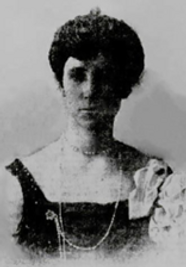
Figure 151 Mabel Thomson. Telegraph-Journal (St. John, New Brunswick), 30 October 1902, p. 1.
In March of 1897, the Thomson sisters and the Blair sisters were all debutantes. Wearing expensive dresses purchased by wealthy fathers (it was “a scene of splendor,” the crowds on Parliament Hill especially admiring the women in “lovely gowns” making their way to the Senate Chamber), the Thomson sisters and the Blair sisters (in their lateteens and early-twenties) had probably (as was the custom among many elite families) received formal lessons in how to curtsy (Ottawa Citizen, 29 March 1897, p. 7). Properly instructed on how to observe the strict requirements of fashion and etiquette, they waited nervously in line with hundreds of others to be formally introduced to Lord and Lady Aberdeen (incidentally, the former was the patron of the Ottawa Golf Club as of the spring of 1894 and the latter was asked to become patroness of the Ottawa Ladies Golf Club upon its formation in the spring of 1895).
The Thomson sisters and the Blair sisters were thus launched formally into elite society.
In February of 1898, they were all presented to Lord and Lady Aberdeen for a second time (Ottawa Citizen, 8 February 1898, p. 5). This annual occasion was the most exciting social event of the year for young society women. The society writer for the Ottawa Citizen (who went by the pseudonym “Frills”) observed the following of the 1898 event:
[It] was one of the largest and most brilliant I have ever attended.
The Senate Chamber, splendidly lighted with hundreds of electric jets, quite outshone itself in dazzling color, the warm crimson of the furnishings, the fine uniforms worn by different officers present, and the many exquisite toilettes of the ladies: silks and satins and brocades and velvets, and feathers and furbelows of all sorts and descriptions, and in every possible and impossible design, hue, color and texture.
It was a sight well worth seeing – full of life and human interest as one thought of all the little ins and outs, the anxiety to show up and put the best foot forward, the inevitable jealousies, the petty triumphs, the poor heartaches, the pride and pomp of power, the arrogance of wealth, the disappointed and the successful ….
All were in evidence, and all were smiling and bowing with their prettiest smile and bow, and everyone pretended to everyone else that there was not within a thousand miles such a thing as an ungratified desire.
Such is society! Such, indeed, is life.
(Ottawa Citizen, 8 February 1898, p. 5)
After such debuts, debutantes would surely have expected that proper husbands were on the horizon.
And they were, indeed, for Mona Thomson, Mary Blair, and Amy Blair.
Mabel Thomson visited Ottawa regularly between 1897 and 1903, always staying with the Blairs, and often spending many weeks in the city. She was close to all the Blairs’ daughters, but one of Mabel’s many friends, Ella Brewin, observed that Mabel was “Mary’s chum” in particular (Ella Brewin, letter to her mother 27 June 1901, in Ella Brewin, My Dearest Mother 1901, Letters from Canada 1901, ed. James Holme [privately printed, United States, 2018], p. 54). “Mary” (alias Marion) Blair frequently accompanied Mabel to luncheons and “at home” teas in Ottawa and occasionally accompanied her on train trips to Toronto (to watch her play golf) or back to St. John.
But as time passed, there were other chums, for, according to Ella, Mabel was always wont to acquire a new “great friend” (Ella Brewin, letter to her mother 2 August 1902, in Ella Brewin, My Dearest Mother 1902, Letters from Canada 1902, ed. James Holme [privately printed, United States, 2018], p. 65).
In St. John, Mabel was described as “a leader in the younger society set, with whom she is very popular” (Telegraph-Journal [St. John, New Brunswick], 30 October 1902, p. 1). This leadership role in St. John was probably extended to Ottawa. Mabel was invited to luncheons by Lady Edgar (who was married to the Speaker of the House of Commons); she was invited to dinners by Mrs. Blair (who, as we know, was married to the Minister of Railways and Canals); she was invited to sit in the box next to the Governor General’s box when their Excellencies attended the theatre. In short, she was invited everywhere by anyone who was someone, and many of the young women who were part of Mabel’s regular cohort at such events included up to half a dozen of her teammates on the Ottawa Ladies’ Golf Club team.
When Mabel Thomson first came to Ottawa in 1897, however, she did not play golf: indeed, she had not yet encountered the game.

Figure 152 Mabel Thomson, early 1900s.
Mabel (and sister Mona) only took up golf in the summer of 1897, shortly after the St. John Golf Club established itself that spring and immediately extended to nine holes a primitive four-hole course laid out by “a few men” the summer before (Moncton Transcript [New Brunswick, 18 July 1939, p. 6). The Moncton Transcript says that “It was on this course, built by one man and a horse, with wire fences surrounding the greens to keep away cows, that Miss Mabel G. Thomson learned to play without instruction” (Moncton Transcript [New Brunswick, 18 July 1939, p. 6).
Like Mabel, her sister Mona liked the new game very much. Indeed, she became quite proficient at it: without ever contending strongly for the title, she would play regularly in Canadian Ladies’ Amateur Golf Championships from the first one in Montreal in 1901 onwards. (At the 1901 tournament, Mabel was rated as a scratch player and Mona was awarded a handicap of 5.)
Mabel became the star, and she did so in very short order.
It was only at the end of June 1897 that “Ladies wishing to unite with the club” were invited to contact the Secretary (Telegraph-Journal [St. John, New Brunswick], 25 June 1897, p. 3). Mabel took up the game and immediately took to it: by the end of the summer, she was easily the best of the 14 women playing in Club competitions and, of course, she won the ladies’ championship in October.
By that point, Mabel Thomson had already discovered that she was a natural athlete.

Figure 153 Left to right: Mabel Thomson and Florence Harvey. 1909.
Interviewing her after her victory in the 1902 Canadian Ladies’ Amateur Golf Championship, a St. John newspaper noted that “she is regarded as an all round athlete” (Telegraph-Journal [St. John, New Brunswick], 30 October 1902, p. 1). Similarly, her friend and golf rival, Florence Harvey (1878-1962), winner of the 1903 and 1904 Canadian Ladies’ Amateur Golf Championship, later remarked: “An expert herself in any branch of athletics she has taken up, she does not often meet a girl who excels her” (Canadian Golfer, vol 1 no 2 [June 1915], p. 109).
In addition to her golf championships, Mabel would also win more than half a dozen Maritime Provinces Tennis Championships. Ralph Reville, the editor of Canadian Golfer, observed that “she amused herself between winning golf championships by carrying off prizes in tennis” (Canadian Golfer, vol 1 no 9 [January 1916], p. 547). She competed in these tennis tournaments until she was in her mid forties, making it to the singles finals in 1920 before losing, but winning the doubles title.
The British magazine Ladies’ Field made similar observations about her athletic prowess: “In addition to [her] most brilliant golfing record,” the editor observed, “Miss Thomson is a very fine tennis player, a fearless horsewoman, and a splendid swimmer” (Ladies’ Field, 12 March 1910, p. 53). She enjoyed yachting, too (her father was Commodore of the Royal Kennebecasis Yacht Club) and she engaged in competitive sailing. She owned her own canoe, and she also enjoyed salmon fishing, although it meant she became “half eaten with mosquitoes” (Ella Brewin, letter to her mother 10 July 1902, in Ella Brewin, My Dearest Mother 1902, Letters from Canada 1902, ed. James Holme [privately printed, United States, 2018], p. 46). And when she was in Ottawa in March of 1902, Toronto Saturday Night magazine reported that “Miss Thompson skates almost as well as she plays golf” (Toronto Saturday Night, cited in St. John Daily Sun, 5 March 1902, p. 5).
Mabel’s exceptional athleticism and the fact that she found “much pleasure in the pursuit of all health-giving pastimes” impressed other young women (Telegraph-Journal [St. John, New Brunswick], 30 October 1902, p. 1).

Figure 154 Ella Brewin, 1901.
When Mabel’ subsequent good friend, the slightly older Ella Brewin (1871- 1952), first met her in 1901, the latter wrote to her mother back home in England that Mabel was “lively & amusing & boy-like” (Ella Brewin, letter to her mother 27 June 1901, in Ella Brewin, My Dearest Mother 1901, Letters from Canada 1901, ed. James Holme [privately printed, United States, 2018], p. 54).
Ella gave her mother a fuller picture of her boyish new friend a month later:
Mabel is just as good as a man ….
She can manage any sort of craft, saves drowning people, is always sent for in accidents, can ride & drive anything & is splendid at golf ….
So one feels perfectly safe with her always, & Mona is really just as good but diffident.
(Ella Brewin, letter to her mother,18 July 1901, Rothesay, N.B.).
Ella enjoyed all three Thomson siblings – Mabel, Mona, and their brother Percy – but time spent with Mabel seems to have been special – even if it involved carrying her golf clubs:
My dearest Mother,
I think I must write you a short letter finishing up my Canadian visit.
I posted my last one to you on the 25th which day I spent in St John, lunching with Mrs. Percy Thomson, spending some time in the Thomson house, & finally acting as Mabel’s caddy round the golf links.
In the evening Mabel & I went out in the canoe.
(Ella Brewin, letter to her mother, 2 Aug 1901, S.S. Tunisian)
Like Ella Brewin, golf writers also regularly observed that Mabel was “as good as a man” – at least insofar as golf was concerned.
After her fourth victory in the Canadian Ladies’ Amateur Golf Championship, the Ottawa Citizen golf writer noted: “Miss Thomson is very strong, much more so than most young women, and this is a great advantage” in golf (Ottawa Citizen, 28 September 1907, p. 14). The golf writer for Canadian Magazine thought her long game was the equal of a man’s: “Miss Mabel Thomson of St. John, the present lady champion of Canada, usually expects to drive a ball one hundred and seventy-five yards from the tee. Few men do better than that” (Canadian Magazine, vol 26 no 1 [November 1905], p. 43). A Montreal golf writer concurred: “Miss Thompson’s style is perfect, and she has a tremendous drive with very good direction: in fact, in the long game she could easily hold her own with the best men players” (The Standard [Montreal], 13 October 1906, p. 6).

Figure 155 A photograph of Mabel Thomson called "Driving!" Canadian Magazine, vol 28 no 1 (November 1906), p. 81.
She regularly won long driving competitions. In 1910, Ladies’ Field observed:
Miss Mabel Thomson, St. John, New Brunswick, has for years been the best known figure in the Canadian golfing world.
Her game is characterized by an easy, graceful swing, and she is one of the longest drivers in America.
(Ladies’ Field, 12 March 1910, p. 53)
Between 1900 and 1910, almost no one could match her driving. At the Toronto Golf Club in the fall of 1900, at the first tournament open to all women of recognized Canadian golf clubs, Mable Thomson won the long drive competition with a hit of 160 yards (Toronto Star, 10 October 1900, p. 1). She got longer as the years passed. Winning the driving contest at the 1909 Canadian Ladies’ Amateur Golf Championship, she hit her longest drive 203 yards (Telegraph-Journal [St John, New Brunswick], 25 August 1909, p. 1).
After her first Canadian Ladies’ Amateur Golf Championship win in 1902, the swing that achieved these prodigious results was celebrated:

Figure 156 Mabel Thomson. Montreal Star, 9 November 1901, p. 19.
Miss Mabel Thomson of St. John, lady golf champion of Canada, is a player who will do justice to her title on any links.
Miss Thomson plays with distinction a game that is brisk and brilliant.
In driving, she addresses the ball briefly and takes a full, free swing – getting a length of about 170 yards on average. It is said that on her home links at St. John, she has frequently driven over 200 yards, and one can readily believe it.
Her brassey [that is, “3-wood”] shots are quickly made and carry about as far as her drives.
Although Miss Thomson’s short game is sound, it is her long game that particularly gives her an advantage over her opponents ….
(Toronto Star, 11 October 1902, p. 6)
A description of her swing in 1907 suggests that she had mastered the art of lag during the downswing:
Her driving and brassey strokes were simply perfect – being sure, straight, and long.
Her long approaches – that is, her full iron or mashie [that is, “five iron”] shots – matched her club work ….
Her wrist work … is superb and at once attracts attention.
She takes a full swing back slowly. Bringing the club head down with accelerating speed, she snaps it through with her wrists as it comes in contact with the ball. She seems to time this with the greatest accuracy and invariably gets a long, straight ball.
She uses the same wrist motion with marvellous precision on her full iron shots.
(Ottawa Citizen, 28 September 1907, p. 14)
In 1915, Florence Harvey similarly celebrated “her graceful swing and splendid wrist action, with the resultant low, long shots with both wooden clubs and irons” (Canadian Golfer, vol 1 no 2 [June 1915], p. 110).
How could Mabel Thomson ever lose with such a length advantage over her competitors?
Golf writers were polite about the matter, but they agreed that her short game was deficient. They might come at the matter indirectly: “Although Miss Thomson’s short game is sound, it is her long game that particularly gives her an advantage over her opponents” (Toronto Star, 11 October 1902, p. 6).

Figure 157 Mabel Thomson putting at the 1908 Canadian Ladies' Amateur Golf Championship at Lambton Golf Club. Rod and Gun, vol 10 no 8 (January 1909), p. 759.
Or they might spell it out: “she was weak in her short approaches and her putting. If Miss Thomson could strengthen her game in these departments, she would cut six or eight strokes off her … score” (Ottawa Citizen, 28 September 1907, p. 14).
How she acquired such a good swing by 1902 is an interesting question, for she was entirely self-taught when she took up the game in 1897 – a fact borne in upon her as soon as she encountered the best golfers in Quebec and Ontario, as we can see when she was interviewed in St. John after her 1902 victory:
The bright young champion has been playing golf only since the establishment of the local club about four years ago and has never had the advantage of professional training, which makes her triumph all the more noteworthy….
“The players in the upper provinces have a professional coaching them nearly all the time, and when they get the least bit off, he puts them straight again. Of course, I have never had that advantage.”
(Telegraph-Journal [St. John, New Brunswick], 30 October 1902, p. 1)
She recognized that she lacked the “advantage” of instruction by a golf professional, but one of the great benefits of being a member of the Ottawa Ladies Golf Club and playing on its teams against the best players from the Quebec, Montreal, Toronto, and Rosedale Clubs is that she learned by observing them what the top women on these teams had been taught by their professional instructors. And so, the self-taught swing of the golfer who won the inaugural championship at the St. John Golf Club in 1897 was not the swing of the golfer who won the 1902 Canadian Ladies’ Amateur Championship.
Since Mabel Thomson knew that her rivals benefitted from instruction by golf professionals, I wonder if she asked for swing advice from the Ottawa golf professionals. It is possible that she encountered Joseph Baizana at the Club in 1898, but he left at the end of that season and so was not there when she became such a prominent member of the women’s team in the spring of 1899. William Divine succeeded Baizana and served at the Club until the end of the 1903 season, so Mabel will certainly have met him.
Playing over the Chelsea Links with such an exceptional golfer as Mabel Thomson will have improved the abilities of many of her fellow members of the Ottawa Ladies’ Golf Club. And it is likely that she exerted a good influence on the developing culture of the Ottawa Ladies’ Golf Club – not just on the course, but off it as well.
As we know, Harvey celebrated Thomson as a “thorough sportswoman,” but accompanying her exceptional abilities and competitiveness was another “outstanding quality” – “a genuine appreciation of anyone who can do a thing well”: “An expert herself in any branch of athletics she has taken up, she does not often meet a girl who excels her, but no matter if it be only in a small point, perhaps one special golfing shot, she is generously outspoken in her admiration of it” (Canadian Golfer, vol 1 no 2 [June 1915], p. 109).
We can certainly see from an interview she gave to a St. John newspaper after her win at the 1902 Canadian Ladies’ Amateur Golf Championship that she was q gracious winner. She was quoted “speaking in a general way of the game in Toronto”:
It was thought throughout that Miss Phipoe [of Hamilton] would be a sure winner, for she had made some splendid scores and was the favorite because she had played so well.
However, golf is a curious game and one can hardly ever be sure just how things are going to turn out.
Anyway, Miss Phipoe went to pieces.
She has played a good deal in Scotland and intends going back there this year, I believe.

Figure 158 Isabella Dick. Rod and Gun, vol 10 no 8 (January 1909), p. 760.
Mrs. [Isabella] Dick, with whom I played finals, was very nervous and it was owing to that [that] she, too, succumbed.
I tried to keep cool and people were kind enough to say that my work was good.
The players in the upper provinces … were all good players, though, and [were] extremely kind to me in every way….
St. John people have been most kind in their expressions of pleasure, and because they are pleased, I am very glad to have brought home the championship.
(Telegraph-Journal [St. John, New Brunswick], 30 October 1902, p. 1)
This interview suggests that Mabel Thomson needed no media coach to tell her how to manage her brand.
Watching her win the 1902 championship, the golf writer of the Toronto Star became a big fan of Mabel Thomson’s similar demeanour on the golf course as she supplemented her golfing skills “with her admirable temperament”: “She remains chirpy and unruffled no matter how the current of the contest may be running” (Toronto Star, 12 October 1902, p. 6).
As all golfers know, to remain unruffled in the face of the slings and arrows of outrageous golfing fortune is a skill in its own right – perhaps another of Mabel Thomson’s self-taught skills, for her progress as a golfer was not all smooth sailing.
In 1901, for instance, there was an unintentional but nonetheless embarrassing breach of the rules:
At the end of the eighteen holes, the two ladies were equal and the first hole was played over again to reach a definite conclusion.
Miss Thomson drove her ball to an awkward lie amongst the trees which form the boundary hazard. A caddie and a spectator held away some branches which interfered with [her] brassey shot and the hole was halved.
By using help to get out of the hazard, Miss Thomson violated – no doubt unintentionally – the rules of the game and Miss Marler would have been perfectly justified in protesting her.
(Gazette [Montreal], 17 October 1901, p. 2)
It seems that neither the competitors nor the official scorer recognized this breach of the rules when it occurred and it is not clear when it was noticed. The Gazette reporter merely observes: “An unfortunate incident in the play for the semi-finals gave Miss Marler of Montreal right to protest Miss Thomson, but the strict letter of the law will not be insisted upon” (Gazette [Montreal], 17 October 1901, p. 2). Apparently, the rule against improving one’s lie by holding branches back was not well known, for it turns out that the spectator who assisted Thomson’s caddie in holding the branch back was another competitor – Marler’s friend “Miss Linton,” who was also Secretary of the Royal Montreal Ladies’ Golf Club:
Miss Marler drove well out onto the green, but Miss Thomson drove her ball into the boundary hazard.
It was a bad lie and she took the caddy in to pull the bushes back, while Miss Linton also went to the rescue.
Miss Thomson drove out beautifully, but the holding back of the bushes was a serious breach of the rules and disqualify Miss Thomson had Miss Marler entered protest.
(Montreal Star, 16 October 1901, p. 6)
Marler and Thomson tied this first extra hole, but Thomson won the second extra hole and advanced to the final. Clearly, no one recognized the breach of the rules until after the match concluded.
As the golf gods are wont to do, when the championship match began the next day, they placed Mabel Thomson’s first shot of the day in the very same trees:
Miss Thomson led off yesterday morning and placed her ball in exactly the same spot in the boundary hazard as she did on Wednesday when the caddie went in and held the bushes back.
This morning, she had to play her ball out as best she could.
She played it well and stood as well down field as [her opponent] on her first two strokes.
(Gazette [Montreal], 18 October 1901, p. 7)
How unnerving, after the first shot of the championship round, to be reminded that there was a question of whether one really deserved to be in the final!
Reporters remembered the rules infraction from the day before; one knows that Mabel Thomson never forgot it.
Two years later, she faced another difficult situation on the golf course when an officious referee’s extraordinary decision that prematurely ended her attempt to defend her title at the 1903 Canadian Ladies’ Amateur Golf Championship.
Playing Florence Harvey in the semifinal match and finding herself two holes down as they played the 16th hole, Mabel left her fourth putt hanging on the edge of the hole. Since balls were not marked and lifted in those days, the ball remained there as Harvey took her own fourth shot, leaving the ball in the same position on the other side of the hole:
A Fuller Account of Thursday’s Game Shows That the Scorer Was to Blame for Miss Thomson’s Defeat ….
Miss Thomson was away; she putted …. and lay on the rim of the cup.
Miss Harvey did likewise and both lay alike.
There was no apparent necessity for putting [the ball] down.
Miss Thomson nodded to Miss Harvey and picked up the ball. Miss Harvey was about to do the same when the scorer stepped forward and announced that Miss Thomson had lost the hole and the match.
(Telegraph-Journal [St. John, New Brunswick], 19 September 1903, p. 1)
Picking up one’s ball was a way of conceding a hole to one’s opponent. The scorer mistook the players’ concession of each other’s putts for Mabel’s concession of the hole. There seems to have been no way back from the scorer’s decision.
Mabel seems to have accepted this injustice with equanimity. I wonder if she thought to herself that “what goes round comes round.”
Mabel Thomson played competitive golf well into her fifties, but when she turned 40, she lost five years to World War I, which thoroughly disrupted Canadian golf. Not only were national championship tournaments suspended, but so were inter-club matches – and even club events. All attention was focused on the war effort, and in this spirit, Mabel Thompson became active as an organizer of charitable patriotic activities in St. John during World War I and, since so many young Canadian nurses were going overseas to help with the war effort, Mabel sought to help on the home front by studying first aid and home nursing in St. John, passing examinations in each.
Then she returned to competitive golf.
After she made the semifinals of the Maritimes Ladies’ Championship in 1925, the editor of Canadian Golfer observed:
Years ago, the Maritimes boasted the leading lady golfer of Canada in Miss Mabel Thomson of St. John, N.B. She created a record when five times she won the women’s championship of Canada. The first time was nearly a quarter of a century ago ….
In those days, she was simply unbeatable in the ladies’ realm of golf. At the recent Maritimes [championship] at Yarmouth, showing that she is capable still of playing a first-class game, Miss Thomson reached the semifinals ….
This record of five championships made by the St. John player has never been equalled in any major Lady championship in this country, the States or Britain.
(Canadian Golfer, vol 11 no 4 [August 1925], p. 310)
Her last hurrah in golf was to win the club championship of the Riverside Golf and Country Club (the renamed St. John Golf Club) in 1927 at age 53.
Note, mind you, that she appeared in the final again four years later.
Balls, clubs, courses, and swings had all changed in extraordinary ways between 1897 and 1931, and yet Mabel Thomson rode that wave of golfing innovation like no other Canadian woman from age 23 to age 57!
So how is it, precisely, that Royal Ottawa stakes a claim to Mabel Thomson as being one of its members when she became the Canadian Ladies’ Amateur Golf Champion of 1902?
We know that she represented the Ottawa Ladies’ Golf Club in matches in 1899 and 1900 both on the Chelsea Links and in matches at Quebec, Toronto, and Rosedale. She was back in Ottawa in 1901 staying with the Blaies. She was in Ottawa in March of 1902 – Toronto Saturday Night reported that “Miss Thompson skates almost as well as she plays golf” – and she was back in Ottawa for a week that June (Toronto Saturday Night, cited in St. John Daily Sun, 5 March 1902, p. 5). It is likely that she played golf at the Chelsea Links from 1899 to the summer of 1902.
It is possible that she first played at the Chelsea Links when she was in Ottawa in 1898, but I can find no record of such play. She may have been introduced as a guest, or, like her friend Ella Brewin, she might have had her name put in for a fortnight’s play. The Club had the following rule: any member “wishing to bring a stranger to the club can do so and the latter can enjoy its privileges for two weeks, on being duly introduced” (Ottawa Journal, 19 April 1898, p. 3). And there was also the possibility of becoming a “monthly member” – in 1897, for example, there were five monthly members (Ottawa Journal, 7 April 1897, p. 6). Or she may have been a social member, a category of membership that allowed for a certain amount of golf: “Any member playing twelve times in the season would have to pay the increased fee of a playing member instead of that of a non-playing one” (Ottawa Daily Citizen, 7 April 1897, p. 7).
By the spring of 1899 Mabel Thomson a full member of the Ottawa Ladies Club. She attended one of the first teas of the year on May 19th with her buddy Mary Blair. She was selected at this time to join the team travelling to Quebec to play against members of the Quebec Ladies’ Golf Club on its 14-hole course on Cove Field. All her teammates were present at the May tea. In the subsequent contest, seven of the eight Ottawa players lost their matches and so contributed no holes in the teams 47 to 1 loss, whereas Mabel Thomson made an immediate impression by beating one of Quebec’s strongest players: “Mrs. Meredith, one of the Quebec club’s most steady players, was the only one on her side down, and Miss Thomson, who won out against her, played a remarkably strong game” (Ottawa Journal, 1 June 1899, p. 3).
On 6 June 1899, “the ladies of the Toronto Golf Club” visited Ottawa (Ottawa Journal, 6 June 1899, p. 3). Toronto fielded a team of 11 players on the Chelsea Links and fell to the Ottawa Ladies’ Golf Club by a score of 29 holes to 23. Mabel Thompson again stole the show:
The Ottawa Ladies’ Golf Club, which was so badly beaten at Quebec a few weeks ago, has redeemed itself. Tuesday morning, it met and defeated the Toronto club by six holes up….
One of the home club’s most expert players is a New Brunswicker in the person of Miss Thomson, daughter of Mr. Robert Thomson of St. John.
(Ottawa Citizen, 8 June 1899, p. 5)
In May of 1900, the Ottawa Ladies Golf Club travelled to Toronto to take on the women’s team at the Toronto Golf Club on Victoria Day, and the Ottawa team unexpectedly prevailed again. In those days, each pair of Ottawa and Toronto players played a full eighteen hole round, keeping a tally of holes won. The match was not over when one player had won more holes than remained to be played; the match was played to the end of the 18th hole and the total of surplus holes won by the victor was added to the total of such holes won by the 9-person team as a whole. Ottawa defeated Toronto by 17 holes to 15 holes, and in her match alone, Mabel Thomson won 7 of Ottawa’s 17 holes.
The Ottawa women then went on to play the Rosedale Ladies’ Golf Club. As it happens, they were defeated in this contest, but they returned to Ottawa with tails high: “The ladies of the Ottawa club feel proud over their defeat of the Toronto Ladies’ Club, though in competition with the Rosedale Club they suffered defeat” (Ottawa Citizen, 15 June 1900, p. 7).
To play in the interprovincial golf competitions between Ontario and Quebec, Mabel Thomson had to be a member of a golf club in one of these provinces. As a member of the Ottawa Ladies Golf, she represented the province of Quebec. (Ottawa golfers represented Ontario when the Club’s course was in Sandy Hill, but they represented Quebec when the Club started to play at the Chelsea Links.) And so, everyone knew that although she was also a member of the St. John Golf Club, she was a proper member of the Ottawa Golf Club. And so, at the interprovincial competition at the Toronto Golf Club in October of 1900, the Globe referred to her as “Miss Thomson of the St. John and Ottawa Clubs” (Globe [Toronto], 11 October 1900, p. 10).
Similarly, Toronto Saturday Night recognized her as a member of the Ottawa Ladies Golf Club:
Four ladies from the Ottawa Golf Club went up to Toronto last Tuesday – Miss Mary Scott (captain of the Ottawa Ladies’ Golf Club), Mrs. Charles Sparks, Miss S. Sparks, and Miss Lemoine.
Miss Mabel Thomson, who has played with Ottawa before, is at present in Toronto and it is almost certain that she will play on the Quebec team, which will make five representatives from Ottawa.
(Toronto Saturday Night, 13 October 1900, p. 6)
Playing on the Ottawa Ladies Golf Club team in matches against other (bigger) clubs in Quebec and Ontario was essential for Mabel Thomson’s development. Recognized from the beginning as the best player in the Ottawa Ladies’ Golf Club, the Ottawa captain usually sent Mable out against the other Club’s best player. These matches against the best players in Ontario were no doubt welcomed by Mabel, for no such level of competition was available to her in the Maritime provinces where, as we recall Rod and Gun observing, she never lost a Maritime Provinces Ladies’ Golf Championship.
Probably the most significant match that she played as a member of the Ottawa Ladies Golf Club was in the first Canadian open championship held at the Toronto Golf Club in the fall of 1900. In her interprovincial match against the best of the Toronto-area golfers, Isabelle Louisa Elizabeth Bernard (alias Mrs. John Dick, 1860-1934), she lost by four holes. Dick won that open championship by medal play. Mabel must have learned a great deal from this match about what it would take to beat her in competition – as she did in the final match of the 1902 Canadian Ladies’ Amateur Golf Championship.

Figure 159 Muriel Dick. Rod and Gun, vol 10 no 8 (January 1909), p. 758.
Mabel would later encounter Isabelle’s daughter Muriel (born 1885) in Canadian Ladies’ Amateur Golf Championship tournaments. In fact, she won her fourth championship by defeating Muriel Dick in the 1907 final match.
Mabel Thomson was thoroughly integrated into the Ottawa Ladies’ Golf Club.
In 1901, she travelled with the Ottawa golfers to Montreal for the first Canadian Ladie’s Amateur Golf Championship, and during the event she qualified to represented Quebec in the interprovincial contest against Ontario by virtue of her membership of the Ottawa Ladies’ Golf Club.
It will be noticed that Miss Thomson, of St. John, N.B., who played off with Miss Young for the championship on Thursday, played for the Quebec team.
The fact of her being a member of the Ottawa Club, which is considered as a Quebec club by the [Royal Canadian Golf] Association, made her eligible.
Gazette [Montreal], 19 October 1901, p. 2)
When Mabel finally won the Canadian Ladies’ Amateur Golf Championship at the Toronto Golf Club in October of 1902, she was still a member of the Ottawa Golf Club and so again represented Quebec in the interprovincial match between Quebec and Ontario (Montreal Star, 11 October 1902, p. 18).
The fact that she was a member of the Ottawa Golf Club was well known in Ottawa. What was less well known, it seems, was that she was also a member of the St. John Golf Club, which prompted the Ottawa Free Press to warn its readers that should Mabel Thomson win the championship, Ottawans should not try to claim her as their own:
Next week, the eyes and thoughts of every lady golfer in this dominion will be fixed on Montreal. Next week will be the greatest week so far in the annals, and [a] never to be forgotten week in the history of Canadian ladies’ golf clubs….
The ladies who go down from the Ottawa club to contest the championship are Miss Mary Scott, Miss Lemoine, Miss Florence Sweetland, and Miss Gormully.
The Misses Thomson, who are guests of Mr. and Mrs. Blair, will go down with the Ottawa ladies and be of their party at the Place Viger ….
But if either of the Misses Thomson should win the championship, the honor will rest upon the ladies’ golf club of St. John, N.B., of which they are members.
(Ottawa Free Press, 12 October 1901, reprinted in the St. John Daily Sun, 15 October 1901, p. 4)
Note that at the 1903 championship, Mabel Thomson played for Ontario: she had become a member of the new Lambton Golf Club.
Perhaps enough time has now passed that we can set aside the reticence expressed by the Ottawa Free Press about stepping on the toes of the St. John Golf Club and simply acknowledge a historical fact: from at least 1899 to 1902, Mabel Thomson was a member of the Ottawa Golf Club, embraced and nurtured by the Ottawa Ladies’ Golf Club as she learned how to compete against the best women golfers in Canada, and so it is simply a matter of historical record that when she became Lady Champion of the Year in 1902, she thereby became the Royal Ottawa Golf Club’s first national champion.
Conservator of the Links: Joseph Baizana

Figure 160 Joseph Baizana. Ottawa Citizen, 15 June 1940, p. 6.
Accompanying the Club when it moved from Sandy Hill to the Chelsea Road was Ricketts’ assistant, Joseph Baizana (1865-1950).
He was accorded several different names: caretaker, guardian, ground man, gardener, greens keeper, and golf professional.
As we know, in those days, a golf professional might be given any or all these things, as well as instructor, layout man, club maker, and ball maker.
In the Rules and Regulations of the Ottawa Golf Club, published in 1899, Baizana was designated by an ever rarer term: “conservator of the links.”
And since he was born in St. André d’Argenteuil, Quebec, Joseph Baizana became, via his employment by the Ottawa Golf Club beginning in 1896, both Quebec’s and Canada’s first native-born golf professional.

Figure 161 Launcelot Servos, early 1900s.
Perhaps the only serious rival to Baizana’s claim to have been the first Canadian-born golf professional is Lancelot Servos (1879- 1969), of Niagara-on-the-Lake. Born in Buffalo, New York, in 1879, but raised in Niagara-on-the-Lake from the age of three, Servos’s first professional appointment was in the United States in 1898. That year, he worked at both the Allston Golf Club in Boston, Massachusetts, and the Wentworth Hall golf course in Jackson, New Hampshire.
As late as 1897, however, we know that Servos considered himself an amateur, for he served as such on the organizing committee for the International Tournament at Niagara-on-the-Lake that year and then entered that tournament as an amateur.
Only after he broke the course record by four strokes in the opening round of the competition did other players object that he must be disqualified as a golf professional since he had worked as a caddie during the 1896 season. At that time, he had expressed the “the intention of becoming a professional” (The Times [Niagara-on-the-Lake, Ontario], 10 September 1897, p. 1).
Baizana clearly preceded Servos as a golf professional. He was the Ottawa Golf Club’s assistant professional in 1895 and he became the head professional in 1896.
How had this come to be?
We recall that in the spring of 1895, still hoping that it might be able to continue at its Sandy Hill golf course for a few more years before suburban development forced it to relocate, and determined to make its course a proper test for the first Canadian Amateur Golf Championship to be staged on it in June, the Ottawa Golf Club authorised Ricketts to hire and train an assistant so that a vigorous programme of course improvement could be undertaken: “various changes and improvements have been decided on, an assistant to the professional has been engaged, and every effort will be made to have the green [that is, the golf course] the finest in America” (Ottawa Journal, 13 April 1895, p. 7).
In the 1890s, an assistant professional was effectively an apprentice to the head golf professional, learning from him all that a professional must know: how to keep a green, how to play the game, how to teach the game, how to make and repair clubs and balls, how to manage caddies, and even how to design a links.
Rumours emerged in 1895 that Ricketts might leave the club. Late in the summer, the Ottawa Journal tried to extinguish such a rumour: “Ricketts spent one week in Coburgh [sic; Cobourg] coaching the players there, but there is no truth in the rumor that he will stay there” (Ottawa Journal, 5 September 1895, p. 6). It is possible that before the 1895 season, Ricketts had given the Club reason to think that he might leave Ottawa and that the Club authorized hiring an assistant that he could train to replace him.
Given that apprenticeship to a golf professional often lasted as many as five years, just how much Ricketts’ assistant professional could have learned from him over the course of the eight months he spent with him in 1895 is an open question. Presumably, he would at least have learned the basic greenkeeping techniques and ground maintenance schedules required to keep the various parts of a golf links healthy and playable over the course of a golf season.
The assistant professional in question is never identified in the Ottawa newspapers, but it is virtually certain that he was Joseph Baizana.
After Ricketts left for the United States in November of 1895, Baizana (sometimes misspelled Baziana, Bazana, Bazena, Bazina, Baezana, Bezano, etc.) was listed in Ottawa City Directories from 1896 to 1899 as “caretaker” for the Ottawa Golf Club, and his residence was always given as the clubhouse of the Ottawa Golf Club. In the 1896 directory, we find the following listing for the building at the corner of Russell and Osgoode: “Ottawa Golf club, Joseph Baizana, caretaker.” The Club had already moved to the Chelsea Road site by the time the 1896 directory was published, but we recall that the clubhouse was not ready for occupation at the beginning of the season, so I presume that Bazaina continued to reside in the old clubhouse. In the 1897 directory, we find the following entry:
GATINEAU ROAD ….
East Side ….
Second toll gate
Ottawa Golf club
Bazana Joseph, caretkr ….
(Ottawa City Directory [Toronto: Might Directory company, 1897], p. 491)
In the early 1950s, when Madge Macbeth devoted two of her columns to the subject of golf in Ottawa before the Club’s move to the Aylmer Road, she received letters from old timers interested in the question of where the Sandy Hill clubhouse had been located:
I have stirred up some discussion among Old Timers as to where the Club House was – if there was a Club House.
One group declares that when the Dominion of Canada Rifle Association moved its ranges from that same area, the golfers used the caretaker’s home as a Club House.
Another group states positively that there was no proper Club House – that the golfers used the caddy’s house, approximately at the corner of Russell Avenue and Osgoode Street.
(Ottawa Citizen, 5 January 1952, p. 30)
We know, of course, that there had indeed been a proper clubhouse, but Macbeth had not arrived in Ottawa until after the Club’s move to the Chelsea Links, so she did not recognize that her correspondents referring to the “caretaker’s home” and her correspondents referring to the “caddy’s house” were referring to the same building – the clubhouse “at the corner of Russell Avenue and Osgoode Street.”
This building had been purpose-built as a clubhouse. It became the “caretaker’s home” only late in 1895 when Baizana moved in (we recall that Ricketts lived on College Street). Baizana, that is, was both the caretaker and the caddy mentioned by the different groups of “Old Timers” – although his job was probably not caddie, but rather caddie master.
An article published in the Montreal Star suggests that for some members of the Ottawa Golf Club, Baizana did not pass muster as a proper golf professional: “Since the inception of the club, when Alf. Ricketts was professional, the club has had no professional but has been satisfied with a ground man” (Montreal Star, 19 April 1904, p. 2).
A proper golf professional, of course, was also a “ground man” – that is, greenkeeper. We recall that after Ricketts’ first year at the Club, President Irwin “spoke very kindly of the professional Ricketts,” affirming that he “was a good ground man” (Ottawa Journal, 4 April 1894, p. 7). But a ground man was not necessarily also a proper golf professional. Perhaps the basis of the criticism that Baizana was not a proper golf professional was that he was not a club maker, for it is unlikely that he had sufficient time to have acquire this skill from Ricketts.
Baizana does not seem to have been deficient in regard to his skill as a golfer. The Baizana family recalled having been told by him that he had played golf with Club members: “In the early days of golf, Mr. Baizana played with Sir George Perley and several other prominent men” (Ottawa Citizen, 15 June 1940, p. 6). Perley and other members played golf with Baizana for the same reason they had played with Ricketts: as a way of receiving instruction and as a way of creating a high-calibre match. In the British system of golf instruction, the golf professional did not take a student aside and build up the elements of a golf swing by practice on a range but rather by playing a round of golf alongside the student, stroke for stroke. To have been invited to play with Club members, Baizana must have been respected for his golf skills.
A hint as to his abilities may be contained in Newman’s 1898 account of the Club. Secretary Simpson informed Newman of the course record for the Chelsea Links: “the amateur record is held by E.C. Grant who made the 18 holes in 81 strokes on May 24, 1897” (Golf [New York], vol 2 no 4 [April 1898], p. 13). This statement about “the amateur record” (emphasis added) may imply that there was also an unmentioned “professional record” that was even lower than 81: if so, it would have been Baizana’s record (there is no report of any other professional playing the course when Baizana was the golf professional at the Chelsea Links from 1896 to 1898).
Simpson provided Newman with the names of the Club’s 1897 officers and he also provided the name of one more person: “Greenkeeper, Joseph Bazano [sic]” (Golf [New York], vol 2 no 4 [April 1898], p. 13). The same information was included a year later in Newman’s Official Golf Guide 1899.
Note that in both his Official Golf Guide 1899 and in his 1898 essay on golf in Canada, Newman generally used the words “greenkeeper” and “professional” as synonyms. For example, in the Official Golf Guide 1899, the Toronto Golf Club’s golf professional from 1895 to 1899, Arthur Smith (he was thirteenth at the 1899 U.S. Open, two strokes ahead of Ricketts), was listed not as the Club’s golf professional but rather as its “greenkeeper” (Official Golf Guide 1899, p. 318). And in his 1898 Golf essay on golf in Canada, Newman also called Smith the Club’s “greenkeeper” when he attributed to him the Toronto course record (Golf [New York], vol 2 no. 4 [April 1898], p. 18). Newman used the words golf professional and greenkeeper interchangeably, of course, because the one job entailed the other in the 1890s.
I find one other interesting reference to Baizana.
At the end of October 1898, when the Ottawa Ladies Golf Club lost to the Ladies’ Golf Club at Toronto, a society reporter for one of Toronto’s newspapers (she went by the pseudonym “On Dit”) observed: “The ladies from the gay capital took their downfall very kindly, as, being beginners, and without a professional at their club, their defeat was by no means unexpected” (cited in Ottawa Journal, 1 November 1898, p. 8).
It is not clear whether this report indicates that the Ottawa women had told folks in Toronto that they did had a greenkeeper named Baizana but did not regard him as a proper golf professional or whether they had perhaps bemoaned the fact (as implicit explanation of their poor performance) that their golf professional Baizana had left the Club earlier in the 1898 season before the beginners on their team could benefit from his instruction.

Figure 162 Joseph Baizana's rare autograph.
Baizana left no doubt as to how he regarded himself.
In the 1899 Ottawa City Directory, he gave his occupation as “professional golf player.”

Figure 163 Marguerite Metivier, Ottawa Citizen, 16 March 1940, p. 6.
Joseph Baizana had been born 6 December 1865 in St. André d’Argenteuil, Quebec. His father Alfred (1833-1925) had immigrated to Canada from Genoa, Italy, and married Marguerite Metivier (1845-1944) of Nicolet, Quebec.
Married in Marguerite’s hometown, the couple moved their family to Ottawa in 1866. Marguerite established herself as a confectioner. Alfred, who later claimed “there were only about ten Italians in the city” at that time, became a sculptor (Ottawa Journal, 12 April 1902, p. 9). Marguerite later claimed that her husband “made the first bust of Sir Wilfrid Laurier” and that “the fine decoration work at which he was an expert [was] found in hundreds of the older Ottawa residences” (Ottawa Citizen 4 February 1944, p. 12; 16 March 1940, p. 6).

Figure 164 Alfred Baizana stands in the doorway of his shop on Sussex Drive, Ottawa, Ontario, in the early 1900s.
Their son Joseph Baizana began work as an electric lineman in the 1880s, a fact that may have left him with the connections that led (after his career as a golf professional ended) to employment as a Motorman by the Ottawa Electric Railway Company from 1899 to 1933.

Figure 165 Quebec Morning Chronicle, 29 June 1894, p. 4. Harry Boakes won the American Professional Racquets Championship in 1883 and was regarded as the court tennis champion of Canada in the early 1890s.
But Baizana was also an exceptional athlete. He excelled at a number of racket sports, including “real tennis,” a game played on an indoor court – about 18 meters by 9 meters – with four walls, all of which were in play. He competed in professional “real tennis” competitions in Ontario and Quebec. He was also an expert at lawn tennis.
He served for several years as the professional of the Quebec City Raquet Court, whose clubhouse was shared with the Quebec Golf Club, and then he served as the professional at the Ottawa Racket Court.
A 1940 newspaper article about the five generations of the Baizana family then living in Ottawa provides a brief account of Joseph’s history in local sports:
Mr. Baizana was widely known as a professional golfer and racket player.
For many years he served as professional at the old Ottawa Racket Court …. Professional tournaments took him to Quebec, Montreal and other points.
Mr. Baizana was professional and caretaker at the old Royal Ottawa Golf Club. The club was then located where the Hull plant of the Canada Cement Company now stands.
In the early days of golf, Mr. Baizana played with Sir George Perley and several other prominent men.
He also played tennis in his younger days.
He is still of robust health.
(Ottawa Citizen, 15 June 1940, p. 6)
Through his professional standing in racket sports, Baizana probably became known to various members of the Ottawa Golf Club before the club had even been formed.
For instance, both in Quebec City and in Ottawa, Lieutenant-Colonel D.T. Irwin was a dedicated and skilful tennis player before a knee injury in the late 1880s led him to explore golf as an alternative expression of his enthusiasm for sports, leading to his becoming one of the founders of the Ottawa Golf Club in 1891. He will have known Baizana for some years before the latter became Ricketts’ assistant in the spring of 1895 and may well have been the one who recommended him to Ricketts.
At the end of 1895, two things became clear to the Ottawa Golf Club: it would have to leave Sandy Hill, and its golf professional Alf Ricketts was intent on leaving Ottawa. As we know, before he left, Ricketts laid out a thirteen-hole golf course on the approximately 100 acres of land acquired by the club along the Chelsea Road, and Joseph Baizana was asked to carry on at the Club in the way that Ricketts had trained him to do.
One of the last things that Ricketts taught Baizana may well have been how to lay out a golf course, for it is likely that before Ricketts left Ottawa in November of 1895, he took Baizana to the Chelsea Road site to explain his vision for the golf course there – a vision that Baizana would be expected to realize.
In the years that followed the move to the new location, Baizana’s work to realize this vision certainly pleased the members of the Ottawa Golf Club.
A good deal of hard work on the Chelsea Links was necessary in April and May of 1896 just to get the new course playable, but newspaper items earlier in April imply that at the beginning of the month, Baizana was probably preparing the Sandy Hill course for another season of golf.
The Ottawa Journal described the beginning of April 1896 as the “go-between season when the skating and winter amusements are over and the ground is not yet ready for golf” (Ottawa Journal, 4 April 1896, p. 5). After the Club’s annual general meeting on April 7th , there was still no mention of any plans to move to Hull and so, when it announced that “The members will commence playing shortly,” the implication is that play would soon begin on the Sandy Hill links (Ottawa Daily Citizen, 8 April 1896, p. 3).
A week later, there was an item about the eagerness of golfers to start play:
Golfers are Impatient
Members of the Golf Club are impatient to get at the game again.
They were playing this time last year but it is hardly likely that the ground will permit play before ten days or two weeks.
(Ottawa Journal, 10 April 1896, p. 3)
The “ground” in question again seems to be the Sandy Hill links.
And the very next day after the Ottawa Journal broke the story on April 17th that “THE OTTAWA CLUB MAY MOVE TO THE CHELSEA ROAD,” the Ottawa Daily Citizen announced that the Club’s first handicap tournament of the new season was taking place that afternoon (April 18th):
GOLF
Match Today
The first handicap golf match will take place this afternoon at 3 o’clock.
Committee meeting at 2:30.
(Ottawa Daily Citizen, 18 April 1896, p. 3)
Since planning for the move to the Chelsea Road had not yet been approved by Club members on April 17th, the April 18th handicap match must have been planned for the Sandy Hill course, which Baizana must have had ready for play by then.
Now, however, there was a new course for Baizana to build, and he had it ready for play by May 2 nd: “The weekly handicap golf match will take place this afternoon on the links on the Chelsea Road” (Ottawa Daily Citizen, 2 May 1896, p. 3). Not surprisingly, many members came out to try the new course:
GOLF
On the New Links
There was a large turnout of golfers Saturday afternoon on the new links on the Chelsea Road.
The greens were somewhat rough and interfered with the scores of the players, but work is to be commenced immediately to put them in good order.
(Ottawa Daily Citizen, 4 May 1896, p. 3)
That play was commenced on such a new course less than two weeks after starting to build it was not unusual in the 1890s. For instance, when Willie Davis laid out the Sandy Hill course on 27 April 1891 (in the company of four Club members), that very day “A trial was made of the ground and it was found very satisfactory for the purposes” (Ottawa Journal, 28 April 1891, p. 4). The Club had announced several days before Davis’s visit that “it is expected that in the course of a couple of weeks all will be in readiness for practice games” (Ottawa Daily Citizen, 21 April 1891, p. 1). And, indeed, play began in May and continued right through to December.
Note also that the weather at the beginning of May was unusually warm (one newspaper report expressed surprise that so many golfers turned out to play on May 9th “despite the intense heat”), which may have helped the grass on the new putting-greens to come along quickly (Ottawa Journal, 11 May 1896, p. 7). By May 14th, there was real optimism that the course would be in decent shape for the visit of the Kingston Golf Club 11 days later:
GOLF AT THE NEW LINKS
Members are Greatly Pleased with the Situation of the Grounds
There was a good attendance of golfers on the links yesterday afternoon [May 14th].
The Greens are fast being improved and are expected to be in very fair condition by the 25th May when the Kingston Club will be played….
Although there is a great deal yet to be done before the course itself will be in first-class condition, the members feel that it will repay the trouble.
(Ottawa Journal, 15 May 1896, p. 6)
Because few members played golf in July and August, Baizana had time to work on the golf course virtually without interruption.
In the 1890s, as we know, most members left the city for summer resorts, so the Club scheduled no activities from late June to the beginning of September. Indeed, until the move to the Aylmer Road site, there were two seasons of golf each year: one in the spring and one in the fall. In July of 1899, for instance, we read” “The Ottawa Golf Club is at present resting on its oars. The weather is so hot that it has driven the majority of the players out of the city and they will not likely return before September” (Ottawa Journal, 26 July 1899, p. 3). Then came an announcement in September after the summer hiatus:
WILL PLAY GOLF AGAIN
Saturday and Monday will see the fall golf season in full swing at the Chelsea Road Links.
During the hot weather, the links have been practically idle, but there will be club matches tomorrow and the fall handicaps will be inaugurated shortly.
(Ottawa Journal, 1 September 1899, p. 2)
Similarly, note the following description of the golf programme that began in September of 1902: “The autumn season of the Ottawa Golf Club opened yesterday amid circumstances of the most perfect nature. The links were never in better condition ….” (Ottawa Journal, 2 September 1902, p. 10). One of the reasons that the course was in such great shape was because there had been so little play on it for two months!
In April of 1897, President Irwin expressed satisfaction with what a year of Baizana’s work on the course had wrought. Members already have “fine grounds to play on,” he observed, but “improvements were now going on, and, when finished, the grounds … would be unsurpassed” (Ottawa Daily Citizen, 7 April 1897, p. 7). Ten days later we read in the Ottawa Journal that “a staff of gardeners are at work on the greens” and that “everything will be in first class shape within a few days” (Ottawa Journal, 17 April 1897, p. 7).
Like the words “caretaker,” “ground man,” “park keeper,” and “green man,” the word “gardener” was a term often used for a greenkeeper in the 1890s. Golf was so new to North America that neither newspaper writers nor census takers yet knew what to call the jobs associated with the upkeep of what they often called a golf ground or a golf field. And neither had terms become settled in Britain, where, for instance, the esteemed golf writer Horace G. Hutchison referred in 1899 to those who laid out golf courses not as architects or designers, but rather as “gardeners”: “it should be the study of the links-scape gardener to lay out his links in such a way as to make the golf as difficult as possible, consistently with giving the reasonably well played shot a reasonable chance of achieving success” (Golf, vol 8 no 6 [April 1899], p. 279).
Baizana’s work on improving the course never ended, of course. After the annual general meeting in April of 1898, it was announced that “the club contemplates making a considerable outlay in improving the links” (Ottawa Journal, 6 April 1898, p. 6). Baizana seems to have turned this outlay of money to good account, according to John P. Roche in his June 1898 essay on Canadian Golf in Outing: “very many improvements have been made in the links and puttinggreens” (Outing, vol 32 no 3 [June 1898], p. 263). In the summer of 1898, we have an image of Baizana at work on these improvements, “walking along the railroad track … [in] charge of a horse pulling a grass roller” (Ottawa Journal, 2 August 1898, p. 7). After the annual general meeting at the beginning of April in 1899, the club expressed confidence that “the many improvements … made to the … links” in 1898 would produce a good course “for the amateur championship matches of the Royal Canadian Golf Association to be held here [in] September” (Ottawa Journal, 5 April 1899, p. 6).
While Joseph Baizana was busy as “conservator of the links,” Emilie Ethier (alias Mrs. Joseph Baizana) must have been in charge of the clubhouse. In the following newspaper item, I take the word “caretaker” implicitly to refer to Emilie:
THE LADIES’ CLUB
The ladies’ Ottawa Golf Club is now thoroughly organized, having about 32 members.
The following are the rules to be respected: on Fridays, ladies’ day, tea will be held, to which all members are expected, and to which each member is entitled to invite two friends.
Members only can have the privilege of the club and tea every day by applying to the caretaker.
(Ottawa Daily Citizen, 24 May 1897, p. 3)
Given his various responsibilities as golf professional, Joseph Baizana will not have had time to look after arrangements for tea in the clubhouse. When he was succeeded by greenkeeper John Fuller in 1899, Fuller’s wife managed clubhouse affairs, so I presume that Baizana’s wife had done the same from 1896 60 1898.
Emelie Ethier (1873-1917) had married Baizana in 1890. The couple had a young and growing family while living in the clubhouse: Flora born 1891, Laura born 1893, Alfred born 1896, and Rosa born 1898. Several more children were born to them after they moved into Ottawa when Joseph became a Motorman for the Ottawa Electric Railway company in 1899.
They seem to have lived quietly and contentedly while residing in the clubhouse, but they made the news for a curious incident in their marriage in 1908:
Jos. Baizana, 13 St. Andrew Street [probably 31 St. Andrew Street], charges his wife, Emile [sic] Baizana, with committing a breach of the peace on Oct. 22.
The case was made out rather strong against Mrs. Baizana, evidently, for the magistrate fined her $20 and $2 or three months in jail or the Good Shepherd’s Convent.
(Ottawa Citizen, 28 October 1908, p. 9)
Many have fantasized about charging a spouse with a breach of the peace; few have been foolish enough to do so.
In the 1890s, of course, the golf professional was also a caddie master. And so, when we read in the spring of 1898 not only that “the grounds are in first-class order,” but also that “the club has 28 caddies registered in their books and all are provided with badges,” we are probably reading once again of Baizana’s work at the Club (Ottawa Citizen, 25 April 1898, p. 6). The caddies’ badges would have been numbered to indicate seniority, with Baizana sending the caddies out according to their seniority number, unless a member asked for a particular caddie. Availing oneself of a caddie was so de rigueur in the 1890s that it is likely that few members (if any) played the Chelsea Links without one.
Baizana left the Club before the spring of 1899, when he was replaced as greenkeeper by John Fuller and when he was replaced as golf professional by William Divine. Did Baizana ever boast that it took two men to replace him?
I add one more note about Baizana.
Since Baizana was the only golf professional in Ottawa in 1898, I wonder whether the various Ottawa Golf Club members who began in the fall of 1898 to organize the Victoria Golf Club (at Aylmer’s Victoria Hotel) sought his advice about their plans for a nine-hole course, which would open in the spring of 1899. In February of 1899, the new Club reported that the land on which it proposed to develop its course was judged to be “exceptionally good” (Ottawa Citizen, 28 February 1899, p. 6).
Was this Baizana’s opinion? Had he laid out the links for the new Club?
Greenkeeper John Fuller
As we know, Ricketts and Baizana were the Club’s first golf professionals, and they were also the Club’s first greenkeepers – the one role entailing the other, for keeping the green was one of the golf professional’s jobs in the 1890s.
In the spring of 1899, however, John Fuller moved his large family from the village of Hintonburg (then on the outskirts of Ottawa) into the clubhouse of the Ottawa Golf Club and became the first person hired by the Club to work as greenkeeper per se.
John Martin Fuller (1874-1933) and wife Sarah (Bentick) Fuller (1874-1925), each born, raised, and married in Soham, Cambridgeshire, England, settled in Hintonburg when they came to Ottawa in 1875, just a few months after they were married. For 19 years, Fuller worked on Richmond Road for a man named J. Durie, but in the fall of 1895, he “purchased a horse and rig and [went] into the parcel delivery business” (Ottawa Journal, 8 November 1895, p. 8).
Early in 1899, however, he was hired to be the caretaker of the Ottawa Golf Club. The writer of the Hintonburg news for the Ottawa Journal, however, had no idea what taking care of a golf course involved, so we read: “Mr. John Fuller of Ninth Avenue is moving to the province of Quebec where he will take up farming” (Ottawa Journal, 25 March 1899, p. 5). Fuller was not farming on the Chelsea Links, of course, but he kept at least a cow in the outbuildings in the courtyard below the clubhouse. He sold it at the end of the Club’s last season at the Chelsea Links: “FOR SALE – COW, MILKING WELL. Apply John Fuller, Chelsea Road, Golf Links” (Ottawa Citizen, 10 December 1903, p. 1).
One wonders whether the cow was for the use of his family exclusively or whether it also provided milk for the clubhouse kitchen. Might the Fullers also have kept other farm animals at the Chelsea Links, such as chickens?
“Farmer” Fuller became the keeper of the green at the beginning of the 1899 season. By 1903, he was working on two golf courses in the same season – both the Chelsea Links and the new Aylmer Road links laid out by Tom Bendelow in the spring of 1903:
New Golf Greens
Mr. John Fuller, green keeper of Chelsea Road golf links, is now engaged on the Ottawa Golf Club’s new links on the Aylmer Road.
Mr. Fuller is an expert in sodding and grass cultivation, as may be judged from the excellent condition of the Chelsea Road golf grounds since he took charge of them a few years ago.
He is overseeing the work of making eighteen greens on the new course, which is six more than the present course affords. The weather is extremely unfavorable to sodding, yet the landscape is rapidly assuming a handsome appearance.
(Ottawa Free Press, 1 June 1903, p. 8)
When the Club moved to its new site on the Aylmer Road in 1904, “caretaker” Fuller was still the greenkeeper and he brought with him an interest in enlisting the help of sheep to maintain the course. We recall that the Club wanted to use sheep to keep the grass short at its Chelsea Links:
SHEEP! SHEEP! – The Ottawa Golf Club owns between 75 and 100 acres of grazing land on the Chelsea Road in Hull and would allow a responsible person to pasture sheep there at a nominal rental, if satisfactory security were given that enough sheep would be put on the land to keep the grass cropped short at all times.
(Ottawa Journal, 16 January 1901, p. 8)
The same project was announced at the beginning of the 1904 season: “The Ottawa Golf Club offers free grazing for sheep, at owner’s risk, for this season at their grounds on the Aylmer Road. Apply Caretaker, Club House” (Ottawa Citizen, 3 May 1904, p. 1). This time, there would be no “nominal rental” fee; there would be “free grazing.”
There can be no doubt that Fuller’s work as caretaker was greatly appreciated by the Club.
On the one hand, at the annual meeting at the beginning of 1902, “it was decided to retain the services of … caretaker J. Fuller. A purse of money was presented to Mr. Fuller by the members” (Ottawa Journal, 17 January 1902, p. 10). On the other hand, when the Club moved to its Aylmer Road property in the spring of 1904, it decided to build “a caretaker’s lodge” for Fuller (Ottawa Journal, 10 September 1904, p. 15). Extra money and a new home!
Fuller remained caretaker until at least the end of 1904, when he repaid the Club’s confidence in him with service above and beyond the call of duty:
Broke Into Club House
Man With Revolver Found In Ladies’ Room
Caretaker at Golf Links Makes Clever Capture…
A young man giving his name as Joseph Martin was caught in the ladies’ dressing room at the Ottawa Golf Club House about one o’clock this morning, and when taken pretended to be asleep.
He had on him a loaded revolver, a box of cartridges, three razors and a large knife, but no money. He had not taken anything from the premises.
Mr. John M. Fuller, caretaker, made the capture ….
Martin gained admittance to the golf house by cutting a piece of glass out of the frame and opening the catch which held the window shut. It was the sound of his knife cutting the sash and the putty, followed by the breaking of the pane on the platform outside the window, that attracted the attention of Mr. John M. Fuller, caretaker, and Mr. Thacker, who was there at the time.
On coming down to that part of the house, Mr. Fuller entered the room into which the prisoner had broken and found him in a high-backed chair, with the revolver in his hand, resting on his knee. He passed behind the chair and turned on the light, after which he grasped the revolver, gaining possession of it, and then seized Martin.
Mr. Thacker meantime phoned the Hull police ….
(Ottawa Journal, 8 June 1904, p. 1)
Shortly afterwards, however, Fuller moved to Point Comfort, Quebec, and actually took up farming. Within a few years, he returned to the Aylmer area where he continued to farm in Eardley for about fourteen years before moving to the Westboro area of Ottawa.
In 1923, he was appointed the superintendent of the Island Park Division of the Federal District Commission (the forerunner of today’s National Capital Commission).
Sarah Martin died in 1925; John, in 1933.
Note that living with the Fullers for many years at the clubhouse on the Chelsea Road, and afterwards also living next door to them in both Aylmer and Westboro, was another couple: their daughter Elizabeth (one of their eleven children) and her husband William Devine – the man from North Berwick, Scotland, who succeeded Baizana as the golf professional of the Ottawa Golf Club, and also the man who became the new caretaker’s son-in-law in 1900.
Golf Pro William Divine
Scotsman William Allison Divine was the Ottawa Golf Club’s third golf professional.

Figure 166 S.S. Sarmatian, circa 1890s.
Although giving his age to immigration authorities as twenty-five, when William Divine arrived at Quebec City from Glasgow on the S.S. Sarmatian on 13 May 1897, he was really twenty-six, having been born on 5 January 1871.
The ship had left Glasgow on April 29th, “with two cabin, 50 intermediate and 44 steerage passengers,” and the crossing was relatively difficult:
The officers report that they experienced strong westerly and nor’westerly winds, with occasional gales and hail squalls throughout nearly the whole of the passage.
Detained for about 30 hours by fog within a day’s sail of the Bank; but sighted little ice, and had a good run, with fine, clear weather in the Gulf.
(Gazette [Montreal], 15 May 1897, p. 8)
Most importantly, they “Had no sickness or fatality during the voyage”: “The passengers, who belong to the better class of Scottish emigrants, were all in excellent health” (Gazette [Montreal], 15 May 1897, p. 8).
Whether Divine remained on the Sarmatian for the next stage of its voyage to Montreal on May 14th is not clear.
Upon arrival in the port at Quebec City after 30 hours of fog, Divine was hale and hearty, but he may have been in a bit of a personal fog, for when asked by the immigration officer what his destination was, he initially misunderstood the question and replied, “Quebec,” but it seems that when he realized he was being asked for his ultimate destination within Canada, he replied, “Vancouver, B.C.”
Whether Divine went to Vancouver It is not clear. And it is not clear when he first arrived in Ottawa, let alone when he was hired by the Ottawa Golf Club.
In fact, it is not clear that when he arrived in Canada, he was even interested in working as a golf professional, for when asked by the immigration officer what his “Profession, Occupation, or Calling” was, he said he was a “baker.”

Figure 167 William Allison Divine (1871-1953), circa 1950. Photograph courtesy of Divine’s grandson William Lowry.
Information about Divine’s tenure at the Ottawa Golf Club is incomplete and sometimes inaccurate, especially regarding the spelling of his name. For instance, the Ottawa Journal reports in 1904 that the Ottawa Golf Club has hired a new golf professional: “John Oke, who succeeded W. Devine [sic]” (Ottawa Journal, 10 September 1904, p. 15).
Since we learn in the same article that “W. Devine [sic] … held the position for three years after Ricketts left,” we would be justified in concluding that Divine served as the club’s golf professional for the three seasons from 1901 to 1903.
There are certainly references in golf publications and newspaper articles to Divine’s work as the golf professional at the club during these three years.
Towards the end of the 1903 golf season, for instance, the Ottawa Golf Club Secretary wrote to David Scott Duncan, editor of Britain’s Golfing Annual, to inform him that “Wm. Divine” was the club’s “Professional” (Golfing Annual, vol 17, 1903-04, p. 481). At the beginning of the 1903 season, we read in the Montreal Gazette that although Ottawa Golf Club members had begun play on the Chelsea Links in mid- March – the earliest ever start for golf in Ottawa – “There will be no matches till William Divine has resumed his duties as professional for the club” (Gazette [Montreal], 25 March 1903, p. 2).
And we read a reference to his work in 1901 in a report about the annual meeting of the Ottawa Golf Club in January of 1902: “It was decided to retain the services of W. Devine [sic], the professional” (Ottawa Journal, 17 January 1902, p. 10). And Club member P.D. Ross recorded the following in his 1901 diary entry for September 2 nd: “bought new mid-iron from Devine [sic] for $1.25” (cited in email from Paul Murray to the author, 18 July 2022).
But we can see that Divine also worked for the Club during the 1900 season, for when Divine married greenkeeper John Fuller’s daughter Elizabeth in the summer of 1900, we learn that he was at that point already an employee of the Ottawa Golf Club:
A Golfer Weds

Figure 168 Elizabeth Fuller (1875-1962) and William Divine (1871- 1953), circa 1950. Photograph courtesy of Elizabeth and William’s grandson William Lowry.
Mr. William Divine, formerly of North Berwick, Scotland, a professional golfer, was married on Wednesday evening at the manse, Hintonburg, to Miss Elizabeth Fuller, formerly of Hintonburg.
The ceremony was performed by Rev. Mr. Eadie.
Afterwards dinner was served at the residence of the bride in Hull [that is, at the clubhouse of the Ottawa Golf Club]. Mr. Divine is the professional who has been the instructor at the Chelsea Links.
(Ottawa Citizen, 24 August 1900, p. 8).
It is clear, then, that Divine was the golf professional at the Ottawa Golf Club for at least the four years from 1900 to 1903.
Yet the information that Elizabeth provided to the Ottawa Journal for her husband’s obituary in 1953 suggests that he may have been appointed the golf professional at the Ottawa Golf Club in 1899:
Noted Golfer W.A. Divine Dies in Almonte Hospital
William Allison Divine, of Almonte, formerly of Ottawa, died suddenly in an Almonte hospital Sunday. He was 82 years [old].
Born and educated in North Berwick, Scotland, he …. married Elizabeth Fuller in Canada in 1900 ….
Mr. Divine came to Ottawa 54 years ago and was employed as a professional golf instructor by the Royal Ottawa Golf Club for many years….
(Ottawa Journal, 27 July 1953, p. 26)
According to his family, William Divine had arrived in Ottawa fifty-four years before his death in mid-1953: that is, he had arrived in 1899.
Unresolved is the question of how a man who was apparently so ambivalent about his prospects as a golf professional when he arrived in Canada in May of 1897 that he identified himself as a baker on his way to Vancouver ended up shortly thereafter as a golf professional at the Chelsea Links of the Ottawa Golf Club.
Instead of going on to Vancouver in 1897, had Divine come to Ottawa, and if he had, did he somehow find work with his future father-in-law in the latter’s parcel delivery business? If so, Fuller would as a matter of course have learned of Divine’s former work as a golf professional in North Berwick. Did they come up with the idea of presenting themselves to the Ottawa Golf Club as a dynamic duo who could more than replace the man who had left the club to become a driver with the Ottawa Electric Railway.
Divine had certainly become close to the Fuller family as a whole by 1900. He had presumably courted Elizabeth Fuller for some months before their August 1900 wedding. And we can see that he enjoyed the complete confidence of the family, for we read the following in the fall of 1900: “Mr. William Divine and Master George Fuller [his wife’s eleven-year-old brother] … sail on Sunday by the [S.S.] Lake Champlain for England” (Ottawa Citizen, 23 November 1900, p. 1). His relationship with the Fullers may well have begun in 1899.
Divine was born in 1871 on the High Street of North Berwick, one of the most famous golf communities in Scotland. He was the son of Helen Robertson and William Divine, a master baker whose bakery had been established in 1862. On either side of the Divine home on the High Street of North Berwick were the shops of golf professionals who made golf balls and/or golf clubs.
After his formal education in the town’s public school, young Willie Divine worked for his father in the family bakery. We recall that he had informed authorities when he arrived at Quebec City that he was a baker. But when he was a schoolboy, he had worked in the summers and during school holidays as a caddie on North Berwick’s West Links, still located on the Firth of Forth in the same location.
Divine was an athletic young man and enjoyed competition. At the “annual Highland sports at North Berwick,” in the 120-yard race “confined to members of local athletic clubs,” “W. Divine” finished second in 1890 (Glasgow Herald, 25 August 1890, p. 10). But he came to love golf (he would play the game into his eighty-second year), so, although he had trained as a baker in apprenticeship to his father, who was a “master baker”, he decided not to work in the bakery but rather to become a golf professional.
As a young caddie, he would have known well two of the fathers of penal golf course design discussed above. On the one hand, Tom Dunn, was the golf professional who served as greenkeeper and clubmaker at North Berwick from 1881 to 1889 when young Willie Divine was regularly caddying. On the other hand, Willie Dunn, Jr, was apprenticed at North Berwick to his older brother Tom during the early 1880s, when Willie Divine started out as a caddie.

Figure 169 The wall built in front of the green on the 14th hole (called "Perfection") during the 1895 extension of the West Links of North Berwick. Photograph circa 1908.
Because Divine learned the game in North Berwick, the stone walls and roofless barn over which golfers had to play shots on the Chelsea Links will not have surprised him, for on the West Links of North Berwick (where play had begun on a rudimentary course in the seventeenth century) walls were placed across entire fairways.
Some of these old walls remain in place on the West Links of North Berwick today.
And note that most such walls were not a quaint relic of an older time at North Berwick: during the lengthening of the golf course in 1895, a wall was placed directly in front of the fourteenth green (as seen in the photograph to the left)
North Berwick caddies such as young Willie Divine became quite expert in all matters related to golf. We read of them during Divine’s time in North Berwick in the Golfer’s Guide for the United Kingdom: “The caddies are a first-class lot, and players will find them good guides as to distance and direction – also as to the amount by which gentlemen ought to show their appreciation of their service, which is certainly not small” (ed. W. Dalrymple [Edinburgh: W.H. White & Co., 1895], p. 202).
Caddies over fourteen years of age were designated first-class; those under fourteen, secondclass. But through excellent service, the younger boys might achieve first-class standing even before their fourteenth birthday. As there was a significant difference between the amount paid to the first-class and second-class caddies, there was a strong incentive to strive for promotion. The best of the North Berwick caddies might become golf professionals, and, of course, this is what William Divine did – as did at least two of his younger cousins.
At North Berwick, there were four kinds of golf professional:
The professional hierarchy could be divided into … sections: the keeper of the green; the professional club-maker; the professional player who would eke out a living in the club-makers' shop and play during the season in foursomes with amateurs; the professional caddie who would be a professional player if he played well enough.
The keeper of the green was engaged by North Berwick and Tantallon Golf Clubs with an annual salary to look after the ground, supervise a number of men to roll, sweep and mow the greens and fill up iron-divot marks.
He collected the visitors’ green fees and was available to play the links at a set fee whether with skilled players or in the instruction of the game.
He was supplied with a building or outhouse for a club-makers' shop where he would employ several men and work himself at spare times.
He organised the “professional players” to play with members, their guests and visitors or carry their bags.
In 1894, a first-class caddie received 1/7d [one shilling and seven pence] and a secondclass caddie received 1/1d, with a penny being retained for club funds.
A professional was paid 3/6d a round while a teaching professional got 2/6d per hour.
At the beginning of the twentieth century there were ten licensed golf professionals working on the West Links at North Berwick. Six were engaged in giving lessons while the remainder were available to play with the members and visitors. Many visiting families would hire the pro for several days during their holiday….
The Green Committee which approved the licenses was made up from representatives of the four golf clubs playing the West Links. The license was in fact a metal badge with a number attached to identify the individual who was sanctioned to act as a professional or caddie and to charge the appropriate fee. If the professional had no engagements he was allowed to work as a caddie.
Although the Greens Committee had the final decision, it was the Starter who was the power behind the throne. He had the authority to recommend that an individual be awarded a license as a caddie or professional. He also had the ability to remove the license from anyone displaying bad behaviour.
(“A History of Golf at North Berwick,” http://www.northberwick.org.uk/origins_ 1.html#West%2
By 1891, 20-year-old William Divine had been licensed by the Greens Committee as one of the ten freelance golf professionals who could engage either to teach golfers or to play with golfers.

Figure 170 Standing left is greenkeeper Tom Anderson; standing right is starter James Crawford; seated left to right: Willie Parker, club-maker James Hay Hutchison, caddie master George Thomson. Seven apprentices unidentified.
Some of the most important local golf professionals at North Berwick in 1894 appear in the photograph to the left, taken in front of the club-making shop of golf professional James Hay Hutchison (1833-1912), who trained more than thirty apprentices over the years after setting up shop in North Berwick in 1889.
We see in this photograph the keeper of the green standing on the left, the starter standing on the right, master clubmaker Hutchison seated in the middle wearing an apron, and the caddie master seated to his right. Hutchison’s seven unidentified assistant golf professionals, toiling as apprentice clubmakers, stand in the back row, all wearing aprons.
It is possible that William Divine is among them.
The best tournament player among the North Berwick professionals, however, was unquestionably Ben Sayers (with twenty-four victories during his career). Divine would have been fortunate to have caddied for him.
In the photograph below, Sayers strikes a tee shot at North Berwick in the late 1870s, watched closely by Davie Strath (in the checked trousers), both surrounded by caddies and other North Berwick professionals. It is possible that seven-year-old Willie Divine was among the young boys that came out to watch the famous players that day.

Figure 171 A young Ben Sayers drives the ball at North Berwick surrounded by caddies and golf professionals. The man in the centre of the photograph wearing checked trousers is superstar Davie Strath, who worked as a golf professional at North Berwick between 1876 and his departure for Australia in October of 1878. Note the youth of some of the caddies on the right side of the photograph. William Divine would have been 7 years old during Strath’s last year at North Berwick.
Sayers’ pre-eminence at North Berwick and the high reputation of the links combined to make North Berwick the location of many important and prestigious professional golf tournaments.
One such, at which Divine no doubt caddied, was the tournament organized in June of 1895 to mark “the occasion of the opening for play of the extended course” (Dundee Courier [Scotland], 6 June 1895, p. 2). Staged just before that year’s Open Championship, the tournament attracted a stellar field: “the muster is in many respects representative of present-day professional golf” (Dundee Courier [Scotland], 6 June 1895, p. 2).

Figure 172 Golf professionals (centre and left), caddies, and spectators at North Berwick, 5 June 1895. John Kerr, The Golf Book of East Lothian (Edinburgh: T. and A. Constable, 1896), p. 146.
Among the 44 professionals to compete were most of the stars of the 1880s and 1890s, as well as stars of the future: Harry Vardon, J.H. Taylor, Willie Fernie, Alex Herd, Andrew Kirkcaldy, Hugh Kirkcaldy, Ben Sayers, Tom Vardon, James Braid, and so on. Divine will have learned a good deal from that experience.
In the spring of 1897, as we know, Divine emigrated to Canada. At the time, hundreds of young golf professionals were seeking jobs at clubs within the British Isles, where the game was booming. Had Divine given up hope of outcompeting this cohort for job at a British club and decided to become a baker in Canada?
Or, despite the fact that he told Canadian immigration authorities that he was a baker, and despite the fact that he had no contract with a golf club, had he set out for Canada with the hope that he might catch on with a golf club in North America?
Whenever it happened to be that Divine was engaged by the Ottawa Golf Club, it is likely that he soon recommended improvements to the Chelsea Links. The golf course was regarded in the late 1890s as already having “a very sporting character,” but there was also an awareness – perhaps originating with Divine’s assessment of the course – that the layout did not realize the property’s full potential for golf (Gazette [Montreal], 26 November 1898, p. 2). “The links … have great natural possibilities,” we read, but we also learn that there was an impediment to any proposals for fully realizing these possibilities: “The proprietor’s objection to selling or granting a long lease has up to this time prevented the club from making many changes by way of improvement” (Gazette [Montreal], 26 November 1898, p. 2).
Divine’s arrival at the Club, however, coincided with the purchase of the golf course by several of its members and by the Club’s declaration of an ambition to make the course one of the best in Canada:
The Ottawa Golf club is to have the best and most attractive clubhouse and links in Canada.
At a special meeting of the club held a few days ago, it was decided to purchase the Chelsea links and house now occupied by the club ….
In the space of a few months, $7,000 had been subscribed, an amount sufficient to purchase the land and building and also to put everything in the best possible condition….
(Gazette [Montreal], 15 September 1899, p. 2)
Divine’s advice no doubt played an important role in helping Fuller to improve the Chelsea Links and “put everything in the best possible condition” (Gazette [Montreal], 16 September 1899, p. 2).
Whether Divine was hired by the Club in time to advise it on the lengthening of the Chelsea Links by 500 yards in advance of the Canadian Amateur Golf Championship at the end of September 1899 is not clear. As mentioned in a chapter above, this redesign work was largely a matter of moving tee boxes back, but it likely also involved choosing a new location for the 2nd putting green.
In March of 1901, the Ottawa Journal observed: “The club’s links on the Chelsea Road form naturally one of the finest golf courses in the country and everything will be made additionally pleasant there by the general fixing up which it is intended the ground shall have” (Ottawa Journal, 7 March 1901, p. 10).
Seven weeks later, the same newspaper reported: “The grounds are now in splendid shape and have been much improved” (Ottawa Journal, 25 April 1901, p. 9). Whether this “fixing up” and “improvement” refers to new design features for which Divine was responsible or refers simply to improved course conditions for which Fuller was most responsible is not clear.
At the beginning of the 1902 season, the Ottawa Citizen noted more improvements: “Many changes have been made on the property which is now among the best ordered grounds in Canada” (Ottawa Citizen, 1 May 1902, p. 6).
Again, it is not clear whether these changes to the Chelsea Links were of an architectural or greenkeeping nature.
When the Club sold its Chelsea Links to the International Portland Cement Company at the end of 1902 and then struck a committee to consider four different sites as possible locations for a new eighteen-hole championship course, it is likely that Divine was asked for advice as to which site would be most suitable for such a layout.
And during his last full year with the club in 1903, since Tom Bendelow did not supervise construction of the eighteen-hole course he laid out on the Aylmer Road site in the spring of 1903, it is likely that Divine worked with his father-in-law John Fuller to interpret and realize Bendelow’s vision for the new course.
Although Divine instructed Ottawa Golf Club members in the art of the golf swing during his five years at the club, his own golf game seems not to have been regarded as befitting that of the golf professional of the Ottawa Golf Club. Divine’s golf abilities were never mentioned in the Ottawa newspapers, except implicitly in the comments about the much better golf game of his successor:
Golf Club’s Latest Move
Importing Great English Professional
John Oke of Richmond Engaged to Coach Local Golfers. Has Splendid Record.
For the first time since its organization the Ottawa Golf Club is importing a professional from England.
He is John Oke, of Richmond, who is one of England’s best known professional golfers, and who finished fifteenth in the last professionals’ championship matches in England….
He is a young man who has shown as a golfer rare ability for his years, and the members of the local club anticipate reaping material benefit from his services.
(Ottawa Journal, 14 March 1904, p. 1).
Of course, this article is mistaken about the Ottawa Golf Club’s “imports.” Alfred Ricketts had been imported from England in 1893. And although Divine was from Scotland, rather than England, he was also an “import.”
But even this article’s mistakes and omissions regarding the Ottawa Golf Club’s previous golf professionals nonetheless serve its main purpose: to declare that no previous Ottawa Golf Club professional was comparable to John Oke.
Perhaps the writer in question was insultingly silent about Divine’s service at the Ottawa Golf Club because his information had come from one of the Club members who did not regard Divine as the kind of golf professional the club needed and deserved. An article published around the same time in the Montreal Star would seem to have as its source some such Club member who thought neither Divine nor Baizana was a “real” golf professional: “Since the inception of the club, when Alf. Ricketts was professional, the club has had no professional but has been satisfied with a ground man” (19 April 1904, p. 2).
According to the Montreal writer’s Ottawa source, Divine and Baizana were merely ground men.
We learn later in 1904 that there had indeed been dissatisfaction expressed within the Ottawa Golf Club about Divine’s suitability as the club’s golf professional, especially as the club was about to open a new championship golf course and a new palatial clubhouse: “the club this year came to the conclusion that a first-class professional was necessary,” so it hired “John Oke, who succeeded W. Devine” (Ottawa Journal, 10 September 1904, p. 15). It is clear that according to some Ottawa Golf Club members, Divine was just not “a first-class professional.”
When Divine was let go by the Ottawa Golf Club, he landed on his feet: he was hired in the spring of 1904 to serve as the golf professional ay the Grand Hotel at Caledonia Springs, which had been acquired by new owners the year before. The completely renovated hotel boasted “a new and interesting Golf course … laid out cy C.R. Murray, the well-known professional of the Westmount Golf Club” of Montreal (Gazette [Montreal, 31 May 1904, p. 10). Divine was probably charged with bringing the new course into play by the time of the hotel’s opening at the beginning of June.
When the CPR took over the hotel in 1905, it maintained the golf facilities: “there is a well laid out nine-hole course, with a man in charge” (Montreal Star, 3 August 1905, p. 6). I suspect that Divine remained the man in charge and that he may have done so for several years.
But the golf course was no longer mentioned in hotel advertisements after 1906 (perhaps suggesting that it was in decline), and it was completely redesigned by Thomas Bendelow in 1909.
By this point, William and Elizabeth had moved to Aylmer with their two daughters and lived beside the Fullers. The 1911 Canadian census records that he was a “Laborer” working “in garden” – perhaps for his father-in-law. The 1921 census records that he was by then an “employé civil.”
During the family’s long residence in Aylmer, Divine joined the new Chaudière Golf Club, which opened in July of 1923. Even though he may not have played golf since leaving Caledonia springs, Divine soon became one of the few golfers at the new club who could play the George Cummings course with a score in the 70s. (Laid out in the spring of 1923, the full eighteen holes were completed only in the summer of 1926.).
Divine frequently entered various club competitions, including the club championship of 1925 in which he reached the semi-finals at fifty-four years of age:
Eddie Taylor won his way into the championship final by defeating W. Devine [sic] on the 19th hole.
W. Devine played a strong game and was three up at the finish of the first nine holes.
Taylor’s game improved, however, and he was able to square the match at the 18th hole, after Devine had missed two approach shots.
(Ottawa Citizen, 11 September 1925, p. 12)
The next year, Divine represented the Club against competitors from Royal Ottawa, Rivermead, the Hunt Club, Fairmont, Larrimac, Kingston, and Perth (as well as golfers from New York and Michigan) in the “Class A” division of the Centenary Golf Tournament held to celebrate Ottawa’s centenary.
And he did well – “W. Devine [sic], Chaudière, and a clubmate, W.L. MacMahon, tying for the best net score for seniors” (Ottawa Citizen, 19 August 1926, p. 10).
Furthermore, it turns out that “Mr. Divine was … the first member to make a hole-in-one at the Chaudière Club” (Ottawa Journal, 27 July 1953, p. 26). A great grandson still possesses the special trophy created to mark the achievement.

Figure 173 William Divine, Almonte, Ontario. Circa 1950. Photograph courtesy of Divine’s grandson William Lowry.
After 20 years in Aylmer, the Divines moved to Ottawa’s Westboro area, living on Java Street. Divine now joined the McKellar Golf Club.
And he returned to his Scottish family’s roots: he opened his own bakery on Wellington Street.
Divine concluded his working life not as a baker, however, but rather as an employee of the Canadian Bank Note Company.
Retiring in 1945, he moved with Elizabeth to Almonte, where they lived with their daughter and son-in-law and their grandchildren.
William Divine “died suddenly” in the Almonte hospital in July of 1953 (Ottawa Journal, 27 July 1953, p. 26).
The Almonte Gazette notes that “he always retained a keen interest in golf and played regularly up to last year” – that is, until he was 81 (6 August 1953, p. 5).
Royal Ottawa's First Clubhouse Fire
I suspect that William Divine came to know the Fuller family very well at dawn on Monday, 2 October 1899, for that is when the entire Fuller family nearly perished after Brigham Hall caught fire.
The day before, in the wake of its successful hosting of the Royal Canadian Golf Association’s annual championship matches at the end of September, the Ottawa Golf Club had staged its biggest entertainment of the year:
the much-looked-forward-to tea, given by Colonel Irwin, president of the Ottawa Golf Club, and Mrs. Irwin, notwithstanding the threatening aspect of the weather, took place with much éclat at the links ….
In a large marquee erected on the lawn, refreshments of the most choice and substantial kind were served, while delightful music was discoursed by a band stationed near at hand.
(Ottawa Citizen, 2 October 1899, p. 5)
The weather was unusually cold for October 1st, and so, “In the cheerful front room of the club house, a bright log fire added to the cheery welcome accorded all” (Ottawa Citizen, 2 October 1899, p. 5). People wore winter clothing to the golf course, for many events were outside, although many women chose to stay inside the clubhouse to be close to the fires:
Nearly all of the four or five hundred who had received [invitation] cards drove out to the golf club in covered carriages, and when they stepped out of their carriages were seen to be attired in garments of a wintry cut and color, and all were equipped with umbrellas, even though the gowns were fur-trimmed.
Mrs. Irwin received in one of the pretty rooms of the clubhouse where a huge log fire burned on the hearth and where many of the ladies found it advisable to remain for most of the afternoon.
On the sloping green behind the clubhouse, refreshments were served in a large marquee, where Col. Irwin had a word of welcome for the quests.
The Guards Band was in attendance, filling the air with bright tuneful music.
Mr. Vere Brown, the champion, was there to be congratulated. He bore his honors modestly.
(Toronto Saturday Night, 7 October 1899, p. 3)
One wonders if the fireplaces were taxed to their limit during the club’s grand entertainment.
What happened next was described in newspapers across Canada:
Had Narrow Escape
Caretaker Fuller and Family Almost Suffocated in Fire at Golf Clubhouse
At 5:10 this morning, fire was discovered in the Ottawa Golf Club’s headquarters, situated in the old Brigham homestead on the Chelsea Road.
An alarm was sent in … and the Hull brigade responded, but as the club house is situated about two miles from the center of the city, no adequate water supply could be obtained and only a bucket brigade was set at work.
Before it was under control the fire had caused about $150 damage to the walls and mantle piece in the ladies’ quarters.
The fire is supposed to have originated from a defective flue.
Caretaker Fuller and his family, who were sleeping in the house at the time, had a narrow escape from suffocation, Mr. Fuller only being awakened by the reflection of the fire after the rooms were filled with dense smoke.
(Ottawa Citizen, 2 October 1899, p. 1).
The Ottawa correspondent for Toronto Saturday Night provided more details:
After the tournament was concluded, fire broke out in the clubhouse.
Only the quick, wise measures taken by the caretaker to subdue the fire, and the great thickness of the walls, saved the building from going entirely.
As it is, the ladies’ quarters are quite ruined, and one of the rooms belonging to the men [apparently, this was the dressing room where the men had their lockers].
A good many “drivers” and cleeks and brassies, and other sticks of that ilk, went up in the flames. Those that remained were charred beyond recognition, but there were no lives lost.
Nor has the fire stopped golf in Ottawa.
Every day this week the ladies have been out playing for a prize given by Miss Sparks.
(Toronto Saturday Night, 7 October 1899, p. 3)
The Ottawa Ladies Golf club was without its dressing room for seven months – the renovation not being finished until June of 1900: “The renovations to the room have only just been completed and are very tasteful in effect” (Ottawa Journal, 16 June 1900, p. 7).
And then there was the question of furnishing the new room – a question resolved by a collective effort: “There have been several gifts of chairs, a couch is placed on one side, and Mrs. Gill was the donor of a white desk” (Ottawa Journal, 16 June 1900, p. 7).
Chelsea Links Caddies: Graduates Cum Laude, and a Dunce

Figure 174 A young caddie leans on two golf clubs held upside down as a player tees off on the 1st hole, called "Oshkosh," in front of the clubhouse of the Ottawa Golf Club at junction of Russell and Osgoode in Sandy Hill, Ottawa, Ontario. Collier's Weekly Magazine, vol 11 no 45 (30 September 1893), p. 4.
Ottawa Golf Club members who played at the Sandy Hill course availed themselves of caddies regularly. Indeed, so ubiquitous were caddies at this course that some members, as we know, later misremembered the clubhouse as the caddy house.
And so, at the Chelsea Links, the Ottawa Golf Club certainly organized a proper caddie service: “The club has 28 caddies registered in their books and all are provided with badge” (Ottawa Citizen, 25 April 1898, p. 6).
The caddies’ badges would have been numbered to indicate seniority, with Baizana sending the caddies out according to their seniority number, unless a member asked for a particular caddie.
Availing oneself of a caddie was so de rigueur in 1890s golf culture throughout North America that it is likely that few members of the Ottawa Golf Club (if any) played the Chelsea Links without one.
When Horsey played the course in the fall of 1898, he described paying caddies as part of the end-of-round ritual:
Twice round the course being pleasurably done as on from hole to hole with varying success, and friendly comment on each other’s play, with chaff and chat we went, the afternoon slipped swiftly by.
The caddies doled their slim reward, we strolled onwards to the old house where, sitting down and temporarily refreshed, … [we] freely talked of what the place [Brigham Hall] had been ….
(Ottawa Journal, 15 October 1898, p. 12)
At the Chelsea Links, there are unlikely to have been what were termed at British golf clubs “first class” caddies: caddies with superior knowledge of the game and the course, able to advise employers about strategy, club selection, and so on. The Club’s caddies were probably all “second class”: young boys whose job was to carry the golf bag (only invented in the 1890s), make sand tees, replace divots, and find the ball after it was hit.
There may also have been occasions when forecaddies were employed to run ahead of players to wave a flag when the group in front was out of range of a drive, then to watch the drive, and finally to mark the location of the driven ball after it landed.

Figure 175 In 1907, about 10 young caddies await assignments, sitting on the grass behind members of the Ottawa Ladies’ Golf Club.
In the 1890s and early 1900s, caddies were generally young working-class boys, although girls sometimes made their way into the caddie ranks.
In Scotland and England, caddies had a long-established reputation for impertinence (laughing at bad play), dishonesty (pretending not to be able to find a ball so that they could later retrieve it and sell it), swearing, fighting amongst themselves over preferred assignments, and so on.
These criticisms of caddies came from within the game, but there was also criticism of caddying from outside the game.
On the one hand, it was suggested that caddying was a dead-end job (since only about one percent of caddies became apprentices and then golf professionals), wastefully taking up a young person’s time that would be better used in learning a job that could provide adult employment.
On the other hand, relatively poor young children were encouraged by the money to be made by caddying to skip school. In 1901, authorities in New York brought to court several superintendents of golf courses who regularly employed truant children as caddies (Ottawa Citizen, 6 March 1901, p. 4).
Figure 176 Ottawa Citizen, 27 May 1899, p. 2.
Caddies received a “slim reward” in the late 1890s and early 1900s: about 25 cents for the first 18-hole round of the day and 10 cents for subsequent rounds.
Employment as a caddie was uncertain and haphazard: whether there was work on any particular day depended on the number of golfers who came to the course and whether the weather would allow play.
And between player and caddie, a master-servant dynamic prevailed, of course, but there was often also an adult-child dynamic – especially when the caddie were very young.
Newspapers in the late 1890s and early 1900s regularly published stories of caddies going on strike at golf courses in Canada and the United States. When their demands were not met, caddies might harass players by mocking them from the edges of the golf course and they might throw stones at strike-breaking replacement caddies.
At the Almonte Golf Club in 1906, caddies formed a union and went on strike, but no such union activity or strikes were ever reported at the Chelsea Links.
In 1896, within weeks of the new caddie operation at the Chelsea Links having been set up by Baizana, one of the young caddies seems to have confirmed one of the most negative stereotypes about caddies: “ARRESTED ON SUSPICION”; “CHARGED WITH THEFT” (Ottawa Journal, 25 June 1896, p. 1; Ottawa Daily Citizen, 25 June 1896, p. 7).

Figure 177 Left: Sandford Hall Fleming (1858-1949), with daughter and father, circa 1895.
One of the founding members of the Club in April of 1891, Sandford Hall Fleming (a son of Sir Sandford Fleming) was the first member to have a problem with a caddie at the new Chelsea Links.
On the old Sandy Hill links, Fleming’s scores ranged from the high 90s to the low 100s, and he produced similar scores on the new course in the spring of 1896. To get to know the new course, he played as soon as he could, and to improve his scores on the new course, he played it as often as he could. Only bad shots disturbed the pleasure he took from his usual game until 24 June 1896, when, upon the conclusion of his round, he proceeded to the men’s dressing room and discovered that $10 was missing from the pocket of a coat he had left in his locker.
When Fleming brought this matter to Baizana’s attention, the two of them put their heads together and quickly came to suspect that the money had been stolen.
Baizana explained to Fleming that the only person who had had access to Fleming’s clothing was one of the caddies, John Cuddie (who would turn 13 in about two weeks’ time):
The man in charge of the clubhouse [Joseph Baizana] states that Cuddie went to him and said that he was instructed to get a golf ball from the clothes of the member [S.H. Fleming] ….
And, taking him at his word, he [Baizana] allowed him [Cuddie] to search the clothes.
(Ottawa Daily Citizen, 25 June 1896, p. 7)
“He searched for the ball,” Baizana said, and then Cuddie “went away” (Ottawa Journal, 25 June 1896, p. 1).
“Upon inquiry” by Baizana whether Fleming had given such instructions, “it was learned that Cuddie’s story was a fabrication” (Ottawa Daily Citizen, 25 June 1896, p. 7). Fleming had not asked Cuddie to retrieve a golf ball for him, and so, “he was accordingly arrested by Detective Hatton” that very night:
CHARGED WITH THEFT
A youth named John Cuddie was arrested last night on the charge of stealing ten dollars from the clothes of a member of the Ottawa Golf Club on the club’s grounds near Chelsea yesterday afternoon.
Cuddie will appear before recorder Champagne in Hull this morning.
(Ottawa Journal, 25 June 1896, p. 1; Ottawa Daily Citizen, 25 June 1896, p. 7).
That Cuddie was ready-to-hand for this arrest makes me suspect that he may have lived at the clubhouse rather than at his father’s farm further up the Gatineau Valley.
John Cuddie – one of the 16 children of a prominent farmer of the same name who became “one of the best known residents of the Gatineau Valley” (serving as Aylwin township councillor, secretary of the school board, church warden for 35 years, and so on) – was scheduled to “appear before Recorder champagne in Hull” less than 24 hours after the alleged crime had occurred (Ottawa Citizen, 31 October 1934, p. 12; Ottawa Daily Citizen, 25 June 1896, p. 7).
But then the Ottawa Journal announced: “Jno. Cuddie, the boy charged with stealing $10 from Mr. Fleming, of the Ottawa Golf Club, did not appear for trial before the recorder this morning. He will come up tomorrow” (Ottawa Journal, 25 June 1896, p. 7). The next day, the Ottawa Daily Citizen made a similar announcement: “The boy Cuddie charged with stealing $10 from the clothes of a member of the Ottawa Golf Club will appear before Recorder Champagne in Hull this morning” (Ottawa Daily Citizen, 26 June 1896, p. 8).
And then crickets: in all the reports of the decisions made by Recorder Champagne in the days and weeks that followed, there was no mention of Cuddie’s case ever having been adjudicated.
Perhaps his case proceeded under a different name, for his last name was not really spelled “Cuddie.” In the late 1800s, Quebec census takers tended to record the Cuddie name as “Cuddy,” but the family itself spelled the name Cuddihey (all these versions of the name being anglicizations of the Irish Gaelic name Ơ Cuidighthigh, meaning “descendant of the helper”).
Whatever the fate of “the boy Cuddie” in the Hull courts in the summer of 1896, John Thomas (“Jack”) Cuddihey (1883-1955) went on with his life. For several years, he worked with a number of his siblings on their father’s farm. In 1913, he married younger neighbour Catherine Amelia (“Millie”) Flynn with whom he would have seven children. They moved to Ontario where he got a job with the Ontario Government as a “Sealer,” first working out of Pembroke and then Timmins. The couple sent children to university to study science and nursing (among other things) and sent a son into the Canadian armed forces as a lieutenant during World War II.
Cuddihey was a caddie for no more than two months and so probably did not learn the game, but caddies generally became good golfers and were increasingly encouraged to do so, as indicated by a New York newspaper article republished by the Ottawa Journal in 1900:
More golf clubs than usual have been favoring the playing abilities of their caddies this season by giving tournaments for them and offering appropriate prizes….
Competitive team matches have been played [between] … the caddies at several clubs, and in other ways the lads who plod over the links carrying big bags of clubs have been made to feel that they are no mere machines to be dismissed after the day’s work with the stipulated price.
If native professionals are ever to be brought to the front, it is from the ranks of the caddies that they must be found.
(Ottawa Journal, 15 December 1900, p. 6)
At this very time, women at the Royal Montreal Golf Club arranged a special event to encourage their caddies to play the game and to make clear that the women did not regard the boys as mere machines:
Montreal lady golfers played a novel sort of golf match at Dixie on Tuesday.
It was a “caddy” match and had been arranged last autumn [1900] but bad weather compelled its postponement.
It was decided on by the lady members of the Royal Montreal Golf Club as a sort of an appreciation of the willingness and cheerfulness with which the boys had worked throughout last season.
Ten ladies and ten caddies took part, each lady playing turn about with her caddie, and it can be imagined how proud the caddies felt.
Each caddie received a prize and the ladies enjoyed the sport very much.
(Ottawa Journal, 20 June 1901, p. 7)
Note that two years before this, the Ottawa Golf Club had feted its own caddies:
GOLF “CADDIES” FEAST
The golf “caddies” – boys who carry the golf sticks – were given a feast at the Golf Club House Saturday afternoon by the managers of the club.
Good things in abundance were served the boys, who greatly enjoyed themselves.
(Ottawa Journal, 8 November 1898, p. 6)
In the newspaper item cited above, the phrase “managers of the club” might have referred to Joseph and Emelie Baizana, who managed the clubhouse and managed the caddies, or it might have referred to the members of the executive committee that managed the affairs of the Club as a whole (perhaps officers of the Club were on hand to serve the boys in a way that anticipates the way the women members at Royal Montreal would serve as caddies to their caddies in 1901), but either way, the Club seems to have been ahead of the curve in promoting the development of a positive caddie culture.
As examples of the positive effects that caddying could have on young boys who worked at the Chelsea Links, three brief stories can be told here.

Figure 178 Arthur Pinault on the ski hill, 1910.
In the 1950s, Madge Macbeth fondly remembered one of her caddies from half a century before – a boy who would become became a ski-jump champion: “Arthur Pinault, who later became ski champion of Eastern Canada, caddied there [at the Chelsea Links] as a youngster” (Ottawa Citizen, 5 January 1952, p. 30).
Indeed, Arthur Joseph Pinault (1891-1966) would become a founder of the Ottawa Ski Club, which many decades later acknowledged his fundamental role in promoting the sport by naming one of its hills after him. In the mid-1960s, he could name every member of the Ottawa Ski Club on sight and was haled by all as “Jolly Art.”
Pinault began to ski when he was 10 years of age, and Macbeth recalled hearing about his feats at that time: “Pinault used to ski many miles to school” – “often across the Ottawa River” (Ottawa Citizen, 5 January 1952, p. 30).
He became the favorite caddie of one of the most enthusiastic members of the Ottawa Ladies’ Golf Club, President Mrs. G.H. Perley (alias Annie Hespeler Bowlby, 1864-1910):
Mrs. Perley, for whom young Arthur Pinault used to caddy, wanted him to accompany her to Montreal on one of the return matches [against the Royal Montreal Ladies’ Golf club].
The lad was conscientious enough to ask permission to skip school.
He was firmly refused. Discipline was discipline in those days.
(Ottawa Citizen, 5 January 1952, p. 30).
No truant he: Arthur Pinault!

Figure 179 Arthur Pinault. Le droit, 21 janvier 1965, p. 24.
Pinault loved skiing more than he loved any other sport, and he famously skied for two hours daily when he was 74 years old (just a year before his death), but that same year (1965) he nonetheless wished that he could still play daily at the sport he loved almost as much as skiing:
M. Pineault ne demeure jamais inactif.
L’été, on peut le voir sur les fairways du club Chaudière où il pratique le golf.
« Mais je ne joue pas tous les jours l’été. »
« J’ai subi une fracture de la hanche il y a cinq ans, j’ai deux plaques de métail dans la hanche, et le golf me fatigues plus que le ski car il y a plus de mouvement. »
(Robert LaBelle, « A ‘l’age de 74 ans, Arthur Pinault [sic] fait deux heures de ski par jour, » Bulletin, Ottawa Ski Club, 1964-65 Season, No 3 [1 April 1965), p. 9)

Figure 180 Harry P. Anderson (born circa 1890). Ottawa Journal, 4 August 1955, p. 18.
Another Ottawa Golf Club caddie who was a contemporary of Pinault’s, Harry Anderson, also acquired a lifelong love of golf, but he also acquired on the Chelsea Links the rather unusual habit of gripping the golf club cross handed.
Why neither Baizana nor Divine corrected this habit is a mystery.
Still, despite the unusual figure he cut on account of this grip, and in spite of the attention and comments from curious competitors that it occasioned, Anderson achieved local distinction as an amateur golfer.
In the 1940s, he won the club championship at the Gatineau Golf Club. And in 1955, as a member of the Rivermead Golf Club, he won the Ottawa District Golf Association “B” Championship (for golfers with a handicap no lower than 9) over a field of 90 competitors.
From the cohort of caddies at the Chelsea Links, what was said to be the one per cent of caddies who went on to become apprentices and golf professionals was represented by one of the youngest of them all: Wyman Chamberlain (“Wy”) Mullen (1894-1965).
Two of Wyman’s older brothers became accomplished local golfers – Reuben (“Rube”) Mullen (1893-1951) became a well-respected head pro at several Ottawa Valley golf clubs between the 1920s and 1950s and Augustus (“Gus”) Mullen (1890-1954) won the Ottawa City and District Association Amateur Championship in 1925, 1930, and 1931 – but whether these Mullen brothers caddied at the Chelsea Links is unknown.
Wyman was not yet ten years old when he began caddying at the Chelsea Links when William Divine was the golf professional. Young Mullen moved to the Club’s new golf course on the Aylmer Road in 1904 and continued to work as a caddie under the new golf professional hired that spring, John Oke.

Figure 181 Ottawa Journal, 19 July 1904, p. 2.
Wyman was eventually chosen by George Sargent in 1907 as an apprentice club-maker. But Sargent left for the United States in 1908, and so Wyman carried on under Sargent’s successors, first, George James (“Jim”) Bingley (who had been assistant professional under Sargent but left the Club in the middle of the 1909 season to rejoin Sargent), second, Bingley’s replacement Edgar Burrows (who lasted until the fall of 1909), and, third, J.C. Blair (who served from April to October of 1910).

Figure 182 Wyman Chamberlain Mullen (1894-1965), circa 1914.
I wonder whether the instability in the pro shop at the Ottawa Golf Club was the reason Wyman Mullen “dropped out of golf for a period of years” (Ottawa Citizen, 1 April 1922).
He seems never to have risen above the level of caddie master. When the clubhouse of the Ottawa Golf Club burned to the ground in October of 1909, “Young Wyman,” who heroically helped to save furniture and equipment from a number of buildings and also freed two horses and three ponies from burning stables and led them to the safety of nearby fields, was described as “the boy who takes care of the caddie house” (Ottawa Journal, 21 October 1909, p. 6).
The way forward for Wyman in the Ottawa pro shop may have been blocked when Karl Keffer was appointed the Ottawa Golf Club professional in 1911, for Keffer brought his own assistant golf professional with him from Toronto: Jimmy Clay.
Ironically, however, when the latter was appointed golf professional at Rivermead in 1920, he talked Wyman into returning to the game as his assistant professional.
After two years at Rivermead, Wyman graduated to the head pro position at the Gananoque Golf and Country Club, where he worked from 1922 to 1925.
He remained attached to Hull, mind you, playing hockey during the winter of 1925 with his brother Rube for the Hull hockey team in the Lower Ottawa Valley Hockey League. When he was younger, he “played on championship hockey teams in Hull and Hamilton” (Kingston Whig-Standard, 4 February 1965, p. 14).
In 1926, however, Mullen accepted the invitation to serve as golf professional at the Ogdensburg Country Club in Ogdensburg, New York. Its 3,200-yard nine-hole course had been laid out (six miles outside the city) in 1920. After two seasons, however, Mullen returned to Gananoque, where he married Edith Lois Haynes (1904-85), after which the couple moved to Oshawa for a brief period where Wyman worked at the Oshawa Golf Club.
By 1930, Wyman Mullen had developed a solid career as a golf professional. He had competed in the Canadian Open championship of 1921 (he finished 3rd in the tournament for assistant professionals) and he competed in the Canadian PGA championships of 1920 and 1924. In 1924, he undertook his first venture as an architect when, at Gananoque’s Griffin Inn, he “laid out four sporty golf holes for the use of the guests” (Ottawa Citizen, 16 October 1924, p. 10). And of course he had been head pro in Gananoque, Ogdensburg, and Oshawa.
But when he returned to Gananoque around 1930, he decided to retire from the golf industry and become the town’s agent for the Excelsior Life Insurance Company, operating out of quarters “on Main Street next to the Customs House,” where he also ran an ice-cream parlor during the tourist season (Kingston Whig-Standard, 4 February 1965, p. 14).
In the 1931 census, under the heading of his occupation was written the word “Golf.” But this word was vigorously crossed out. Beside it was written the word “ice cream.”
Perhaps Wyman was clinging to the idea that he might yet make a career in golf.
He retired as an insurance agent in 1952 and died in 1965.
The 1899 Championship
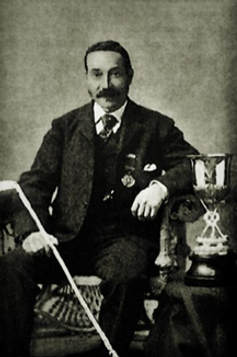
Figure 183 John Kerr, The Golf Book of East Lothian (Edinburgh: T. and A. Constable, 1896), p. 249.
The Chelsea Links have a permanent place in Canadian golf history as the host of the 1899 Canadian Amateur Golf Championship.
The Ottawa Golf Club had hosted the first national championship in June of 1895 at which the Club’s patron, Lord Aberdeen, awarded for the first time a trophy he had commissioned for the Champion Golfer of Canada. Now lost (the only known photograph of it appearing to the left), this trophy was awarded for the fifth time in 1899 on the lawn below the Brigham Hall courtyard.
The 1895 event was novel and the game of golf was still seen as an exotic activity that many male athletes were reluctant to recognise as a proper sport.
Attendance at the tournament was not large.
At the 1899 tournament, however, attendance was both large and enthusiastic. Furthermore, spectators were willing to endure bad weather to watch the matches, for rain fell every day, and it fell all day for the 36-hole championship match. Even Ottawans who did not come out to the Chelsea Links talked about the events unfolding there, as revealed by the Ottawa correspondent for Toronto Saturday Night:
While the Royal Canadian Tournament was in progress last week, it was impossible to interest a large portion of Ottawa society in any subject of conversation which had not in some way or other to do with golf or golfers.
The greatest possible interest was taken in the matches.
Ladies as well as men were out at the links both morning and afternoon, even though the weather was far from perfect.
Each day, groups of women were seen following the different players through the fields….
The day when the finals for the amateur championship were played, … the rain came down in torrents ….
(Toronto Saturday Night, 7 October 1899, p. 3)

Figure 184 Were C. Brown. New York Journal, 8 October 1898, p. 8.
As we know, the final match pitted the Quebec Golf Club’s 21-year-old J. Stuart Gillespie (1878-1964) against banker Vere Cecil Brown (1868- 1943) of the Rosedale Golf Club. Gillespie had won the 1896 Canadian Amateur Golf Championship on his home course, and both golfers had represented Canada at the international match against the United States at the Toronto Golf Club in 1898.
They were worthy finalists, but it had been hoped that the 1899 tournament would produce a final match between the two best amateur players in the country: A.W. Smith, on the one hand, and George S. Lyon, on the other.
There was great excitement when they met:
“The round between Lyon and Smith which is to be played today will be a feature of the tournament as these two gentlemen are the best exponents of the game in Canada” (Ottawa Citizen, 28 September 1899, p. 6). Alas, to universal regret, they were drawn to face each other in the quarter finals, Lyon winning the match 3 and 2.

Figure 185 J. Stuart Gillespie. New York Journal, 8 October 1898, p. 8.
Andrew Whyte Smith (1849-1901), a member of the Quebec Golf Club from 1890-92, had taught the game to Gillespie, a young teen at that time. By 1896, Gillespie had won most of the important competitions at the Quebec Golf Club as well as the Canadian Amateur Championship, and Canadian golfers knew who shared in the credit for these accomplishments: “Mr. J. Stuart Gillespie, who won the Canadian championship this year at Quebec, defeating such golfers as [defending champion] Mr. T.M. Harley, of Kingston, …. received his first lessons in Golf from Mr. Smith” (The Week [Toronto], vol 13 no 51 [13 November 1896]).
When at the Toronto Golf Club before and after his stint in Quebec, Smith had also tutored the person who would become the 1897 Canadian Amateur Golf Champion, young Toronto lawyer William Archibald Hastings Kerr (1870-1908). Known familiarly as “Archie,” Kerr had developed rapidly under Smith’s tuition:
Mr. Smith’s … kindness and readiness in instruction have left their mark upon many young players ….
Mr. W.A.H. Kerr, who holds at present the amateur record of the Toronto links, and whose play throughout this season would warrant the belief that if he keeps up his practice, he should soon take first rank as a golfer, received his first lessons in Golf from Mr. Smith.
(The Week [Toronto], vol 13 no 51 [13 November 1896])

Figure 186 A.W. Smith. Daily Mail and Empire (Toronto), 11 July 1896.
Born in St. Andrews, Scotland, in 1849, and learning the game on the Old Course alongside his childhood friends Young Tom Morris and Davie Strath, Andrew Whyte Smith remained an amateur player while pursuing a career as a bank clerk, becoming secretary of the Glasgow Golf Club in the 1870s and establishing himself as probably the best amateur golfer in the world before immigrating to Brantford, Ontario, in 1881.
Having won most of the top amateur competitions in Scotland, Smith immediately established himself as the best golfer in Canada and was regarded as such for the next two decades (even establishing a winning record against Montreal’s golf professional Willie Davis over the course of six matches between 1882 and 1992).
Competing as an amateur, Smith finished third in both the 1895 and 1896 U.S. Open tournaments.
In 1900, Toronto Saturday Night magazine declared that “this grand old golfer … may be said to be the father of the game in Canada and, even on an off day, can play the majority of our scratch men to a standstill” (Toronto Saturday Night, 1 September 1900, p. 6).
George Seymour Lyon (1858-1938), born in Richmond, Ontario, but working in the insurance industry in Toronto, had come to golf from cricket just four years before the 1899 tournament on the Chelsea Links. He had already represented Canada eight times as a cricketer. He arrived in Ottawa as the defending champion and would win the Canadian Amateur Golf Championship seven more times. Just as the original Open Championship Belt in Britain was permanently awarded to young Tom Morris in 1870 after he had won the Open for the third time in a row, so the Aberdeen Cup was given to Lyon in perpetuity when he won it for the third time in a row in 1907.

Figure 187 George S. Lyon. Golf Illustrated [London], 18 January 1901, p. 51.
The trophy has not been seen since.
When these two giants of Canadian golf met on the Chelsea Links, Smith was 50 years old and Lyon was 41. Smith would die of cancer 18 months later; Lyon would go on to become Canada’s most accomplished golfer of the early twentieth century (frequently competing internationally and even winning the gold medal in golf at the 1904 Olympics).
Although Lyon won their match on the Chelsea Links, the two men met again a few days later in medal play (stroke play) in the handicap competition that concluded the Canadian Amateur Golf Championship in those days. Unusually, a scratch player won.
Brown, playing off scratch, shot 90. Gillespie, playing off scratch, tied for second with 87. Lyon, also playing off scratch, also tied for second with 87. Scratch player Smith won by shooting 85.
Smith’s 1899 winning scratch score of 85 on the Chelsea Links helps us to appreciate that the Ottawa golf course was a proper test of championship golf in the late 1890s: in 1895, a younger, fitter Smith shot rounds of 90 and 86 to place third at the US Open held at the Newport Golf Club, and in 1896, he shot rounds of 78 and 80 to place third at the US Open held at the Shinnecock Hills Golf Club.
Reviews
Strangely, looking back on the Chelsea Links in 1991, Robert Marjoribanks called it a “somewhat make-shift course” (p. 15). In its own day, however, the golf course was praised by all.
The layout was celebrated regarding its turf, its ability to withstand heavy rain, and its design. During the Canadian Amateur Golf Championship of 1899, for instance, an Ottawa reporter observed:
The links are on fine sandy soil and the recent rains have improved them rather than otherwise….
The Ottawa links are about the average in regard to difficulty.
The turf, however, is good, and they are taken all around as splendid links.
(Ottawa Journal, 28 September 1899, p. 3).
A reporter for the Globe who was sent from Toronto to cover the tournament surveyed the opinions of golfers about the course:
All the players here are unanimous in their praise of the Ottawa links. They say without doubt they are the finest in Canada.
The turf cannot be beaten; good play is always rewarded by a good lie.
A sliced or pulled ball is always penalized pretty heavily as there are so many stones off the course [that is, off the fairway].
(Globe [Toronto], 28 September 1899, p. 9)
Club member James David Edgar (he was speaker of the House of Commons, representing a Toronto riding) declared in his book Canada and Its Capital (1898): “The Golf Club is flourishing, and it is a treat to play over their breezy links beyond the river. The hazards are all that could be desired and the turf is admirable. The links are perhaps the best in Canada, except those at Quebec” (James David Edgar, Canada and Its Capital [Toronto: George N. Morang, 1898], pp. 135-6).
In the spring of 1899, a writer in the Montreal Herald voiced the same opinion: “With the exception of the links at Quebec, those of the Ottawa Golf Club are considered the best in Canada” (Montreal Herald, 1 April 1899, p. 14).
Perhaps understandably, members of the Royal Montreal Golf Club would not go so far as to say that the Ottawa course was the best in Canada (or even second-best after Quebec’s links), but in the fall of 1898, they talked up the Chelsea Links to a Montreal Herald reporter who was interested to know whether the Ottawa course would provide a proper test for the 1899 Canadian Amateur Golf Championship:
The links, played on for three years, have great natural possibilities and even now are of a very sporting character.
The chief hazards are palings, boulders and swamps….
Montreal golfers have … been very favorably impressed with the Ottawa course and are sure that it is admirably adapted for the coming tournament.
(Montreal Herald, 26 November 1898, p. 2)
We recall Horsey’s judgement in 1898: “It certainly is an ideal golfing ground, as the course … is ample in extent and varied in its formation, affording all sorts of opportunities for the exercise and display of the skill of the canniest player of this ancient game of skill” (Ottawa Journal, 15 October 1898, p. 12).
In the late summer of 1899, after a group of members purchased the old Brigham farm on behalf of the not-yet-incorporated Club, a report emerged from the annual meeting in March of 1900 that implied that members had read reviews of their course like the ones cited above and taken them to heart: “Now that the club owns its own links, which are considered to be as fine as any in the country, it is expected that a general all round boom both in membership and otherwise will be in evidence” (Ottawa Journal, 7 March 1900, p. 6).
Perhaps the best review of the course consists of the Club’s own attitude toward it: before the International Portland Cement Company unexpectedly offered to buy the property in the fall of 1902, the Club had intended to make the Chelsea Links its permanent home.
We recall that the Club wrote to the cement company to say that it “did not wish to sell the property” (Marjoribanks 15). And when it afterwards decided to sell, the Club told the newspapers that it did so only out a sense of duty to the public good: “The club did not really desire to sell but considered that as the new company was going to be one of the most important industries of Hull, they would help them all they could” (Ottawa Journal, 4 November 1902, p. 9).
And note also that two years later, at the end of the 1904 golf season, as play was still underway on the new course on Aylmer Road, it was reported that the Club had indeed intended to stay on its Chelsea Road site forever:
On the new [Chelsea Road] property, the club thought of making a permanent home, and it looked as if they would do so.
The ground was splendidly suited for golf and within easy distance of the city. There was a good turf surface and fine bunkers while, in addition, the club had the advantage of obtaining a solid stone house, which made an admirable clubhouse….
The links proved eminently satisfactory and the membership of the club increased by leaps and bounds ….
(Ottawa Journal, 10 September 1904, p. 15)
The Chelsea Links was no make-shift course.
Dandelion Whine
In 1901, Ella Brewin, a good friend of Mabel and Mona Thomson (Ella was also staying with the Blairs), learned to play golf on the Chelsea Links. Her friend Amy Blair learned the game at the same time and on May 10th took a lesson (presumably from William Divine). Eary in May, Ella had already been on the course three times over in six days when she wrote to her mother about the experience:
Yesterday afternoon [14 May 1901] Amea & I went to play golf.
My name has been entered for a fortnight’s play.
I very much enjoyed it – tho’ my arm is very stiff this morning from the force with which I struck the ground at intervals ….
It certainly looks much easier to play than it is.
(My Dearest Mother, Letters from Canada 1901, p. 25)
A week later, she was on the course again:
Yesterday morning [21 May 1901], Amea & I & a Miss Crombie, daughter of … [the former Ladies’ Club secretary Mrs. Crombie], drove out quite early to the golf links.
I do not do the long drives as I have to share Amea’s clubs & it would take too long, as I cannot play well, but I do the approaching & putting & am getting on quite satisfactorily in that.
(My Dearest Mother, Letters from Canada 1901, p. 29)
After two weeks of practice, Ella found her game much improved – so much so, in fact, that she was hitting the ball far enough to have trouble finding it – but not so much because she had it the ball farther than she could see, but rather because a peculiar condition on the course interfered with her sight of the ball:
On Monday & Tuesday [27 and 28 May], Amea & I went to golf.
People talk of a bicycle stare [one rivets attention on what is straight ahead, paying no heed to what is left or right] – I am sure it is nothing in comparison to a golf eye ….
The fields are perfectly white with dandelion clocks, so after a drive or a far hit you have to keep your eye immovably fixed on the spot where the ball fell or you never see it again & it is an unforgivable sin to lose a ball.
I was fortunate yesterday for I found 2 which did not belong to us.
My fortnight is up now so I shall not be able to play again unless no one is there….
(My Dearest Mother, Letters from Canada 1901, p. 33)
The dandelion problem may have become so bad by 1900 that it prompted the decision announced in the Club Secretary’s advertisement in the local newspapers in January of 1901:
SHEEP! SHEEP! – THE OTTAWA Golf Club owns between 75 and 100 acres of grazing land on the Chelsea Road in Hull and would allow a responsible person to pasture sheep there at a nominal rental, if satisfactory security were given that enough sheep would be put on the land to keep the grass cropped short at all times.
(Ottawa Journal, 16 January 1901, p. 8)
Sheep love dandelions (cattle and horses, not so much). In fact, dandelions are so nutritious for sheep that sheep often eat dandelions first when placed on a new pasture.
Sheep may well have been on the golf course in 1896 when the grounds were first leased, for one stipulation of the contract with Emma Hall was that players would be liable for damage to “crops, fences, buildings, personal property, or animals” (Marjoribanks, p. 13). In 1969, an Ottawa Journal writer recalling this “rather amusing proviso in the agreement,” said that “golf hazards were added to by the sheep who got in the way” (Ottawa Journal, 26 July 1969, p. 36).
Emma Hall, who was not operating her property as a farm in 1896, must have leased her pastures to other farmers. I suspect that the Club soon managed to rid the golf course of the grazing animals in the fields in 1896 but found by 1900 that the proliferation of dandelions showed that having done so was a mistake.
I suspect that the 1901 offer to rent the property to a sheep farmer came come to nought. We know, on the one hand, that Emma Brewin reported dandelions everywhere at the end of May of that year – which means that there were no sheep on the course then. And, on the other hand, we also know that at the annual general meeting held on 6 March 1901, the executive committee was “instructed … to purchase a new horse lawnmower to assist in keeping the playing course clear” – a mower that would have been unnecessary had the January plan to put sheep on the course come to fruition (Ottawa Journal, 6 March 1901, p. 9).
Watering the Fairy Ring
We know from accounts of the rain-plagued 1899 Canadian Amateur Golf Championship held on the Chelsea Links that the property was renowned for its excellent natural drainage. Rainfall seldom impacted the playability of the course.
But this aspect of the property made the turf vulnerable to burning during dry, hot weather. And so, in March of 1901, the executive committee was “instructed to put in a waterworks system” (Montreal Herald, 8 March 1901, p. 8). The Club’s annual report in January of 1902 reveals that the committee did as instructed: “A water system has been put in” (Ottawa Journal, 17 January 1902, p. 10).
Indirectly, information provided by an interesting letter to the editor of the Ottawa Naturalist journal at the end of a dry September in 1902 confirms that the “waterworks system” was necessary and may indicate that it was working:
EDIBLE FUNGI – The dry weather previous to the last week was not favorable to fungi growth and before the end of September, few edible fungi of any kind could be procured….
The only species which can be collected in large quantities at the present time is Marasmius oreades.
The golf links and the lawns at the Experimental Farm are the best places to look for this delicious fungus.
At both places, the dark colored rings that denote its presence can be seen at many yards distance.
Boiled, or fried with butter, its flavour is more delicate than that of the common mushroom.
(J.M.M., letter to the editor, 4 October, Ottawa Naturalist, vol 16 no 2 [October 1902], p. 153)
In late September of 1902, it seems to have been too dry for the growth of fungi anywhere – too dry anywhere, that is, except for land with a waterworks system: the Experimental Farm and the Chelsea Links.
Marasmius oreades is more often known as the Fairy Ring or Scotch Bonnet mushroom. It grows in circles, often appearing on turf growing in sandy soil – turf that has become drought stressed.

Figure 188 Fairy Ring or Scotch Bonnet mushroom.
Since “the dark colored rings … [could] be seen at many yards distance,” one can perhaps imagine a caddie’s advice late in the summer of 1902: “play the ball on a line to the left over the Fairy Ring”!
The Prodigy
The Ottawa Golf Club’s 1896 club champion was 17-year-old Rex Watters. Even before that, he was talked about as likely to become amateur champion of Canada.
In Watters’ first year at the Ottawa Golf Club in 1893, for instance, Ricketts took this still 13-yearold junior member under his wing and turned him into an excellent golfer. Over the course of one year, the teenager the newspapers called “Master Rex” went from scores in the mid-120s to scores in the mid-90s – which were extremely good scores according to the standards of the day, placing him in the ranks of the top two or three players at Ottawa.
Louis Frederick Reginald Watters (born 1879), usually called “Rex,” but sometimes called “Reggie” by his family, was the son of Thomas J. Watters and Louise Watters.
The latter was a widely admired figure. Sadly, she died of a stroke when Rex was not yet 16:
AN ESTIMABLE LADY’S DEATH
The death of Mrs. T.J. waters, which took place yesterday morning, was learned with sorry throughout the city.
Mrs. Watters had endeared herself to a wide circle of friends by her many estimable qualities.
A lady of culture, very winning and attractive, she also possessed considerable musical ability, and her loss will be greatly felt by society in the capital.
(Ottawa Daily Citizen, 25 April 1896, p. 7)
Less than a year before this trauma, Rex’s father had been released from incarceration in Carleton Jail for misappropriation of funds as Commissioner of the Customs Department in Ottawa. He made restitution of the funds and Watters’ friends believed wholeheartedly that the misappropriation was unintentional. Rex’s older brother, Don, attended all court appearances with his father, but Rex did not. Perhaps he was regarded as too young to do so. Thomas Watters was sentenced to a year in jail but was released after five months for health reasons.
During the 1890s, while Customs commissioner, Rex’s father became a successful entrepreneur in the rough-and-tumble world of mica mining. There were lots of lawsuits about claims staked here and there on mineral rich properties. When Thomas Watters emerged from jail, he went from success to success in mining, finding powerful backers in Canada, the United States, and England.
At school in Ottawa, Rex was a good student and early proved to be a good all-round athlete, excelling at hockey in the winter and at both golf and cricket in the summer. Indeed, as a teenager, he joined Ricketts in the starting eleven of the Rideau Cricket Club. When the “Rideaus” travelled to Almonte to play the Almonte Cricket Club in the summer of 1895, even though they were playing before a highly partisan Almonte crowd, “young Rex Watters of the Rideaus made three phenomenal catches and received loud cheers” (Ottawa Journal, 24 June 1895, p. 6]). He was not yet 16 years old. In 1896, he was invited to play for the bigger and better Ottawa Cricket Club, which was led by a professional cricketer.
By age 14, Watters was playing on the senior men’s golf team in matches against the Kingston Golf Club. At 15, he represented Ontario in the 1894 interprovincial competition against Quebec. Obviously, he was beginning to bring great credit to instructor Ricketts.
At the Canadian Amateur Golf Championship in Ottawa in June of 1895, Watters’ advanced abilities were noted by all when he finished second behind Simpson (and well ahead of Harley) in the handicap competition:
The surprise of the day was the fine play of Rex Watters.
He is only a boy of 15 years of age and improving at the rate he is doing he will undoubtedly soon be the champion of Canada.
He is a pupil of A. Ricketts, the Ottawa club professional, and his teacher is naturally gratified at the fine showing he made.
(Ottawa Journal, 6 June 1895, p. 3).
Yet because Watters was so young, the committee in charge of the championships did not allow him to play in the match-play competition for the national amateur championship, in which Harley triumphed over Simpson in the final.
The next year, however, 16-year-old Watters exacted some measure of revenge for Simpson’s defeat at the hands of Harley:
REX WATTERS GOLFING
The Kingston papers speak highly of the work of Mr. Rex Waters, who was one of the members of the Ottawa Golf Club that visited Kingston on Saturday.
Mr. Waters defeated T. Harley who is ex-amateur champion of Canada.
(Ottawa Journal, 14 October 1896, p. 8).
In 1897, Watters became a stalwart member of the Club’s teams that met the Kingston Golf Club and the Royal Montreal Golf Club in regular competition. And, of course, he won the club championship again.
But then the question of further education and an adult career arose. In the late 1890s, Watters studied civil engineering and followed his sister to El Paso, Texas, where he worked as “a civil engineer on the El Paso and South Western Railway” (Ottawa Journal, 17 September 1903, p. 5). In 1903, he established a civil engineering firm called “Rex Watters & Company.”

Figure 189 Bisbee Daly Review [Bisbee, Arizona], 25 October 1903, p. 7.
Watters also opened a second company that year with his partner, specializing in surveying – apparently preluding his entry into the mining business in Arizona. Within a year, we find him applying for patents on mining claims. And then we find him working as a civil engineer for the massive Copper Queen Mine in Bisbee (Cochise County) – guided tours of the famous mine are still available.
Thereafter, his business interests regularly took him back-and-forth across North America, with records showing him crossing the U.S.-Canadian border from the east coast to the west coast, and at many points in between, over the next dozen years. He lived in Douglas, Arizona, until 1912. He returned to Ottawa for a year (1912-13) and then moved to Los Angeles in 1913.
In 1918, describing himself as a “Y.M.C.A. Student,” he became naturalized as a U.S. citizen and at the same time, at 39 years of age, registered for the U.S. draft during World War I. And then, in 1919, at age 40, he married 24-year-old Annette Theresa Lawrence (originally from Wisconsin).
The couple spent the rest of their lives in Los Angeles, their social lives being regularly reported in newspapers down to the early 1930s.
Rex died there in 1944.
I can find no evidence that he ever played golf again after he ended the 1897 season on the Chelsea Links as Club champion.
Alas, after he left Ottawa, the Club seems to have forgotten him. When twenty-something Alex Fraser won the Club championship in 1913, the name of every winner of the Club championship since 1891 was published (including the name of Rex Watters for 1896 and 1897) and the following observation was made: “Alex [Fraser] is still in his early twenties and is perhaps the youngest member to have won the title at the Ottawa club” (Ottawa Citizen, 26 September 1913, p. 8).
Visiting Golfers
Many non-members of the Ottawa Golf Club played on the Chelsea Links. Most visitors were casual golfers like Ella Brewin, who registered for a fortnight of golf. Some were golfers brought to town by their election to Parliament: the courtesy of the links was extended to them as a matter of course. Others, visiting Ottawa for one reason or another, heard about the Chelsea Links and – happening to be lovers of golf – just had to play the well-known course.
As the home of the Canadian Parliament, the City of Ottawa became the home of Members of Parliament from across Canada, and, as the popularity of golf spread across the country in the 1890s, more and more of these Members of Parliament arrived in Ottawa as lovers of the Royal and Ancient Game:
This parliamentary session is expected to give the game quite an impetus in the capital as it brings quite a number of enthusiastic golfers to the city, including Senator Drummond [Montreal], Speaker Edgar [Toronto], Messrs. Penny, Montreal; Osler, Toronto; and Macpherson, Hamilton.
(Ottawa Journal, 31 March 1897, p. 6)
Visiting Parliamentarians seem not to have played in Club competitions, but as Speaker J.D. Edgar observed:
The hospitality of the club is liberally extended to golf players among the non-resident legislators.
It is one of their greatest treats to go round the links on a holiday or in the morning before the house meets.
(Edgar, Canada and Its Capital, p. 136).

Figure 190 Thomas Henry Macpherson.
Thomas Henry Macpherson (1842-1903) was the Member of Parliament for Hamilton from 1896 to 1900. A partner in various wholesale grocery firms in Hamilton before becoming head of his own firm, Macpherson had been born in Perth, Scotland, and immigrated to Canada in 1871 after receiving his early business training on the stock exchange in London, England.
Macpherson was a founding member of the Hamilton Golf Club in the fall of 1894 and, as one of the few members who was already familiar with the game, played in the new club’s opening match at the end of October that year: “There was a large and fashionable turnout, and over a hundred spectators followed the players, watching with interest the subtle play” (Toronto Daily Star, 26 October 1894, p. 2).
When a number of Ottawa Golf Club members decided to form a summer golf club at Aylmer’s Victoria Hotel in 1899 (this hotel was preferred as a site for summer golf because the Hull Electric Railway ran right up to it), Macpherson was a founding member and hosted one of the weekly “golf dinners” that spring: “there was another jolly golf dinner at Hotel Victoria, which signifies a dinner preceded by a game of golf. The host was Mr. Macpherson, M.P., of Hamilton” (Montreal Star, 22 June 1899, p. 9).

Figure 191 E.G. Penny. Montreal Star, 16 January 1894, p. 6.
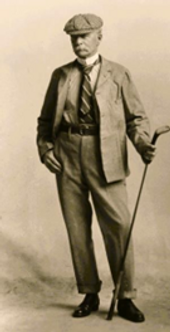
Figure 192 George A. Drummond, 1900.
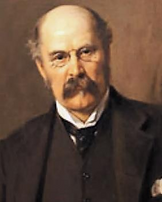
Figure 193 E.B. Osler.
Edward Goff Penny (1858-1935) was a Montreal businessman, financier, and politician. Before his election to the House of Commons in 1896, he had served for many years as secretary-treasurer of the Royal Montreal Golf Club.
As such, Penny had led the hiring process that brought Tom Smith to Montreal from Great Yarmouth (England) in 1894 to serve as Royal Montreal’s third golf professional (after Bennett Lang (1893) and Willie Davis (1881, 1889-92).
A member of the Senate of Canada since 1888, Sir George A. Drummond (1829-1910) had come to Montreal from Edinburgh Scotland in the mid-1850s and quickly became an important figure in city business and finance: he became president of the Redpath Sugar Company and then, successively, vice-president and president of the Bank of Montreal.
In 1888, he was appointed a member of the Senate of Canada.
He was a past president of the Royal Montreal Golf Club, to which he had donated the prestigious Drummond Cup for match-play competition.
In 1895, he was elected the first president of the newly founded Canadian Golf Association, which was designated “Royal” the following year.
Sir Edmund Boyd Osler (1845-1924) was a Toronto banker, stock broker, financier, and philanthropist (he would become a founder of the Royal Ontario Museum). He was first elected to the House of Commons in 1896. By this time, had already served several times as Captain of the Toronto Golf Club.
In 1894 he donated the Osler Cup to the Club for a what immediately became a prestigious knock-out handicap competition by medal play (the first winner being A.W. Smith).

Figure 194 Sir James David Edgar, late 1890s.
As we know, Sir James David Edgar, the Speaker of the House of Commons, loved the golf course:
The Golf Club is flourishing, and it is a treat to play over their breezy links beyond the river.
The hazards are all that could be desired and the turf is admirable.
The links are perhaps the best in Canada, except those at Quebec.
(James David Edgar, Canada and Its Capital [Toronto: George N. Morang, 1898], pp. 135-6).
Edgar found that golf improved his health (which was not good) and so played the Chelsea Links frequently – often with his daughters Beatrice and Maud (the latter was as good at golf as her father).
Edgar no doubt encouraged Members of Parliament to try the Chelsea Links.
And when golf-loving foreign visitors to the nation’s capital heard about the Chelsea Links – which had hosted a national championship! – they made it a point to visit them.
One such visitor was Henry Alexander Boyd (1877-1943), a celebrated Irish rugby player who was touring Canada in the fall of 1899 with the Irish national team, which became so notorious for the politeness of its players on the field of this rough game that some Canadian newspapers referred to this cohort of young men in their early twenties as “The Gentlemen of Ireland” (Hamilton Spectator, 4 November 1899, p. 5).
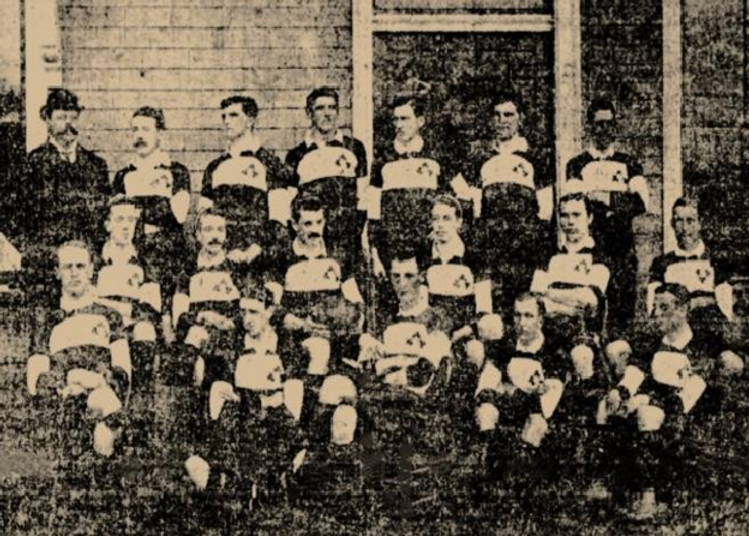
Figure 195 The Irish national rugby team touring Canada in the fall of1899. H.A. Boyd is at the right end of the back row. Montreal Star, 18 October 1899, p. 3. “The Irishmen … dressed in green, white-trimmed jerseys, with a triple shamrock on the breast” (Ottawa Journal, 30 October 1899, p. 3).
In 1899, when he was both a student at Trinity College (Dublin) and a captain in the Royal Artillery of the British Army, Boyd was a 157-pound halfback picked from the Trinity College team to play for the all-Ireland team. He struck Ottawa observers as “a fine runner and tackler” (Ottawa Journal, 26 October 1899, p. 3).
By 1899, Boyd was also one of the best golfers in Ireland.
A GOOD GOLFER
While in the city, H.A. Boyd, of the Irish football team, visited the Ottawa golf links on several occasions and gave excellent exhibitions of golf.
He is a first-class golf player and played in the Irish championships last year. [It was called the South of Ireland Championship.]
(Ottawa Journal, 1 November 1899, p. 3)
In the world of Irish golf, Boyd was trending upward. Having reached the third round of the South of Ireland Championship earlier in 1899 against strong players from Scotland and England, he would become the first Irish winner of the Irish Amateur Championship in 1905, after a runner-up finish in 1903. He also won half a dozen other tournaments in Ireland.
Recently, Boyd was ranked 44th in an all-time list of Ireland’s greatest amateur golfers.
As of 1899, A.W. Smith and George Lyon were the best golfers yet seen on an Ottawa golf course. Boyd was of their class. The active golfers at the Club turned out in large numbers to witness players such as these, who were able to play certain kinds of shots and extricate themselves from certain difficult lies in ways that local players had never conceived possible.
And so, the visits of such players elevated the local golf IQ.
It is no surprise, then, that about four months after Boyd’s visit, some Club members wanted to bring Harry Vardon to the Chelsea Links during his 1900 tour of the United States and Canada: “There has been some talk of bringing Harry Vardon, the crack player, here during the visit which he intends to make to America again in June, but as his price is pretty high, his visit to Ottawa will hardly materialize” (Ottawa Citizen, 22 March 1900, p. 6).
Still, Vardon’s Ottawa fans were loathe to forego the opportunity of watching the three-time Open Champion play his game on the Chelsea Links (Vardon would win the U.S. Open later in 1900, and he would win the Open Championship three more times), and so Club members seem to have stayed in touch with Vardon’s manager as he planned Vardon’s Canadian visit. The following item appeared in the Ottawa Journal in mid-August:
GOLF
GOLF CHAMPION VARDON COMING
(Special to the Journal)
Montreal, Aug. 15 – Harry Vardon, the golf champion, is to make a tour of Canada this autumn.
The Spaldings, who are managing his American tour, have arranged for the champion to visit Cobourg, Toronto, Ottawa, Montreal and Quebec between September 24 and October 2.
(Ottawa Journal, 16 August 1900, p. 5, emphasis added)

Figure 196 Vere Brown playing against Harry Vardon (who wears white shoes) at Rosedale Golf Club in September of 1900. Canadian Magazine, vol 17 (October 1900), p. 345.
But Vardon’s fee of $250 per exhibition match, plus expenses, proved prohibitive for Ottawa, Cobourg and Quebec; Vardon played matches only at Rosedale and Royal Montreal.
The Club’s surrender to harsh reality was eventually announced at the beginning of September:
It was thought that Vardon might be brought to Ottawa, but the club thinks the cost of having him come would be rather high.
Consequently, Vardon will hardly have an opportunity to show his ability to people here [on the Chelsea Links].
(Ottawa Journal, 8 September 1900, p. 5)
But if Vardon could not be brought ‘to people here,” could people here – “a number of Ottawa golf fanciers” – be brought to Vardon (Ottawa Journal, 8 September 1900, p. 5)?
Fortunately, the fever dream of Ottawa’s true golf fanciers was acknowledged and addressed by their friends at Royal Montreal:
The Montreal Golf Club has very generously invited the members of the Ottawa Golf club to visit its links on next Tuesday to see the exhibition of the famous professional golfer, Vardon.
He will play both in the morning and in the afternoon.
(Ottawa Citizen, 22 September 1900, p. 6)
In the one session, Vardon was scheduled to play the best ball score of two top amateurs, and in the other session, he was scheduled to play the best ball score of Royal Montreal pro Tom Smith and Toronto Golf Club pro George Cumming. Since at Rosedale, just days before his visit to Montreal, Vardon had defeated the best ball score of 1898 Canadian Amateur Champion George Lyon and 1899 Canadian Amateur Champion Vere Brown (who had won his title on the Chelsea Links), and since Vardon had also set a new course record on his first round of the18- hole Rosedale layout, there was keen interest in what he might do in Montreal: “Nearly a dozen Ottawans will go down” (Ottawa Journal, 22 September 1900, p. 5).

Figure 197 Sir Algernon and Lady Coote (with an unidentified woman, perhaps a daughter), at Ballyfin, County Laois (formerly queen’s County), Ireland. 1903.
The last dignitary to visit the golf course proved to be one of the last people ever to play the Chelsea Links: Sir Algernon Coote.
In the fall of 1903, he and Lady Coote were touring Canada to celebrate the centenary of the British and Foreign Bible Society, of which Sir Algernon was vice-president.
The idea was to invite donations to a fund of £255,000, asking for $50,000 from Canadians: “it is to arouse interest in the undertaking that Sir Algernon is visiting Canada” (Montreal Herald, 5 November 1903, p. 2).
After a day of speeches delivered to various audiences by Sir Algernon and Lady Coote, it was announced that Sir Algernon would play golf in Ottawa:
Sir Algernon and Lady Coote, of Ballyfin, Ireland, who are spending a few days in town, leave tomorrow afternoon for Montreal, Quebec, New York and Washington, sailing for home on by the Luciana on November 28th.
They were guests of His Excellency the Governor-General at lunch at Rideau Hall today, and tomorrow morning Sir Algernon, who is very fond of golfing, will visit the Chelsea Links.
(Ottawa Free Press, 4 November 1903, p. 2).

Figure 198 A contemporary image of Coote's estate at Ballyfin. it is now a hotel.
Sir Algernon was fond of golf, indeed: he enjoyed a private golf course on his estate at Ballyfin, located in what was then called Queen’s County but since 1922 has been known as County Laois.
There are no reports of Sir Algernon’s having played golf anywhere else during his 1903 visit to Canada and the United States. The Chelsea Links must have enjoyed a very good reputation for Sir Algernon to have been interested in playing this course above all.
And its good reputation in November of 1903 had survived the loss of three holes earlier in the year to construction of the International Portland Cement Company plant.
The Curious Case of Dr. Carruthers
One of he most exotic visitors to the Chelsea Links was Dr. John Ferguson Carruthers.
We learn of his visit late in the summer of 1897 when the Ottawa Journal reports that on Saturday, September 11th, a man named “Dr. Carruthers,” recently arrived from North Berwick (which William Divine had left just months before), played two matches against one of the Ottawa Golf Club’s best players, Alexander Simpson, who had finished second to Tom Harley in the first Canadian Amateur Championship in 1895 and who had won the Ottawa Club championship three years in a row from 1893 to 1895.
An Expert Golfer
Dr. Carruthers Gave an Exhibition on the Local Links on Saturday
Dr. Carruthers, a visitor from North Berwick, Scotland, visited the golf links on the Chelsea Road on Saturday and gave an exhibition of expert golf playing.
Dr. Carruthers is an expert golf player and beat one of the best local players in two rounds. He played against Mr. A. Simpson and in the first round won by 3 holes and in the second round by 6 holes.
The scoring was low and the play keenly contested.
(Ottawa Journal, 14 September 1897, p. 3)
Simpson’s resounding defeat on his home grounds by a Scotsman new to the course no doubt confirmed in the minds of some of the local players that they needed better instruction if they were ever to become competitive with the best players from the Old Country.
Another match was immediately arranged for six days later between Carruthers and a member of the visiting Boston Cricket Club who, it was discovered, was not just a “phenomenal cricket player,” but also an expert golfer, Ralph Cracknell (Boston Evening Transcript, 31 October 1895, p. 6):
Golf Experts
Two Visitors Will Meet in a Game Tomorrow on the Chelsea Links
An interesting match will be played on the links on the Chelsea Road tomorrow.
Dr. Carruthers of North Berwick, Scotland, and Mr. R. Cracknell, of Boston, who is here with the cricketers, both excellent players, will meet in a friendly game.
The game will be played in the afternoon, and it is likely a large crowd will attend.
Mr. A. Simpson will probably play Mr. Cracknell also. Mr. Simpson was beaten a few days ago by Dr. Carruthers, but he played him a close game.
(Ottawa Journal, 16 September 1897, p. 7)
When he visited Ottawa in 1897, Ralph Cracknell (1863-1913) was the golf editor of the Boston Globe (he would serve the newspaper in this capacity for twenty years). He was a member of the Wollaston Golf Club of Wollaston, Massachusetts, where he regularly contended for the club championship (winning it several times), but virtually from the moment he arrived in Massachusetts from his English homeland in 1884, he was also “celebrated in baseball, tennis and cricket” (Detroit Free Press, 21 October 1895, p. 3).
He had competed in amateur golf tournaments throughout the summer of 1897 at places such as the Country Club at Brookline and the Myopia Golf Club. A few years later, he would enter the 1899 USGA Amateur Championship held in Chicago. He was clearly a better-than-average amateur player (he defeated the accomplished player Arthur G. Lockwood in the Massachusetts State Championship), and he was in good form in 1897, so he was expected to be quite competitive in a match with Carruthers.
Alas, however, the match between the two men was cancelled when it happened that both men had to leave town earlier than expected:
Golfers Disappointed
The golf match to have been played on the local links yesterday did not take place.
Dr. Carruthers of North Berwick and R. Cracknell of the Boston Cricket Club were to have played a match. Both, however, had to leave town, Dr. Carruthers going to British Columbia and Mr. Cracknell to Montreal.
Many local golfers were disappointed.
(Ottawa Journal, 18 September 1897, p. 2)
The disappointment arose from the expectation that Ottawa Golf Club had been about to witness golf played at a higher level than anything seen in Ottawa since Alf Ricketts played a match against A.W. Smith in 1893, when they each set the record for the Sandy Hill course (83). No one of that calibre had yet played the Chelsea Links course.
Carruthers was not a native of North Berwick, but rather of Inverness, where he was born in 1857, eldest son of the Editor of the Inverness Courier, Walter Carruthers, and grandson of the newspaper’s founder Dr. Robert Carruthers. Young Carruthers attended the Inverness Royal Academy, where he was a top student, winning a scholarship at fourteen years of age to study at Fettes College in Edinburgh, graduating in 1875 after four years of high school. From 1872 to 1875, he played on both the College football team and the College cricket team.
He returned home for a short time, during which he played county cricket for the team known as the Northern Counties, but he soon became a world traveller and spent many years abroad, including several years in Fiji, where he was appointed Sub-Agent for Immigration in 1886. Labour strife on plantations and in mills was prevalent in Fiji at this time, and Carruthers travelled widely to inspect working conditions and to assess immigrant workers’ complaints, his reports leading to significant reforms.
When he returned to the Inverness area in the late 1880s, he played golf at the new Forres Golf Club, whose course had just been laid out, and he played for its men’s golf team in competitions against other clubs. He also returned to cricket, playing regularly for the “Old Fettesians.” At this time, Carruthers decided to become a physician, winning the Grierson Bursary to study medicine at the University of Edinburgh from 1888 to 1892, where he played for the university’s cricket team. He graduated in the summer of 1892 with the degrees Bachelor of Medicine and Master in Surgery.
Although born in Scotland, and although he indicated on the 1901 Canadian census that he was “Scotch,” Carruthers regarded himself as English, as he makes clear in his comparison of German culture to English culture in his 1890 essay, “A Trip in North Germany” (The Highland Monthly: A Magazine, vol 1, 1889-90, pp. 689-99, 734-39). So, perhaps it is no surprise that Dr. Carruthers established his first practice in England, serving briefly as “medical officer for the Revesby district” of Lincolnshire before he “left the district and moved to Tattershall” and established a practice in partnership with a local physician (Lincolnshire Echo, 28 June 1893, p. 2).
But he returned to Edinburgh in September of 1893 to marry Ina Scott, of Glasgow, in the Chapel of Fettes College. The newlyweds took up residence back in Tattershall, where Dr. Carruthers would in November be appointed Medical Officer for the Tattershall District and where the couple’s only child, daughter Irralie, would be born in June of 1894.
Carruthers’ surgery was actually across the River Bain from Tattershall in Coningsby. Unfortunately, the couple’s stay would be remembered for what took place between the fall of 1894 and the spring of 1895:
Charges Against a Coningsby Surgeon
At the Horncastle Police Court yesterday, Mr. John Ferguson Carruthers, surgeon of Coningsby, was charged on a warrant under the criminal Law Amendment Act with assaulting Ada Stamper, aged 15 years.
The girl declared that prisoner had frequently assaulted her in his surgery, and that he knew her age, as her mother had told him in her presence.
(Lincolnshire Echo, 7 May 1895, p. 2)
Testimony showed that “in October of last year he took liberties with her and subsequently accomplished his purpose. He frequently repeated the offense” (Nottinghamshire Guardian, 11 May 1895, p. 3). Ada Stamper further testified that “on the 18th of April … he twice committed the offence alleged” (Lincolnshire Echo, 13 May 1895, p. 2).
Remarkably, Carruthers survived the scandal completely unscathed.
He continued as the Medical Officer for the district until the spring of 1897, when he tendered his resignation, but not because of his unethical and illegal behaviour, but rather to spend four months playing golf for Lincolnshire’s Skegness Golf Club, representing it in a number of matches against other clubs, including at the Inter-Club Championship of the East Midland Union (Lincolnshire Echo, 6 April 1897, p. 3).
Then Carruthers returned to the University of Edinburgh on August 2nd, 1897, to be awarded his M.D.
Dr. Carruthers had got away with a crime, perhaps with some help from Ada Stamper’s mother. Since the charge was that he had committed “an offence upon … a girl above the age of 13 and under the age of 16 years of age,” Mrs. Stamper helped the defence raise doubts as to whether Carruthers knew the that Ada was under the age of sixteen: “The mother was called [as a witness], and said she was not aware that Dr. Carruthers knew her daughter’s age, as she had never told him, that she knew of” (Lincolnshire Echo, 13 May 1895, p. 2, and 7 May 1895, p. 2, emphasis added).
Oh dear ….
After his graduation from the University of Edinburgh, at forty years of age, Carruthers immediately left Britain with his family, sailing for Ottawa in the middle of August, arriving in Montreal by the end of the month. He travelled shortly thereafter to Ottawa, intent on joining the federal government’s Yukon expedition, scheduled to depart for Vancouver late in September.
Shortly after his matches with Simpson, Carruthers indeed left for the Yukon, where the Klondike gold rush was underway. The expedition largely comprised government officials (led by Clifford Sifton, the Minister of the Interior) interested to assert Canada’s land claims in an area of the Yukon whose ownership was in dispute between Canada and the United States, but where the United States was collecting taxes on all matters related to the gold rush. At the Ottawa train station, thousands bid them a fond and supportive farewell.
Carruthers was not supposed to be part of this Canadian expedition – he was “not of the Yukon party” – but “he secured this privilege through the friendship of Lord Strathcona and Mount Royal” (Globe [Toronto], 25 September 1897, p. 17; Ottawa Daily Citizen, 25 September 1897, p. 2). “Strathcona and Mount Royal” was the name as of August 1897 of the Scottish-born Canadian financier and politician formerly known as Sir Donald A. Smith, who served as the High Commissioner for Canada in Britain. Carruthers was fortunate to have a friend in a high place.
The Ottawa Journal suggests the reason why Carruthers wanted to get to the Yukon: “Dr. Carruthers is going to Alaska on a gold mining expedition for a number of British capitalists” (Ottawa Journal, 18 September 1897, p. 2). Carruthers may not have been a personal friend of Lord Strathcona per se; rather, it may be that his business friends used their influence with the High Commissioner for Canada to get their agent Carruthers a passage to the gold fields.
Only in July of 1897 was news of the Klondike gold rush trumpeted in British newspapers, and thereafter stories of fortunes made overnight by all and sundry appeared daily. Donal Smith (not yet “Strathcona and Mount royal”) was at his Highland residence at Glencoe, Scotland, at this time and was asked by a reporter about the tens of thousands of people from all over the world succumbing to gold fever and dropping everything in their lives to set out with little preparation for gold fields in an area where the boundary between Canada and Alaska had not yet been fixed and proper policing was almost non-existent:
Nobody should think of setting out for the goldfields without first going thoroughly into all that the step implies.
The region is far distant and very inaccessible, and the climate is one involving much hardship. A man must be strong physically, and he must have a strong resolution with which to meet difficulties.
Further, experience would be most important, as the inexperienced should remember. Those who have not been accustomed to rough work, such as gold mining, would find the trouble doubly hard to bear….
My advice to any who would think of going now or later is to make every inquiry beforehand, and to be certain as to their own suitability for the undertaking.
(Retford and Worksop Herald and North Notts Advertiser [Retford, Nottinghamshire, England], 31 July 1897, p. 6)
Whether Smith personally conferred with Carruthers about the latter’s intentions, and perhaps personally offered him a version of his published advice, or whether he simply acceded to the request of certain “British capitalists” that, as High Commissioner for Canada, he exert his influence to have Carruthers included in the mission is not clear.
Like Carruthers, “Strathcona and Mount Royal” travelled at the end of August from Scotland to Montreal and then on to Ottawa, where he was scheduled to consult with the Canadian government at the beginning of September about the government’s “fast Atlantic steamship contract” that was being negotiated in Britain [Ottawa Daily Citizen, 7 September 1897, p. 7]). If he and Carruthers were indeed friends, they may have sailed together.
Whether Carruthers travelled all the way to the Yukon in the fall of 1897 is not clear – the Globe reported that he travelled as far as Dyea but that “it is likely Dr. Carruthers will return to Vancouver and wait until spring” – but it is certain that at some point he drew up detailed maps of the area in question (Globe [Toronto], 3 November 1897, p. 7; 4 October 1897, p. 6).
Whatever his original purpose may have been in joining the government expedition, he decided to stay in British Columbia. He resided there for several years, becoming an important consultant for both Vancouver’s Board of Trade and Victoria’s Board of Trade, many of whose members had significant interests in the Klondike.
And Carruthers also became an important British Columbia golf pioneer.
He was living in Vancouver by the fall of 1897 and by December had joined the Vancouver Golf Club. And from the moment he joined the club, he attended its committee meetings, participating in the December 1897 decision to lay out a new nine-hole course on the old Rifle Range of the Moodyville Flats.
Here, Carruthers had his first taste of golf course design and construction: “The cost of completing the links was $35, the work being done by Tom Wilson (late Fruit Inspector) and two men, under the supervision of Messrs. Keyser, Carruthers, and Chaldecott” (F.M. Chaldecott, Jericho and Golf in the Early Days in Vancouver: 1892-1905 [Vancouver: privately printed, circa 1935], p. 10). The other members of the Vancouver Golf Club clearly respected Caruthers’ knowledge of golf.
In April, Carruthers entered the British Columbia Open Championship held at the Victoria Golf Club. He advanced far into the match-play competition but did not win. In the handicap part of the tournament, however, he was accorded a scratch handicap and won the competition, setting a new course record on the Victoria Golf Club’s venerable Oak Bay Links (Victoria Daily Times, 28 March 1898, p. 5).
A month later, for the sake of “two or three old country players in the district” of Kelowna, “Dr. Carruthers laid out a short nine-hole course along the lake shore north of the English church” (Vernon News, 24 August 1899, p. 1). Carruthers was the best player by far among the 15 members of the Kelowna Golf Club, easily winning their concluding tournament of 1899 on his own course:
The links were in a very unfavorable condition, owing to the wet weather experienced of late, but nevertheless the ardour of the golfers was not dampened and the contest started by 10 a.m.
The course in its peculiar state was rather too “kittle” for most of the players; in fact none of them showed any form excepting Dr. Carruthers who played a splendid game, getting over all obstacles by means of his cool, calculating head, firm hand and hawklike eye.
The doctor won easily after giving two of the best players a long handicap.
(Vernon News, 7 September 1899, p. 1)
The report of his “getting over all obstacles” hints that he probably laid out fairway-wide cross hazards on his Kelowna course according to the same principles of penal golf course design established by Tom Dunn in England and applied by Alfred Ricketts on the Chelsea Links.
In the spring of 1899, Carruthers qualified to practice medicine in British Columbia by passing the examination of the British Columbia College of Physicians and Surgeons (The Province, 6 May 1899, p. 8). He was appointed Medical Officer of Health in Revelstoke in 1903, but he returned to Britain to study ophthalmology and then practised in Guernsey, a location chosen to benefit his health.
The expertise he acquired as an eye specialist served the country well when he joined the Royal Army Medical Corp during Word War I and was appointed principal eye specialist at the Royal Herbert Hospital, the celebrated military hospital in Woolwich, England.
When Carruthers died in 1925, it was said that “his health had suffered from the hard work he did during the war” (North Star and Farmer’s Chronicle [Ross and Cromarty, Scotland], 20 June 1925, p. 4).
Location?
From the beginning, the location of the Chelsea Links produced a tension between members of the Ottawa Golf Club whose priority was to play golf on a proper golf course and members who wanted easy access to a clubhouse that would serve as a locus of their social life.
We recall that when the first rumour of the Club’s possible move to Quebec was reported in a gossip column, the proposed site of the new golf course was said to be remote from civilization: it was “in the wild country the other side of Hull” (Ottawa Journal, 22 June 1895, p. 5). So it seemed to the woman who wrote the column in question.
And we recall also that the women members of the Club were implicitly described as having boycotted the new golf course for most of 1896 because of the inconvenience of the location:
They moved the links across the river to the County of Ottawa to the gently sloping and fragrant fields that lie between the Chelsea Road and the Ottawa River.
It is a beautiful place when one once gets to it.
Many among the golfers were delighted with the new links, especially those enthusiastic golfers who play because they really like the game.
The ones who play because everyone else plays found it rather far from town. The women never went near it at all and the lady members of the club were members in name only. (Montreal Star, 15 May 1897, p. 17)
The thinking of the executive Committee was revealed to the Ottawa Journal in April of 1896:
The grounds offered are ideal for the sport, level and clear.
The distance is the only drawback.
But the club expect that a spur of the Hull Electric Railway will run out to Wright’s Quarry, and it is only a quarter of a mile from there [to the clubhouse] ….
(Ottawa Journal, 17 April 1896, p. 1)
The reference to bicycles might seem odd, but in the mid-1890s, cycling had become a fad amongst North American society folk – both gentlemen and ladies.
Just as an Ottawa gossip columnist had suggested in June of 1895 that the “the men want[ed] to have the links all to themselves somewhere in the wild country the other side of Hull,” so an Ottawa correspondent for the Montreal Star reported that the fact that “the lady members of the club were members in name only” suited the men just fine: “At this, the old golfers were more than ever delighted, as they never were called upon to put themselves to the least inconvenience for any one” (Ottawa Journal, 22 June 1895, p. 5; Montreal Star, 15 May 1897, p. 17).
At the beginning of April 1897, golfers promised to put their pedal where their mouth had been in April of 1896 when they said the trip to the Chelsea Links was but a nice bicycle ride:
GOLF SEASON OPENS
The golf season has opened.
There is now quite an attendance of the enthusiasts at the Chelsea Road links.
Now, every dry day, and when the roads are in good shape for wheeling [cycling], it is expected that the clubhouse will prove quite a resort.
(Ottawa Journal, 12 April 1897, p. 6).
Bicycles indeed became the preferred mode of transportation for Club members. “Most of the members have bicycles,” it was noted in April of 1896 (Ottawa Journal, 17 April 1896, p. 1). But they were ridden to the golf course only “when the roads [were] in good shape for wheeling” (Ottawa Journal, 12 April 1897, p. 6).
And the generally poor condition of the roads often tempted members of the Ottawa Golf Club to ride through Hull on the sidewalks, for which indiscretion they were fined:
Recorder Champagne, of Hull, had a little game with several prominent members of the golf club the other day.
The links were laid out in the court room and the man of justice won out in each case by three bills up, and more to pay if the sidewalk bicycling is persisted in.
(Ottawa Citizen, 1 June 1901, p. 10).
The condition of the Chelsea Road was not the only issue regarding access to the golf course.
Since there was just one bridge across the Ottawa River between Ottawa and Hull, travel from work in downtown Ottawa to the new golf course was a bit of an adventure – and for Horsey, a romantic adventure:
ON THE WAY
Come congenial friend. Put past your work for an afternoon. Just turn the key in your office door and lock in all your care.
Put off that city coat and hat for one of florid hue [the red golf jacket] and mount your wheel [bicycle] in garments unconfined and freely breathe the pure and fragrant air and feel again, as when a boy, the great delight of muscled legs and arms.
Come! Clear away the cobwebs from your mind which clog the spirits and mar the better man.
My friend who has the sporting spirit warm within him, the golfer’s pent up feverish accumulation of a week which seeks some natural outlet, needs but to look upon my gear to fall an easy victim to my challenging request – to 18 holes.
So off we go, and, whizzing westward through Le Breton flats (and on with watchful care and skill), tread our onward way through that great crowded busy hive of active, toiling, sweating men who feed the greedy, rapid, buzzing [wood] saws from dawn till dark.

Figure 199 In the foreground is the “cable bridge,” also called the “Union Suspension Bridge.” Parliament Hill appears in the background, and to the right are Le Breton Flats’ piles of lumber produced in the saw mills through which Horsey cycled. Photograph circa 1870. Library and Archives Canada, Topley Studio fonds, Box number: 00602A.
We cross the cable bridge hung high in air which spans the noble Ottawa above the great boiling kettle “The Chaudière,” which rushes, foams, and roars over a ragged edge of limestone rock into the chasm below to join the more placid portion of the stream that gracefully glides past the houses of Parliament and onwards toward the ocean.
Passing through Hull, we soon find ourselves on the Chelsea Road ….
(Ottawa Journal, 15 October 1898, p. 12)
Throughout the Club’s residence on the Chelsea Road, getting to the golf course from downtown Ottawa remained an adventure – and it was more usually called a problem or difficulty:
The only difficulty with which the club has to contend is the difficulty to get transportation to the links from the city.
This fact has been receiving the attention of the club recently and as soon as the interprovincial bridge, now under construction [built 1899-1900, opened 1901], is completed, an effort will be made to induce the Ottawa Electric Co. to extend its trolley line to the links.
The accomplishment of such a scheme would give a great impetus to the sport and would afford lovers of the game a convenient way of getting to the most picturesque links in Canada.
(Ottawa Citizen, 19 October 1899, p. 6)
Ella Brewin enjoyed the drive across the Ottawa River but found the drive through Hull to be so painful that she wrote an extensive description of the experience to her mother:
On the 9th [May 1901] … I went for a lovely drive past the fine Chaudière Falls where the Ottawa River descends 50 ft over ragged ledges of rocks ….
We had to drive through some of the wood yards to get to the Falls & then went on to the Golf Links about 4 miles from here.
The roads are quite too awful for words.
I have never in Italy or Switzerland seen anything like them. I am told it is the severe frost.
The crossings are made of wood which is generally about 6 inches higher than the rest of the road; often the wood is quite rotten & has large holes in which the horses catch their feet and fall down; the rest of the road is nothing but hills and valleys …
Amea [Blair] has positively to hold me down when we are going quickly to prevent my being jolted out of the carriage.
There is not the least pleasure in driving; in fact it is painful but I am told the golf links is on the worst road so I must not judge altogether yet.
(My Dearest Mother, Letters from Canada 1901, p. 22)
Looking back to 1869, one finds a letter to the editor of the Ottawa Daily Citizen that might make one wonder whether anything had changed between then and Ella Brewin’s painful experience:
Sir ….
You perform good service to the public by taking notice in your leading article of the state of the roads in this neighbourhood. Certainly your description of the Gatineau Road [a.k.a. Chelsea Road] is very good ….
Having occasion frequently to travel that road, I can testify that from Brigham’s Corner to Chelsea is the vilest piece of road to be met with in any part of the country.
I have travelled in almost every part of Canada and in most of the Northern states, in all sorts of fashions, but certainly travelling from Ottawa up the Gatineau beats them all….
I remain your respectfully, “Viator”
(Ottawa Daily Citizen, 23 November 1860, p. 2)
The conditions in 1897 seem to have been as bad as ever:
THAT CHELSEA ROAD
[To the] Editor, Journal:
Permit me to occupy a small space [in the Journal] in order to call attention to the wretched condition of the Chelsea Road upon which the full toll is exacted and no value given therefor.
That portion of the road from Hull to the first gate is simply disgraceful and positively unsafe to go at a faster rate than a walk.
The remainder of the road to Chelsea is so bad as to encourage profanity to a degree highly discreditable to the [Gatineau Road] Company’s directors.
(Ottawa Journal, 15 May 1897, p. 12)
It seems that when the weather was dry, the society women who patronized the Friday teas at the clubhouse were not reluctant to travel the Chelsea Road, although rather than riding the last stretch in a carriage or horse-drawn bus at no “faster rate than a walk,” many women chose literally to walk:
Mrs. Gascoigne gave an at home at the golf grounds on Friday afternoon [11 June 1897], which, owing to the lovely weather and popularity of the hostess, was largely attended….
Many people rode out on bicycles, others drove, and a large number went out by electric car and walked the short distance between Hull and the golf grounds.
(Ottawa Daily Citizen, 16 June 1897, p. 5)
As we know, during the winter of 1898-99, a golf club was formed at Aylmer’s Victoria Hotel by several members of the Ottawa Golf Club who regarded the Chelsea Links as too difficult to access.
Their complaint was reported in the Montreal Herald: “The golf players who make Aylmer their homes during the summer months find the links near Ottawa on the Chelsea Road too far” (Montreal Herald, 13 June 1899, p. 4). Toronto Saturday Night magazine made the same observation about the geographical motivation of the Club members who had formed the new Victoria Golf Club: “It has its golf links nine miles from Ottawa, but really more get-at-able than the Chelsea links, which, though only three miles from town, are not reached by any street-car, not by water, but only by carriage or bicycle over a large stretch of very bad roads” (Toronto Saturday Night, 24 June 1899, p. 3).

Figure 200 Circa 1899 photograph showing in the foreground the Hull Electric Railway platform in front of the Hotel Victoria in the background.
The Victoria Hotel was more “get-at-able” despite being three times farther from downtown Ottawa than the Chelsea Links: “Though farther from the city, it is much more accessible than the present links, as it can be reached in half an hour by electric cars” (Herald [Montreal], 1 April 1899, p. 14).
The Ottawa Golf Club’s expectation that a spur of the Hull Electric Railway would run close to the clubhouse was disappointed, such that a stopgap measure was put in place in the spring of 1899: “Arrangements have been made to have buses leave the terminus of the electric railway for the links at 10:30 and at 11 o’clock in the morning and at 2:30 and 3 o’clock in the afternoon, the fare being ten cents.
This arrangement will no doubt be much appreciated by those interested in golf” (Ottawa Journal, 29 May 1899, p. 8).
By 1900, the electric railway had still not been extended any nearer the Chelsea Links, and so the problem endured and continued to prompt negative comment:
Apropos of extending trolley lines, it might be with reason pointed out to … the Ottawa Club that some step of this kind could with advantage be taken ….
The distance from the end of the track to the club-house is extremely inconvenient.
Who on earth wants to walk half a mile on a hot summer’s day carrying a bag of clubs and a portmanteau?
(Golf, vol 6 no 5 ([May 1900], p. 322)
In the end, the electric railway was never extended to the Chelsea Links.
But then a new mode of travel arrived.
As Robert Marjoribanks notes, an automobile made its way to the golf course for the first time in 1901. It was just two years before this that the first automobile had appeared in Ottawa – an electric car that rolled along Sparks Street late in the summer of 1899. By the time of the Victoria Day weekend in 1902, however, travel to the clubhouse by automobile had become common: “It was the first Golf Tea of the season and many people thought it quite worth while to go out, so carriages, bicycles, and even automobiles were gathered on the Chelsea road about the clubhouse” (Toronto Saturday Night, 24 May 1902, p. 8).
One wonders if the man complained of in the following newspaper item was a golfer:
AFTER AN AUTOMOBILIST
Many complaints are made of an Ottawa gentleman who scorches on the Chelsea road with an automobile.
It is claimed he has been the cause of three serious upsets as he drives along the road in a cloud of dust at about 20 miles an hour.
Several farmers vow they will draw a load of stone in front of him and bring him to a halt, while lawsuits are talked of by those who were upset.
This automobile pays no toll on the road, the tariff only demanding fare from vehicles drawn by one or two horses.
The road company intend having their charter amended to cover such vehicles.
(Ottawa Journal, 30 June 1902, p. 10)

Figure 201 Hull Electric Railway car returns to Ottawa from Hull via the Alexandra Bridge, early 1900s.
Getting to and from the new golf course on Aylmer Road would be neither a problem nor an adventure, for there was an electric railway station near the clubhouse and the electric railway ran directly from downtown Ottawa via the newly opened Alexandra Bridge.
Location!
The Chelsea Links proved to be laid out in the best of all possible locations when a key ingredient for the production of cement was found on the Club’s property.
In his capacity as President of the Railway Commission, Club member Hon. A.G. Blair (who would become Club president in 1906) visited the site of the cement plant while it was under construction in July of 1903 and came away with nothing but good words for the International Portland Cement Company:
I was much impressed with the extraordinary combination of material advantages the locality affords and with the very substantial and methodical arrangement of the works constructed.
All the raw materials, so to speak, are assembled on the property in such an unusual way, it almost appears as if the arrangement was especially designed for the site of a great cement industry.
(Ottawa Journal, 25 July 1903, p. 3)
The cement company had purchased a quantity of property several times larger than the approximately 100 acres that it purchased from the Ottawa Golf Club, and different materials necessary for the production of Portland cement were located in different areas of the land acquired.
The Club’s contribution to the recipe for Portland cement was marl – a naturally occurring mud or mudstone comprising a mixture of lime, clay, and silt: “The Ottawa golf grounds comprise a part of the big property purchased and right where the golf enthusiasts teed their balls and strove to drive further than Vardon could there is a bed of marl rock which will make cement sufficient to last the company for ages” (Ottawa Free Press, 16 September 1903, p. 5).
It was commonly said that the cement company had acquired enough raw materials near Lac Leamy to last for more than a century:
Dr. Ami, of the geological survey, … says the raw materials are second to none on the continent for the manufacture of Portland cement.
He also states that the cement rock [marl] extends to a depth of at least 250 feet and that the 120 acres of fine clay owned by the company is at least 125 feet deep.
It is readily seen, therefore, that the raw materials are unlimited in quantity as well as perfect in quality.
(Ottawa Citizen, 2 October 1903, p. 8)
After having leased the golf course property for three years, the several Club members decided to buy the golf course and clubhouse on behalf of the Club during the 1899 season, completing the purchase just before that year’s Canadian Amateur Golf Championship:
OTTAWA WILL BUY HOUSE ….
The Ottawa Golf Club is to have the best and most attractive clubhouse and links in Canada.
At a special meeting of the club held a few days ago, it was decided to purchase the Chelsea links and house now occupied by the club ….
In the space of a few months, $7,000 had been subscribed, an amount sufficient to purchase the land and building and also to put everything in the best possible condition….
The purchase of the links will place the club on an exceedingly strong footing and the membership, in consequence, is bound to increase.
(Gazette [Montreal], 15 September 1899, p. 2)
Since the Club was not an incorporated entity, the purchase could not be made by the Club per se; it was made by three individuals acting on behalf of their fellow members: A.B. Brodrick, H.K. Egan, and G.H. Perley.
Members had voted at the beginning of the summer “to raise money by subscription” (Gazette [Montrel], 15 September 1899, p. 2). Perley later “recalled the old days of the club on the Chelsea Road,” and he spoke about this process: the Club “purchased an $8,000 property when it had no funds, sheerly on its ‘nerve’” (Ottawa Citizen, 20 June 1912, p. 10). In 1899, the Club consisted of “75 active and 29 non-active members” and “50 active and 25 non-active” “lady associate members” (Ottawa Journal, 5 April 1899, p. 6). But just 15 members had attended the annual general meeting in April of 1899, and at that time the club had “a cash surplus of $75.00” only (Ottawa Journal, 5 April 1899, p. 6).
Against this background, raising $7,000 “in the space of a few months” was a remarkable vote of confidence in the future of the Club.
The Club was duly incorporated in the fall of 1901, leading to important transactions at the annual general meeting in January of 1902:
A SEASON OF PROSPERITY
ENJOYED BY OTTAWA GOLF CLUB
The Organization is in Good Shape
Satisfactory Reports Presented at Annual Meeting
The Ottawa Golf Club is in a decidedly prosperous condition and has a very successful season last year.
At the annual general meeting of the organization which was held Wednesday at the clubhouse on the Chelsea Road links, considerable important business was discussed and transacted and satisfactory reports were presented.
The club is now an incorporated body in the Province of Quebec, and the meeting was the first held since incorporation was granted….
The fact of being incorporated gives the club power to hold property as a club and to raise money for improvements and takes responsibility off individual members.
(Ottawa Journal, 17 January 1902, p. 10)
At this meeting, the Club formally approved the assumption of a mortgage by which it purchased the property and the clubhouse from Brodrick, Egan, and Perley for $10,000. The first bylaw approved by the new Club was to accept all members of the unincorporated club as members of the new incorporated club “without any further formality or entrance fee” (Marjoribanks, p. 14).
Less than nine months later, the Club received a letter from the Council of the City of Hull: would the Club be willing to sell its property to the International Portland Cement Company?
Executive Committee minutes dated 6 October 1902 summarize the Club’s letter in response to this inquiry: “a reply was written stating that the Club did not wish to sell the property but that a direct offer must be made to the Club, stating price, which would then have to be considered at a meeting of the Club called for that purpose” (Marjoribanks 15).
Although the minutes cited above suggest that the Club expected negotiations to begin with a formal offer submitted by letter, a story came down to the 1990s in the family of one of the members from those early days:
The people on the Committee talked about it and they decided they wouldn’t, under any circumstances, take less than $15,000.
So they go to the meeting, determined to be tough, and the head man at Canada Cement [sic] walks in and says, “I won’t give you a cent more than $20,000!”
(Marjoribanks, p. 16)
Perhaps what actually happened was not that the head man walked into a meeting and announced a surprising offer but rather that the head man wrote a letter making the higher-thanexpected offer.
At the beginning of 1902, the Club intended to make the Chelsea Links its permanent home. The reluctance to sell that it expressed to Hull City Council was repeated to the local newspapers:
GOLF LINKS SOLD
The Chelsea Golf Links, about 106 acres, have been sold to the International Portland Cement Company for $20,000.
The club did not really desire to sell but considered that as the new company was going to be one of the most important industries of Hull, they would help them all they could.
The club will endeavor to obtain a property somewhere along the Aylmer Road ….
(Ottawa Journal, 4 November 1902, p. 9)
Two weeks before this item appeared, Brodrick, Egan, and Perley had already taken an option on the 113-acre property that would become the Club’s present home on Aylmer Road.
The Club’s purchase and sale of the Chelsea Links between 1899 and 1903 yielded a windfall that was the making of the present Royal Ottawa Golf Club. As Perley observed in 1912: “The sale of this property to the cement company for $20,000 had left the club with about $12,000 in hand, and it had initiated its present venture and bought the splendid site it now occupies” (Ottawa Citizen, 20 June 1912, p. 10).
1903 Construction Here and There
When the International Portland Cement Company purchased the Club’s land in 1902, the Club knew that during the 1903 season, the golf course would lose three holes: the 8 th and 10th (the two holes that crossed the CPR tracks), as well as the 9 th hole, which ran from the 8th green to the 10th tee between the CPR tracks and the ON & W tracks (formerly the O & GVR tracks).
Until May 8 th , however, the only signs of construction were stakes driven into the ground in the vicinity of the 8th green (as well as the 8 th fairway leading up to it) and the 9th tee (as well as the 9 th fairway leading away from it). Most of these stakes marked the various buildings that were to be erected, covering “between 6 and 7 acres,” the largest of which was “a large warehouse and office building 152 feet long and 30 feet wide”:
The site chosen is upon a high and dry, level tract overlooking Leamy’s Lake, and easily accessible by both water and rail.

Figure 202 In this circa 1903 bird's-eye view of the cement plant looking across Lac Leamy from southeast to northwest, one can see at the right margin of the sketch the kind of ships that the cement company at one time imagined might be able to access the plant through the lake.
The exact position of the building is surveyed and staked out, and also the trackway [into the plant east] from the main line of the C.P.R.
(Ottawa Citizen, 9 May 1903, p. 15).
The warehouse/office building on the site of the 8th green was completed by the end of May, and at the point where the 10th fairway crossed the tracks, a CPR construction gang began work on the railway spur into the plant in the first week of June.
Since there was nothing in a golfer’s way but wooden stakes, golfers began the year playing the regular course. And as fate would have it, in 1903, golf began in Ottawa earlier than ever before. Full rounds of the course were played as of March 19th . And so, the club was able to begin the 1903 season with just over seven weeks of golf on its full 13-hole course.
The Club’s last year on the Chelsea Links will have involved considerable distraction by construction noise, especially when play approached the holes near the CPR tracks at the eastern boundary of the course, but sometime in the fall, construction also began along the southern boundary of the golf course where the cement company had received permission to relocate Brigham Street. (The old Brigham Street became a private cement company road.)

Figure 203 Annotated version of a map published in the Ottawa Citizen, 27 July 1903, p. 5.
The new road began at the junction of Mountain Road and Chelsea Road (in front of the clubhouse) and ran east as a continuation of Mountain Road along the northern side of clubhouse.
It continued alongside the 18th hole and then crossed the CPR tracks.
Although construction of a new Brigham Street was approved by Hull City council in April, and although it is marked on the July 1903 map above, it is not clear when construction on the new road began. It was officially opened with great fanfare only in December, with local people celebrating the fact that the new road allowed a route into Hull avoiding the toll gate on Chelsea Road.
The remains of the road can be detected on the 1933 aerial photograph below.

Figure 204 Annotated version of 1933 aerial photograph. National Air Photo Library (Canada). A4572. Photo no. 59
It is not clear whether construction of this new road impacted play on the 18th hole. We know, however, that the course was still sufficiently its old self for the Club to have hosted a team from the Royal Montreal Golf Club on October 17th .
Can't Wait
The sale of the Chelsea Links enabled both the purchase of the Club’s present property on the Aylmer Road and the construction of its first grand clubhouse.
Members “agreed that the new clubhouse should be of most handsome proportions. It will be not only a clubhouse but also a country house and will be most modern in type” (Ottawa Citizen, 22 January 1903, p. 6). The Club knew that the standard for the modern clubhouse had been set in the United States: “a special committee has been investigating the various American golf club houses and has prepared a report upon the features best adapted to meet local requirements” (Daily Witness [Montreal], 17 February 1903, p. 10).
The Club took rather more time in deciding who would lay out the new 18-hole championship course. It was not until the first week of May 1903 that the Club’s plan was revealed:
PROFESSIONAL TO LAY OUT LINKS
Thomas Bendelow Will Come to Ottawa to Lay Out Links of the Ottawa Golf Club
(Special to the [Ottawa] Journal)
Montreal, May 9 – Mr. Perry, of the Ottawa Golf Club, has been in this city and has arranged with Mr. Thos. Wall, Spaulding’s representative, that Thomas Bendelow, the celebrated golf professional, shall go to Ottawa during the coming week to lay out the new links there.
(Ottawa Journal, 9 May 1903, p. 1)
Bendelow subsequently laid out the 6,200-yard course in mid-May, declaring “the natural features of these links … the finest he had ever seen” (Ottawa Journal, 30 May 1903, p. 9).
We recall, however, that in 1903, golf began in Ottawa earlier than ever before: March 19th . Spring was still two days away, but the Club’s devotees of the Royal and Ancient Game were out on their Chelsea Links.
How could such enthusiasts not walk their new grounds on the Aylmer Road and imagine its possibilities for golf?
It turns out that they did.
And they could not wait for the new course to be laid out: “Several players have visited the site of the proposed new links on the Aylmer Road and have enjoyed games on a roughly outlined course” (Ottawa Free Press, 30 April 1903, p. 2).
Was this course roughly laid out by William Divine? Did his father-in-law greenkeeper John Fuller prepare putting greens?
I wonder whether this early layout had identified the present site of the 18th green as a green site well before Bendelow set foot on the property, for note that a golfer is imagined putting on a green at this very location in the architect’s April sketch of his proposed clubhouse seen below.

Figure 205 One can see above a golfer addressing a golf ball. He or she appears above what seems to be the signature of the architect, Machado, in this sketch of the clubhouse planned for the Aylmer Road grounds. Ottawa Journal, 30 May 1903, p. 9.
Boston architect Ernest M.A. Machado had been in town at the end of April “arranging all the final details” and the Club had approved everything: “the plans and site have been approved by the committee” (Ottawa Journal, 2 May 1903, p. 6).
Since Bendelow had not even been hired by this point, I wonder if Machado had observed golfers putting on a green near the site where he planned to build the clubhouse, for he was on the property at the end of April – precisely when “players … visited the site of the proposed new links on the Aylmer Road and … enjoyed games on a roughly outlined course” (Ottawa Free Press, 30 April 1903, p. 2).
© Donald J. Childs 2026